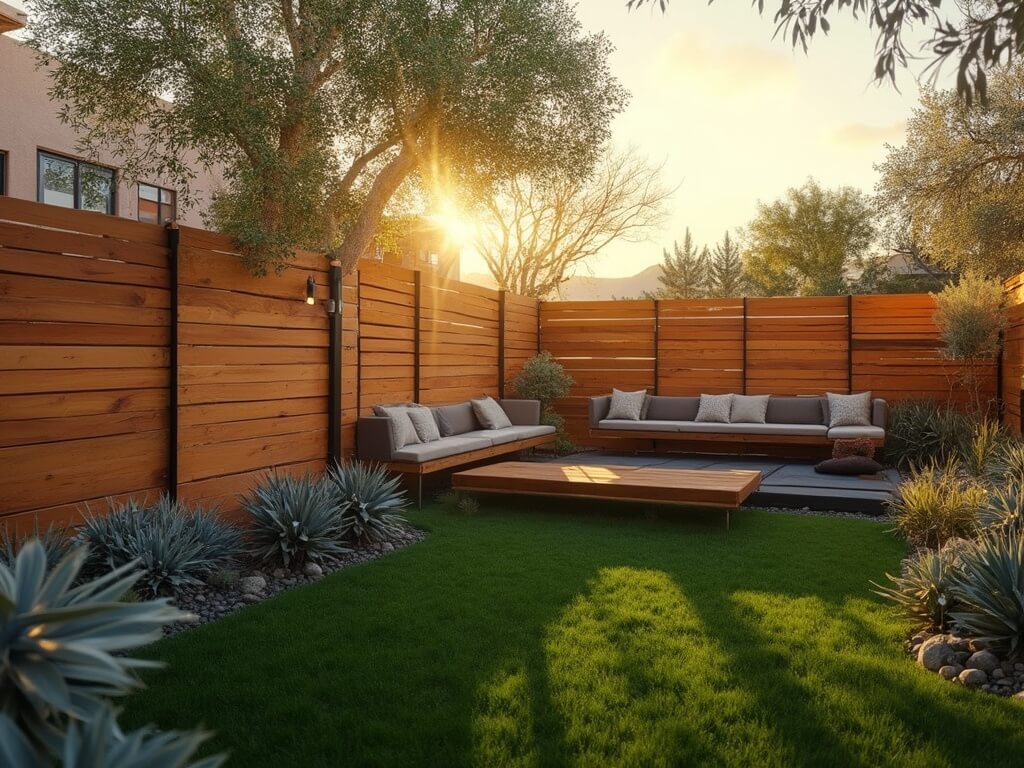
Small Apartment Balcony Ideas: How I Turned a 3×8 Concrete Slab Into My Favorite Room

The Look and Who It’s For

The small apartment balcony was the spot I actually sat in once I stopped treating it like storage. The trick is one rug and a chair you will use, not a rack of plants you forget.

I settled on what I’d call a cozy urban café setup — a mix of modern boho warmth (jute, terracotta, lanterns) with the clean lines of Scandi-minimalist furniture and the compact practicality of a Parisian bistro balcony.

It suits you if:

– You rent and need everything reversible.
– Your balcony is under 30 square feet.
– You want a real morning-coffee spot, not a Pinterest photo.
– You’ve got plants but also want somewhere to actually sit.

I’ve made this work on a shallow slab, but the same layout logic scales up to a 40–60 sq ft patio without changing the bones.
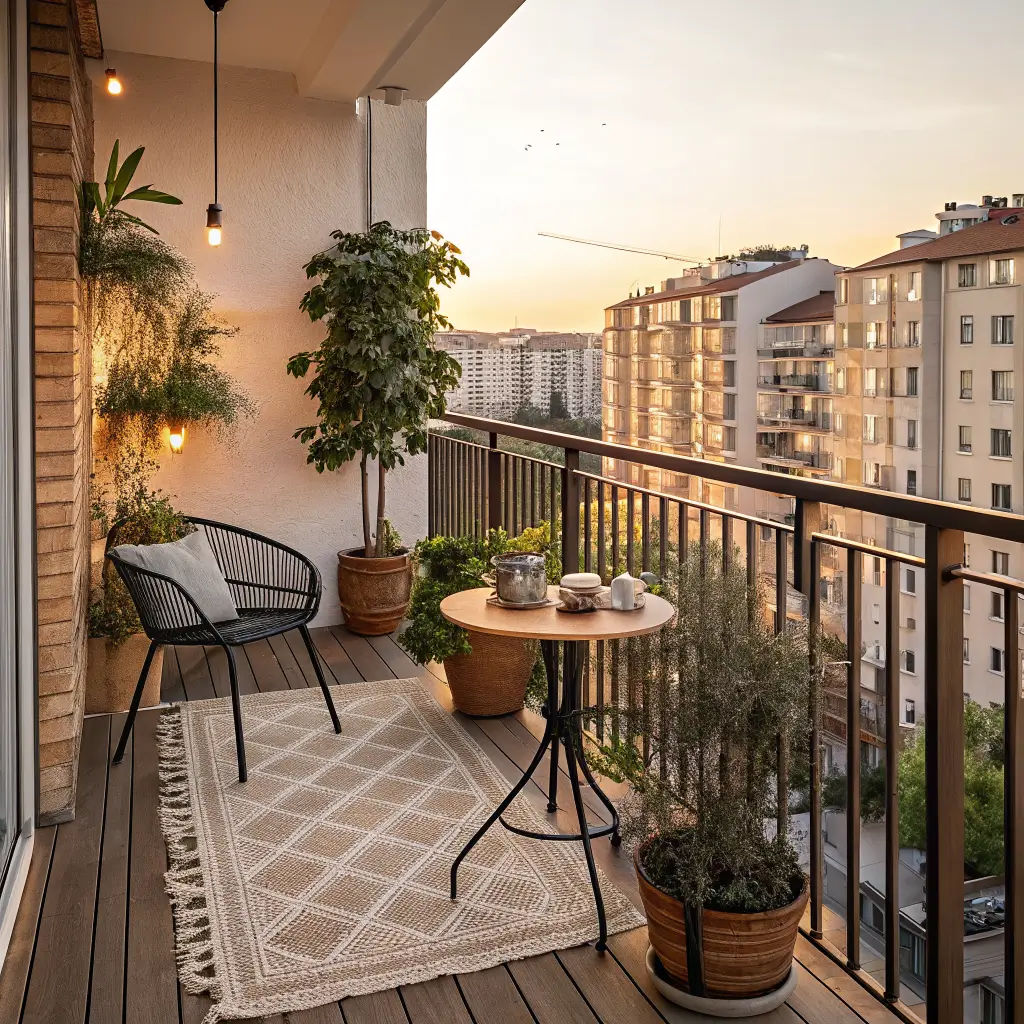
Photorealistic narrow apartment balcony styled like a cozy urban café with acacia deck tiles, jute rug, black bistro chair and railing table, olive tree planter, terracotta plants, and Edison string lights in warm golden-hour light.

Budget: What You’ll Actually Spend

I’ve done this three times at three different price points. Here’s the honest breakdown.

Budget refresh: $150–$350
– Interlocking acacia deck tiles (covers ~27 sq ft): $70–$120
– Outdoor rug, 4×6: $40–$90
– Folding bistro set: $80–$150
– Commercial-grade string lights, 48 ft: $25–$60
– Fiberclay or plastic planters: $15–$40 each

Mid-range: $400–$800
– Small modular sofa or loveseat: $250–$600
– Concrete or thick fiberglass planters: $60–$150 each
– Bamboo or willow privacy screen: $60–$200
– Cantilever umbrella or shade sail: $150–$300

High-end: $800+
– Compact daybed or chaise: $300–$700
– Railing bar set with stools: $250–$600
– Smart outdoor lighting and custom planters: usually pushes total past $1,000
Where I’d spend and where I’d save: spend on the rug, the deck tiles, and one heavy planter. Save on the string lights (the cheap ones look identical once lit) and the smaller pots. My biggest regret was a $180 rattan chair from a big-box store that unraveled after one summer. I replaced it with a $95 powder-coated steel bistro chair that still looks new.

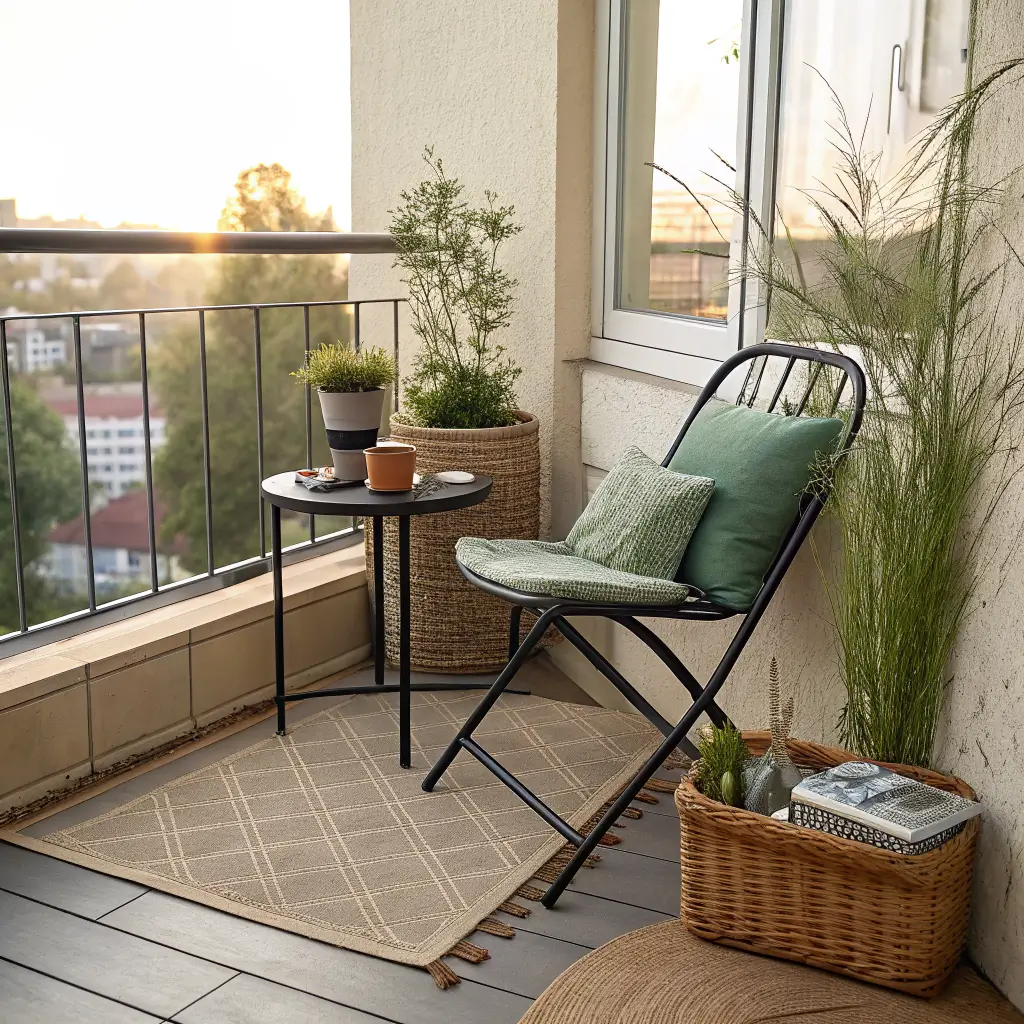
Close-up of a modern boho–Scandi balcony corner with black bistro chair, sage cushion, acacia side table with coffee and rosemary, seagrass basket, and olive planter in warm morning light.

Time Commitment

Quick refresh (rug, lights, plants, seating): 2–4 hours.
Full makeover (deck tiles, privacy screen, vertical garden, zones): a weekend, spread over two days. Deck tiles alone took me about 90 minutes because I kept re-cutting the edge pieces with a hand saw.

Skill level is beginner to lower-intermediate. If you can assemble IKEA furniture and stick a Command hook to a wall, you’re fine.
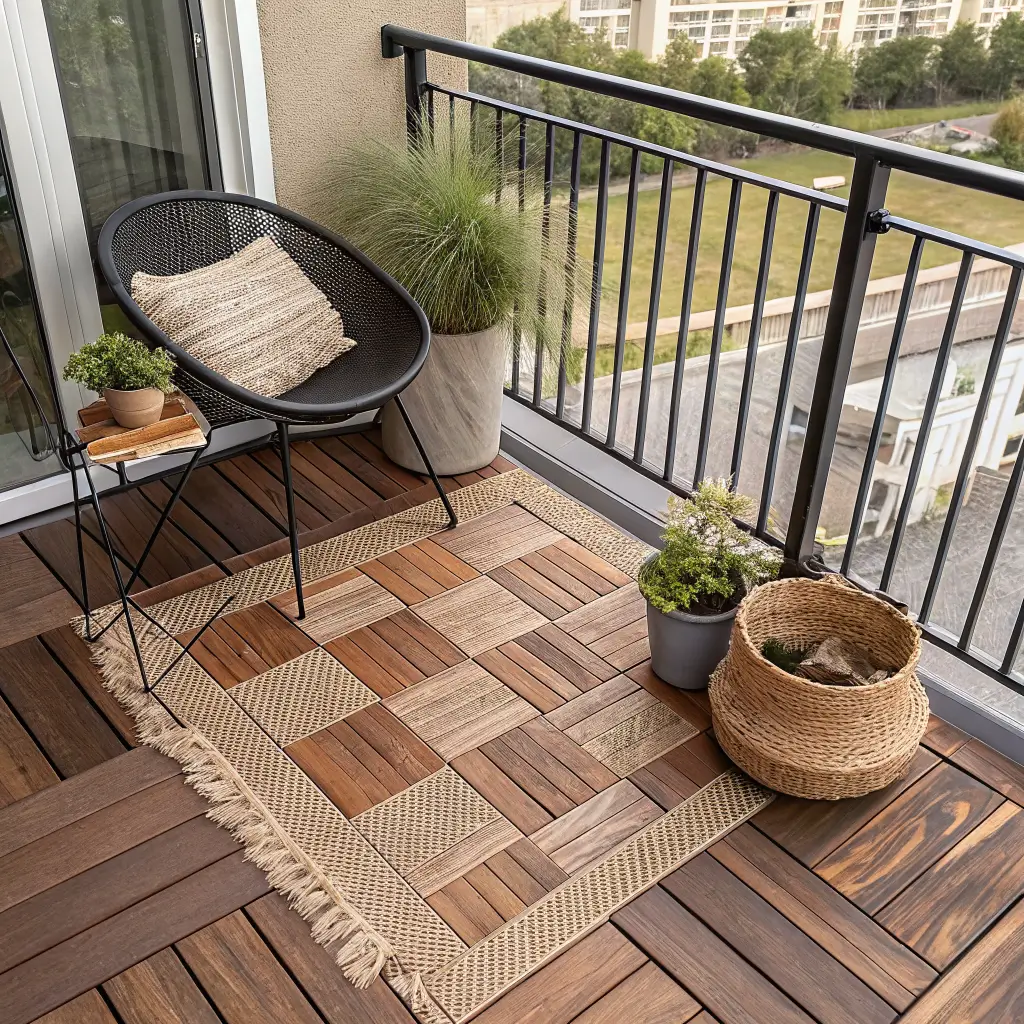
Overhead flat-lay of a 3x8 rental balcony with acacia interlocking deck tiles, a cream-and-taupe woven rug, partial black bistro chair leg, and staged terracotta pot, matte black planter, and seagrass basket in soft daylight.

The Hero Pieces That Do the Heavy Lifting

Five things carry the entire look. Get these right and everything else is decoration.

1. Deck tiles or an outdoor rug covering nearly the full floor.

The concrete slab is what makes a balcony feel like a fire escape. Cover it. I use 12″x12″ interlocking acacia tiles from Home Depot, roughly $4 per square foot. They snap together with no tools, lift out when I move, and hide grout stains and paint drips underneath. Layer a 4×6 outdoor rug on top for texture.

2. One piece of seating, chosen with intention.

Not two chairs and a loveseat. One. My rule: if the balcony is under 32 inches deep, do a single lounge chair plus a railing-hook table. If it’s 32–48 inches deep, a folding bistro set for two works. Anything shallower than 24 inches, go with floor cushions and a low tray table.

3. A tall anchor plant.

One plant taller than the railing changes the whole space. Mine is a 4-foot olive tree in a matte black fiberglass planter, tucked in the back left corner. Dwarf citrus, bamboo, or a tall ficus work too. The trick is one big one, not five medium ones.

4. String lights, but the good kind.

Skip the flimsy fairy lights. Get commercial-grade Edison bulbs on thick black wire — the kind rated for outdoor use with rubber sockets. About $40 for a 48-foot strand. Hang them along the ceiling edge with outdoor Command hooks, not the railing (railing lights blast into your face when you’re sitting).

5. A privacy element you can adjust.

This is where most balconies fail. Either you feel like you’re on display, or you block all the light with a solid screen. I zip-tied a natural bamboo reed roll to the inside of the railing on the neighbor-facing side only, leaving the view side open. Cost me $35 and took ten minutes.
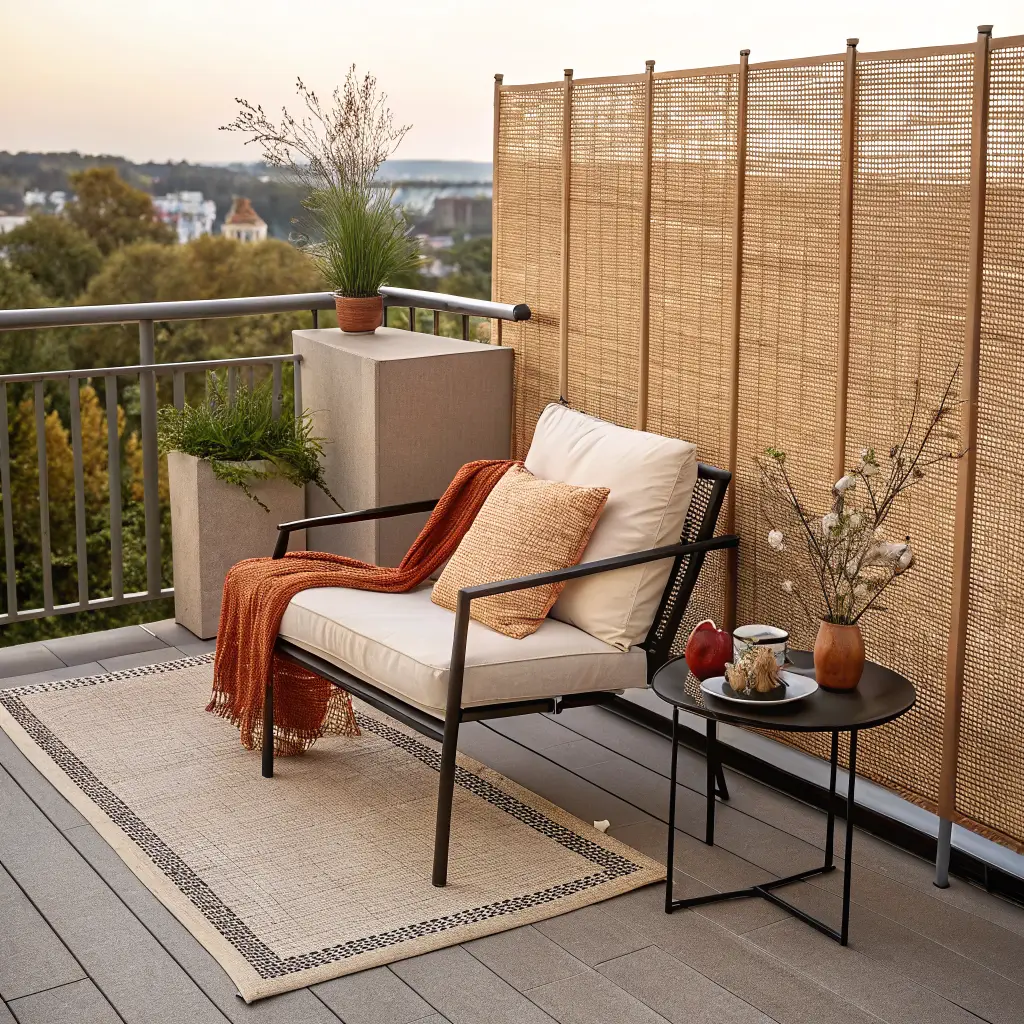
Photorealistic rental balcony vignette with a matte black lounge chair, cream cushion, burnt orange throw, acacia tiles, small hook table with mug and eucalyptus, and bamboo privacy screen in warm late-afternoon light.

Colors and Materials I Actually Use

Neutrals first, then earth tones, then one accent metal.

Base neutrals: warm beige, taupe, cream — for the rug and larger textiles.
Earth accents: sage green, terracotta, burnt orange — for cushions and pots.
Frame color: matte black on planters, chair frames, and lighting cords, to pull it all together.
Materials: acacia wood, powder-coated steel, fiberglass or concrete planters, outdoor polyester textiles, terracotta pots, woven seagrass baskets.

Two accent colors max in cushions and small decor. I learned this after a phase where I had mustard, blush, sage, rust, and navy pillows crammed onto one bench. It looked like a yard sale.
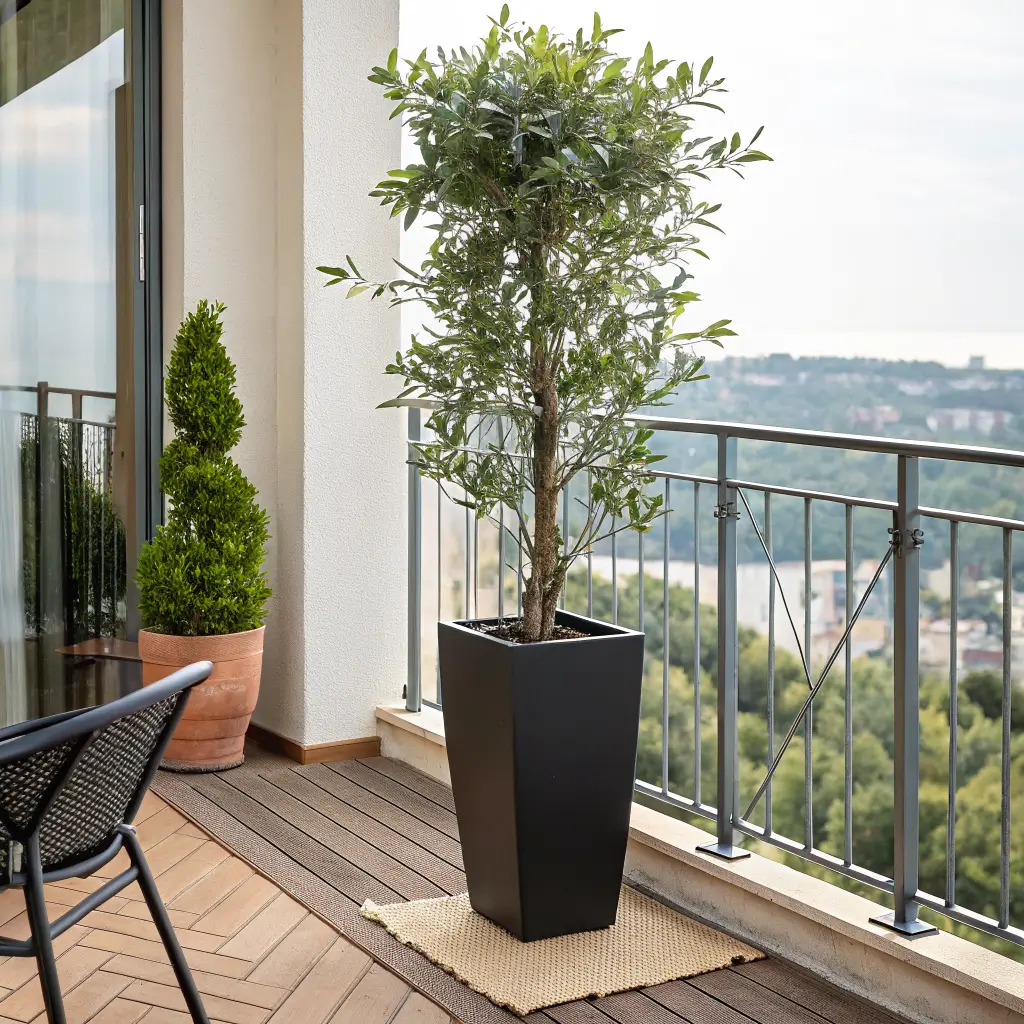
Low-angle midday photo of a 4-foot olive tree in a matte black planter on a small rental balcony with acacia deck tiles, basil in a terracotta pot, and a partially cropped black bistro chair against a blurred parking lot and blue sky.

How to Lay It Out (Step by Step)

The order matters. If you place the lights before the furniture, you’ll wonder why the shadows are in the wrong places.

1. Lay the floor first. Deck tiles, then the rug on top. The rug should tuck partly under the furniture so nothing floats.
2. Place your one seat. Face it toward the best view — or, if there is no view, face it toward the door so the sightline from inside makes the balcony feel bigger.
3. Add the side or railing table. Half-round tables that hook over the railing are the single best small-balcony hack I’ve found. Costs about $50. Doesn’t touch the floor.
4. Set the tall plant in the back corner. Fills vertical space without eating floor space.
5. Cluster smaller plants at seating height. Railing boxes with herbs (basil, rosemary, mint — all useful, all cheap) go along the railing. Trailing plants like string of pearls on a tension pole in the corner.
6. Bring in textiles. Cushion, pillow, throw. Sand-filled inserts if it’s windy — my first outdoor pillows blew off the balcony twice before I figured this out.
7. Hang the lights last. Now you can see where the dark corners are.

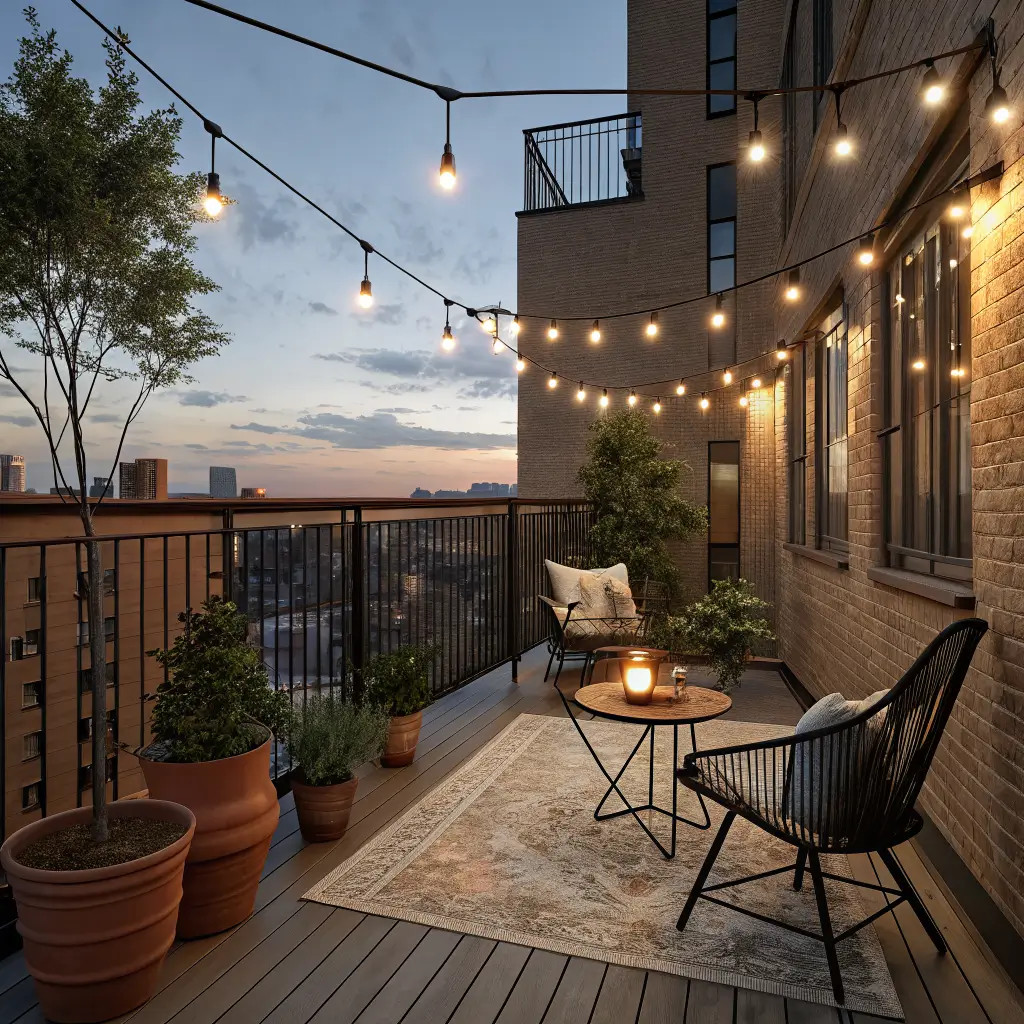
Photorealistic dusk view of a small urban rental balcony with warm Edison string lights, black bistro chair with sage cushion and burnt orange throw, acacia tiles and railing table with a lit candle, olive tree and terracotta herb pots against a deep blue twilight sky.

Creating Zones in Under 30 Square Feet

Zones sound absurd on a small balcony, but they matter. Even a 3×8 space feels bigger when it has two purposes instead of one crowded blob.

One end: seating zone — chair, rug, side table, throw.
Other end: plant cluster or a slim fold-down bar rail.

That gap between the two — even 18 inches of visual breathing room — is what makes the space feel intentional instead of packed.
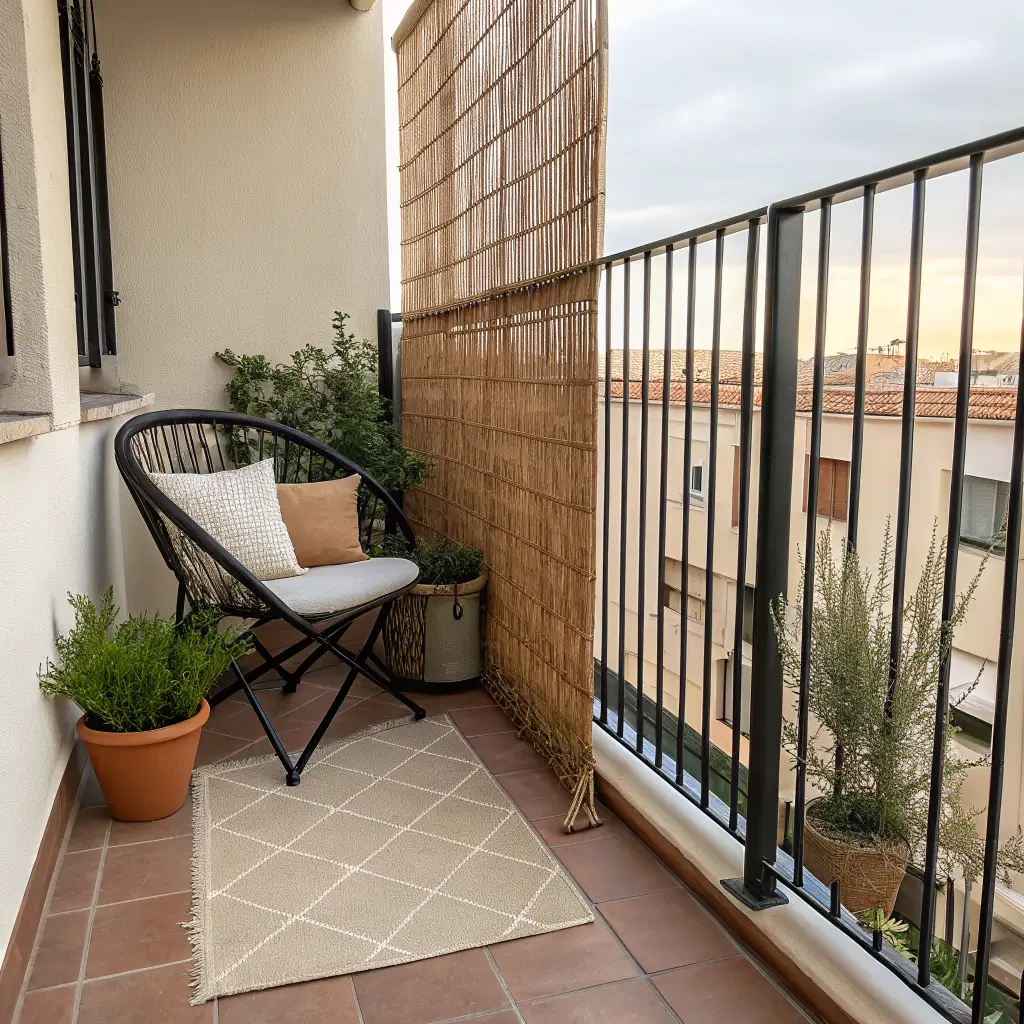
Bamboo reed privacy screen zip-tied to a black balcony railing, contrasting with an open side over acacia deck tiles, beige rug, black bistro chair, rosemary pot, and trailing plant in warm late-morning light.

Seasonal Swaps

The frame stays the same year-round. The soft stuff changes.

Spring/summer: linen-look cushion covers in coral or mustard, sheer outdoor curtain panels on a tension rod to diffuse afternoon sun, herb-heavy railing planters.
Fall/winter: chunky knit throws, faux sheepskin over the chair, battery lanterns instead of just string lights, boxwood or dwarf conifers replacing summer annuals.

I keep two labeled bins in a closet — “balcony summer” and “balcony winter” — and swap them out on the first cool weekend in October. Takes twenty minutes.
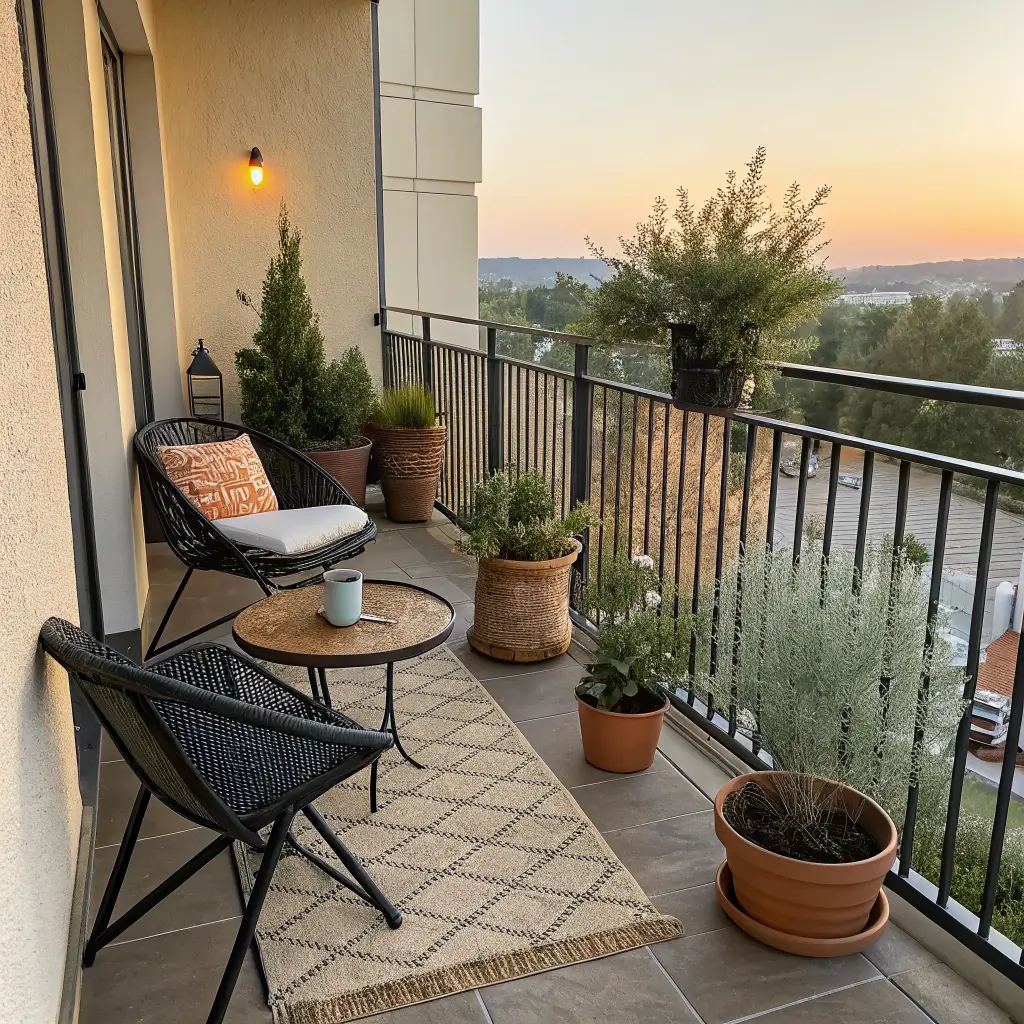
Wide golden-hour shot of a small rental balcony with a black bistro chair and rug on the left and an olive tree with terracotta herb pots and trailing string of pearls on the right, separated by an open gap.

Mistakes I’ve Made (So You Don’t Have To)
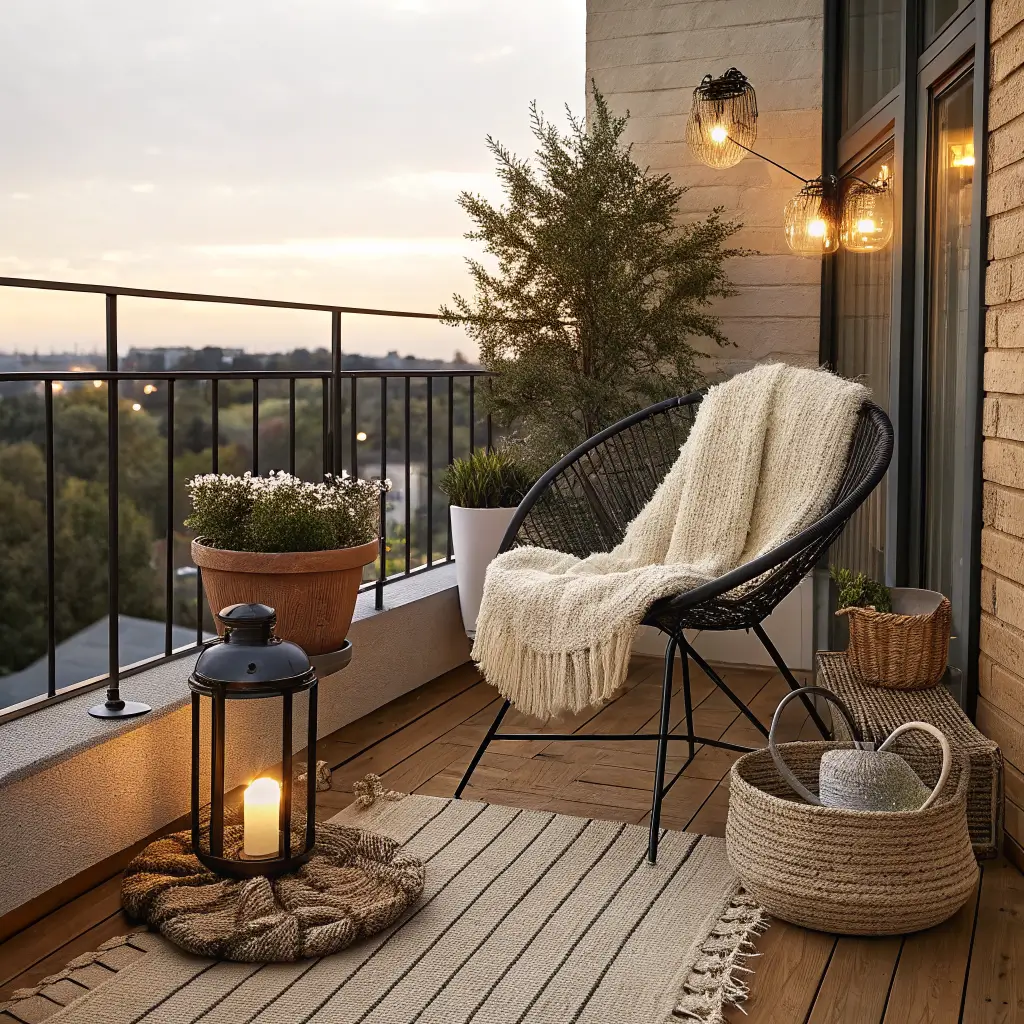
Overfurnishing. My first attempt had a small sectional, an ottoman, a side table, and two planters. I could barely open the sliding door. Cut it down to one chair, one table, and I gained back the whole space.

Cheap plastic planters. They fade to a chalky gray in one summer and crack the first time it freezes. Spend $60 once on a fiberglass one instead of $15 four times.

Too much privacy screen. I once covered the entire railing in reed fencing. The balcony went dark, felt claustrophobic, and killed my herbs. Now I only screen the neighbor-facing side.

Scattering plants everywhere. Five pots of different sizes and styles spread evenly along the railing looks like a garden center display. Group them in clusters of three, matching or coordinating pots, varying heights within the cluster.

Ignoring the wind. Everything on a balcony that isn’t weighted down will eventually end up on someone’s car. Sand-filled cushion inserts, heavy planters on the windward side, string lights zip-tied — not just hooked — at the corners.

Photorealistic fall/winter rental balcony with acacia tiles, beige rug, black bistro chair with sheepskin and cream knit throw, lantern and mug on railing table, terracotta boxwood and olive tree, and softly glowing string lights.

Renter-Specific Notes

Before you buy anything, check your lease for:

– Rules on attaching things to railings (most allow zip ties and hooks, some don’t).
– Weight limits (older buildings sometimes cap balcony load — heavy concrete planters can be an issue).
– Visible-from-street decor restrictions in some HOAs.

Everything I’ve described is removable. Deck tiles lift out. Command hooks peel off. Tension rods leave no holes. Railing tables unhook. When I moved from my last apartment, I packed the whole balcony into three boxes in about an hour.
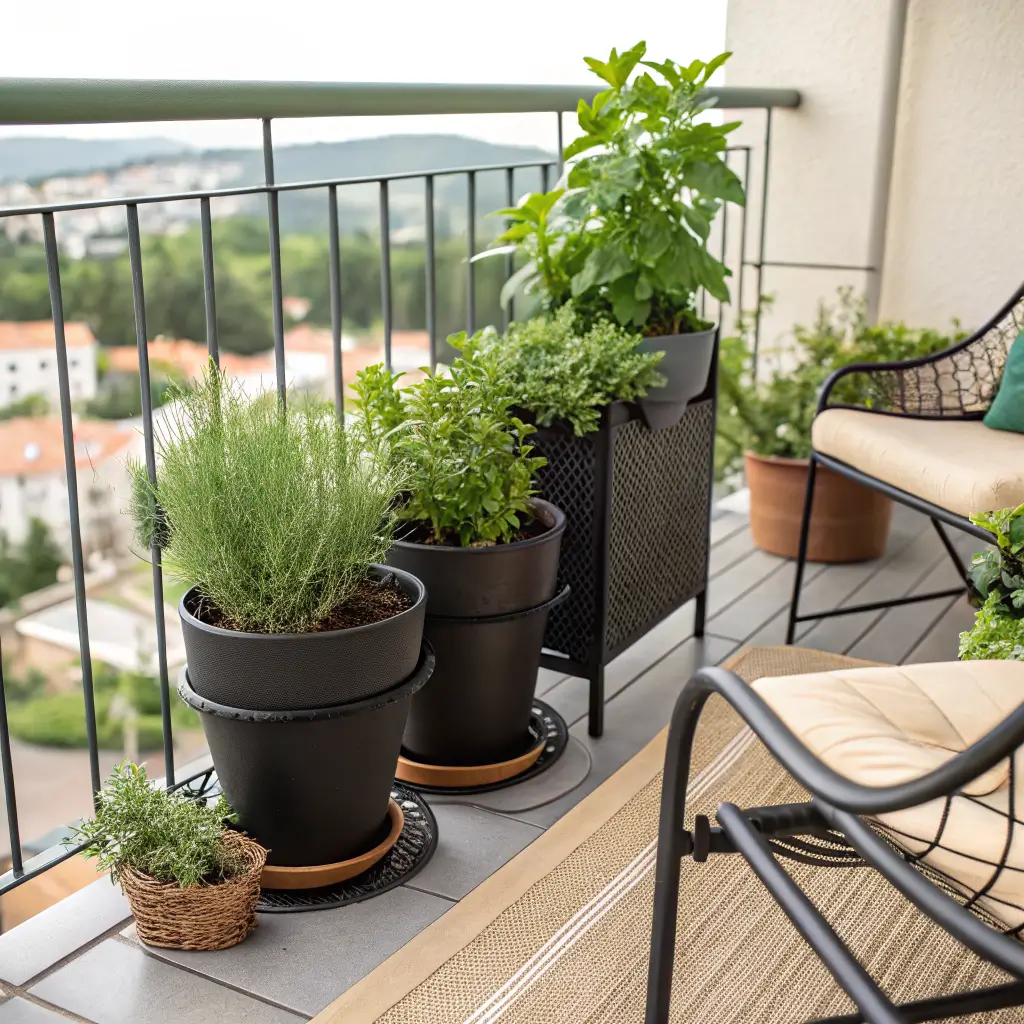
Clustered rosemary, basil, and trailing mint in matte black and terracotta pots on a balcony railing with bistro chair and seagrass basket in soft midday light.

The One Thing That Made the Biggest Difference

If I had to pick a single change with the highest impact-per-dollar, it’s the deck tiles. Covering that concrete pulled everything else together — the plants looked more intentional, the rug stopped sliding, the chair legs stopped scraping. About $90 and a Saturday afternoon. Do that first, then work outward from the floor.
Trophywifestyle
🛋️ Passionate about home decor, fashion, interior design, and exploring the world 🌎 Join me as I curate stylish spaces and seek out adventure!
Scroll to Top