Timeless Decor Style: How to Build a Classic Home That Still Looks Right in 20 Years
The timeless decor style is less a look than a short list of things that age well. I keep wood I can refinish and linen I can wash, and skip the rest.
Timeless decor style is what you want when you’re tired of redecorating every three years because the internet decided gray is out and mushroom is in. I’ve been there. I painted an entire living room Agreeable Gray in 2019, bought a velvet blush pink accent chair, and by 2022 the whole thing felt like a dated Pinterest board. That chair now lives in my mother’s guest room, reupholstered in oatmeal linen, and it looks better than it ever did.
So let’s talk about what actually holds up.
What “Timeless” Really Means Right Now
It isn’t one look. In practice, the homes that age well tend to be transitional — a mix of traditional bones and modern lines — or soft traditional, which leans on symmetry, natural materials, and calm colors instead of ornate carved everything.
The through-line: a neutral foundation, quality natural materials, simple-lined furniture, and a curated mix of old and new. That mix is the whole trick. Rooms full of matching new furniture look like a delivery day. Rooms full of only antiques look like a museum gift shop. You want both.
Who this style is for: anyone who’d rather buy a great sofa once than a cheap one three times, and anyone who wants their house to feel like them rather than a specific year on a mood board.
Budget: Where to Spend and Where to Save
I’ll be honest — the big pieces are where the money goes, and it’s worth it. A living room done well runs somewhere between $3,000 on the low end (with thrifted finds and one or two new anchors) and $10,000+ if you’re buying most things new.
Spend on:
– Sofa: $800–$2,500 for something with a hardwood frame and performance fabric. Article, Crate & Barrel, and Pottery Barn all make solid classic-lined options. Avoid trendy silhouettes (curved marshmallow sofas, I’m looking at you).
– Solid wood tables: $400–$2,000 for a coffee or dining table in oak, walnut, or maple. Skip veneer if you can — it chips and never recovers.
– Rug: $300–$1,500 for a wool or vintage-style 8’×10′. Hand-knotted antiques cost more and are worth it if you can swing it.
– Flooring, if you’re renovating: white oak in a medium natural tone, $8–$15/sq ft installed. Avoid orange or red undertones. They’re the fastest way to date a floor.
Save on:
– Curtains: pinch-pleat linen panels run $80–$250 each. Hang them 4–6 inches above the window frame and let them just kiss the floor. That single move makes a room look twice as expensive.
– Art and accents: thrift stores, Etsy, estate sales, Facebook Marketplace. I paid $18 for a brass candlestick lamp last spring that I’ve seen retail for $240.
– Lighting: $200–$900 gets you a classic chandelier or lantern pendant that reads far more expensive.
The Foundation: Colors and Materials That Won’t Betray You
Paint
Stick to warm off-whites and soft greiges on walls. My favorites after painting a lot of rooms:
– Benjamin Moore Simply White — clean but not cold
– Benjamin Moore Swiss Coffee — warmer, works in low-light rooms
– Soft greige in the family of Sherwin-Williams Accessible Beige for rooms that need a little more weight
Skip pure stark white unless your room has serious south-facing light. It goes blue and clinical.
For a low-cost drama move: paint interior doors in a deep color — I did mine in Benjamin Moore Black Beauty and it made the hallway look like it cost something.
Woods and Metals
– Medium and light natural woods: white oak, walnut, maple. Nothing orangey.
– Mixed metals, deliberately: warm brass on cabinet hardware, polished nickel on the faucet, matte black on a lamp. Two metals per room minimum. All-matching metals look like a builder-grade catalog.
– Stone over engineered surfaces where you can: honed marble, soapstone, quartzite. Real stone patinas; laminate just wears out.
Textiles
Linen, cotton, wool, velvet. Solids or restrained patterns — stripes, small florals, herringbone, subtle checks. If you can’t picture the pattern on a 1920s sofa AND a modern one, it’s probably too trendy.
The Pieces That Do the Heavy Lifting
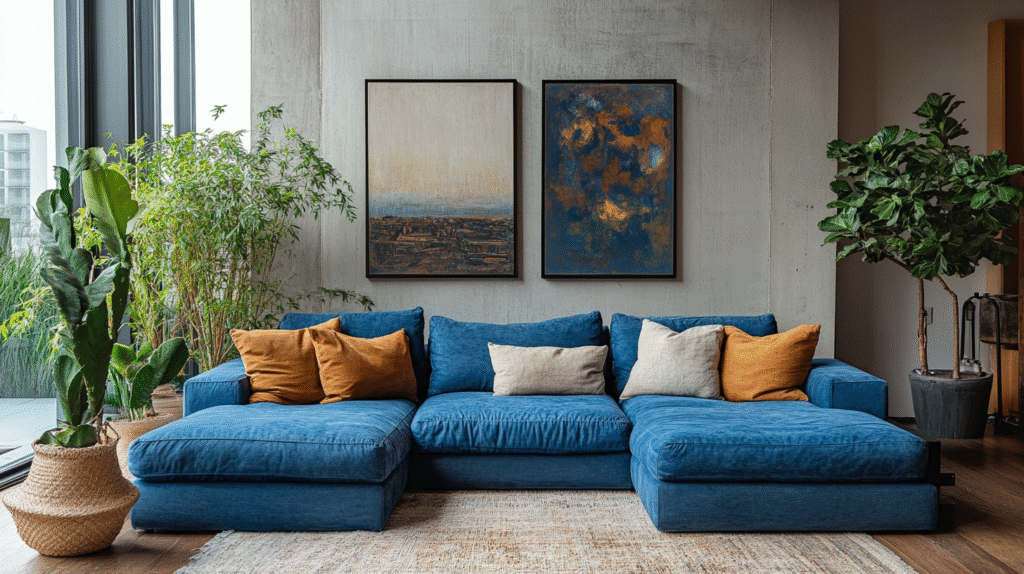
A well-shaped sofa. Straight or gently rolled arms, tight back or semi-attached cushions, neutral upholstery in cream, oatmeal, beige, or light taupe. 80–90 inches for most rooms, 100–120 for a bigger space. That’s it. That’s the sofa. Don’t overthink it and don’t buy a color you’ll be sick of.
A vintage-style rug. Muted Persians or Turkish-inspired designs in soft reds, blues, and neutrals. Size it so the front legs of your sofa and chairs sit on it — an 8’×10′ works in most living rooms, 9’×12′ if you’ve got the space.
Simple wood tables. Rectangular or oval. Wood top, no ornate metal geometric bases that will look like 2021 in three years.
Shaker cabinets if you’re touching the kitchen. Recessed panel, painted in a soft neutral, with brass or matte black hardware. They’ve looked right for 200 years and will keep doing so.
Layered lighting. Ceiling + floor lamp + table lamps in every room where you spend real time. One overhead fixture makes a room feel like a dentist’s office no matter how expensive the sofa is.
How to Actually Put It Together
Order of operations matters. This is what I do every time now:
1. Anchor pieces first: sofa, rug, main table, primary lighting. Get these placed and live with them for a week before adding anything.
2. Window treatments and big art next, hung to architectural lines. Art centered over the sofa, bottom of the frame 6–8 inches above the sofa back.
3. Textiles third: pillows and throws in a limited palette. I use three pillow fabrics max on one sofa — usually a solid, a stripe or small pattern, and a texture like bouclé.
4. Personal and vintage pieces last. Books, framed photos, the ceramic dish your grandmother had. This is what keeps a room from looking like a showroom.
Coffee table rule I follow: one to three groupings, no more. A stack of two or three books, a small tray with a candle or bowl, maybe one sculptural object. That’s it.
Shelves: leave real negative space. If every inch is filled, it reads as clutter regardless of how nice the objects are. I aim for roughly a third of each shelf empty.
The Mistakes I’ve Made So You Don’t Have To
Buying a matching furniture set. My first apartment had a sofa, loveseat, and chair in identical taupe microfiber. It looked like a hotel lobby that had given up. Now I mix: a linen sofa, a leather chair, a vintage wood side chair I recaned myself.
Following a specific trend too hard. The all-gray phase. Barn doors on everything. Live edge slabs. If it’s having a moment, it’s probably going to have an ending.
Neutral without personality. A room that’s all beige and cream and no personal objects reads as an Airbnb. The fix is small: framed family photos in real frames, actual books you’ve read, a bowl from a trip, one weird thing you love. My “weird thing” is a large brass duck. Non-negotiable.
Fighting the architecture. I tried to do industrial-modern in a 1935 bungalow with plaster walls and arched doorways. It fought me for a year. Once I leaned into what the house was — softer traditional with modern furniture — everything clicked.
Keeping It Fresh Without Starting Over
The whole point of building this way is that seasonal updates cost almost nothing:
– Fall/winter: swap in velvet or bouclé pillow covers, wool throws, darker candles, branches in a vase.
– Spring/summer: back to washed linen pillow covers, lighter throws, hydrangeas or eucalyptus.
– Every few years: repaint one accent (doors, a piece of built-in cabinetry), swap art, rotate rugs between rooms.
The sofa stays. The rug stays. The wood tables stay. Only the $15–$40 accents change.
The Honest Answer on Whether “Timeless” Exists
Everything gets dated eventually if you look closely enough — you can pick out a 1995 kitchen from across the room, and someone in 2050 will do the same to ours. But rooms built on natural materials, simple shapes, and personal history age slowly and gracefully. Rooms built on trends age like milk.
Buy the good sofa. Paint the walls a warm off-white. Put down a real wool rug. Add a vintage brass lamp and a stack of books you actually read. Mix an antique in among your new pieces. Leave some empty space.
That’s the whole thing. It’s not a secret formula, it’s just restraint plus a little bit of taste, applied consistently, for as long as you live there.