The Beach-Inspired Bedroom, Done Right: A Modern Coastal Guide Without the Kitsch
The beach inspired bedroom was the one I kept from going kitsch. Bleached wood and one linen duvet read coastal without the shell collage.
A beach-inspired bedroom sounds simple until you’re standing in a home goods aisle holding a rope-wrapped starfish and wondering how your grandmother’s guest room happened to you. I’ve done this makeover twice — once badly, with every anchor and “Beach House” sign I could find, and once properly, after I threw most of it out and started over. The good version is what I want to talk about.
The goal here is a room that feels like the second morning of a vacation: quiet, sun-warmed, a little sandy at the edges. Not a themed restaurant.
What This Style Actually Is (and Who It’s For)
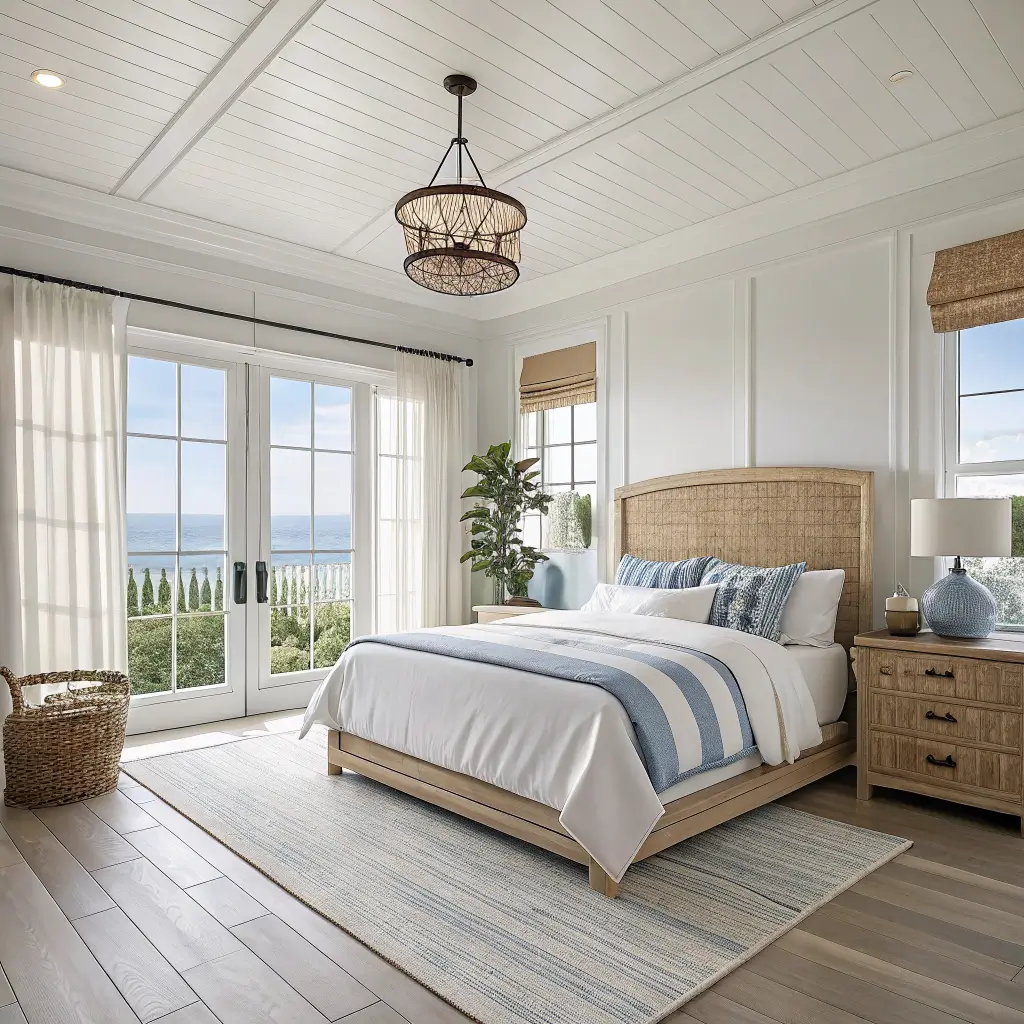
Modern coastal is what happens when you strip the nautical clichés out of beach decor and keep the good parts: natural light, breathable fabrics, sand and ocean colors, woven textures. It borrows from minimalism (uncluttered surfaces) and a light touch of boho (rattan, plants, unfussy layering).
It works best for:
– Anyone who wants their bedroom to feel like a place they exhale in
– Renters who need paint-and-textile impact without a renovation
– People burned out on gray-and-greige and craving something with a pulse but no drama
– Guest rooms, primary bedrooms, and even teen rooms if you lean into surf photography instead of shell wreaths
Room size doesn’t matter much. I’ve styled this in a 10′ x 12′ second bedroom and in a larger primary — the palette does the heavy lifting either way.
Time and Money: What You’re Actually Signing Up For
Light refresh (paint, bedding, a rug, a few accents): one solid weekend, roughly 10–15 hours of active work.
Full makeover (add furniture, lighting, window treatments): plan on 2–3 weekends.
Rough budgets from what I’ve spent and priced out recently:
– Budget: $300–$800. Cotton coverlet ($60–$150), 3 pillows ($20–$50 each), a 5′ x 7′ jute rug ($80–$200), a rattan basket or two ($25–$70), and one or two pieces of coastal art ($40–$150).
– Mid-range: $800–$2,500. Add a whitewashed or light-oak queen frame ($300–$900), weathered-wood nightstands ($250–$900 for the pair), a woven pendant ($120–$350), linen bedding ($150–$400), and layered curtains + bamboo shades ($150–$400).
– High-end: $2,500–$7,000+. Custom upholstered headboard in seafoam or sky blue ($600–$1,500), wool-jute designer rug ($400–$1,200), gallery-grade photography ($300–$1,000+), and a capiz shell or designer rattan fixture ($400–$1,200).
Skill level is beginner to intermediate. Painting, assembling a platform bed, layering bedding — all beginner. Installing bamboo shades, hanging a pendant, applying limewash or shiplap — intermediate, and the pendant is the one place I’d call an electrician if you’re not confident.
The Color Palette That Makes or Breaks It
This is where most people go wrong. They pick teal, they pick turquoise, they pick a bright coral, and the room starts screaming.
The rule I go by: 60% neutral, 30% ocean, 10% accent.
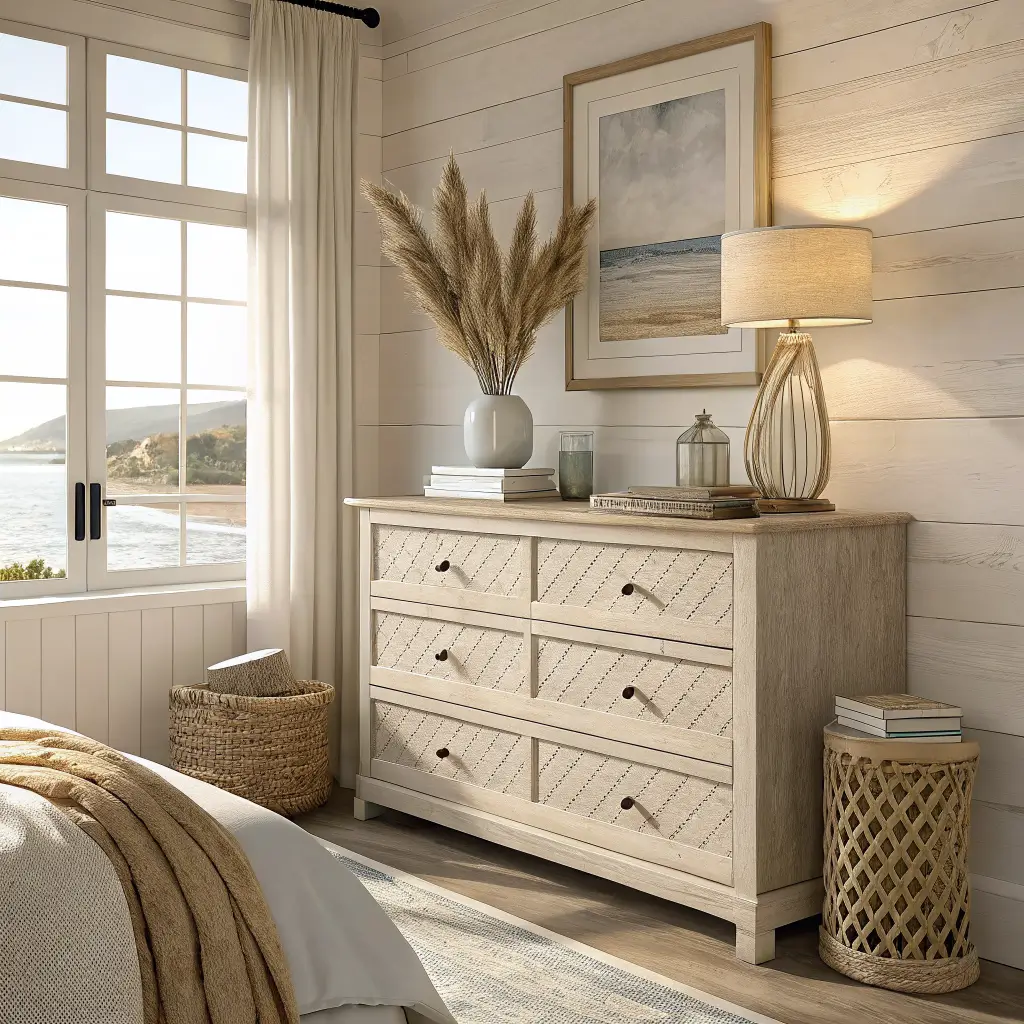
– Walls: crisp white, soft ivory, pale beige, or a whisper of gray. Benjamin Moore’s White Dove and Swiss Coffee are both good. If you want more warmth, try a sandy off-white like Manchester Tan.
– Ocean tones (used sparingly): seafoam, sky blue, muted teal, navy. I like navy best as an anchor — one dark lamp base or bed frame does more than five turquoise pillows.
– Sand tones: warm beige, taupe, driftwood gray.
– Accents (barely there): coral, soft blush, sunset peach. A single throw, one pillow. That’s it.
The mistake I made the first time: I treated turquoise as a neutral. It is not a neutral. It is a spice.
The Materials That Do the Work
Textures are what separate a beach room from a beige room. You want your hand to want to touch things.
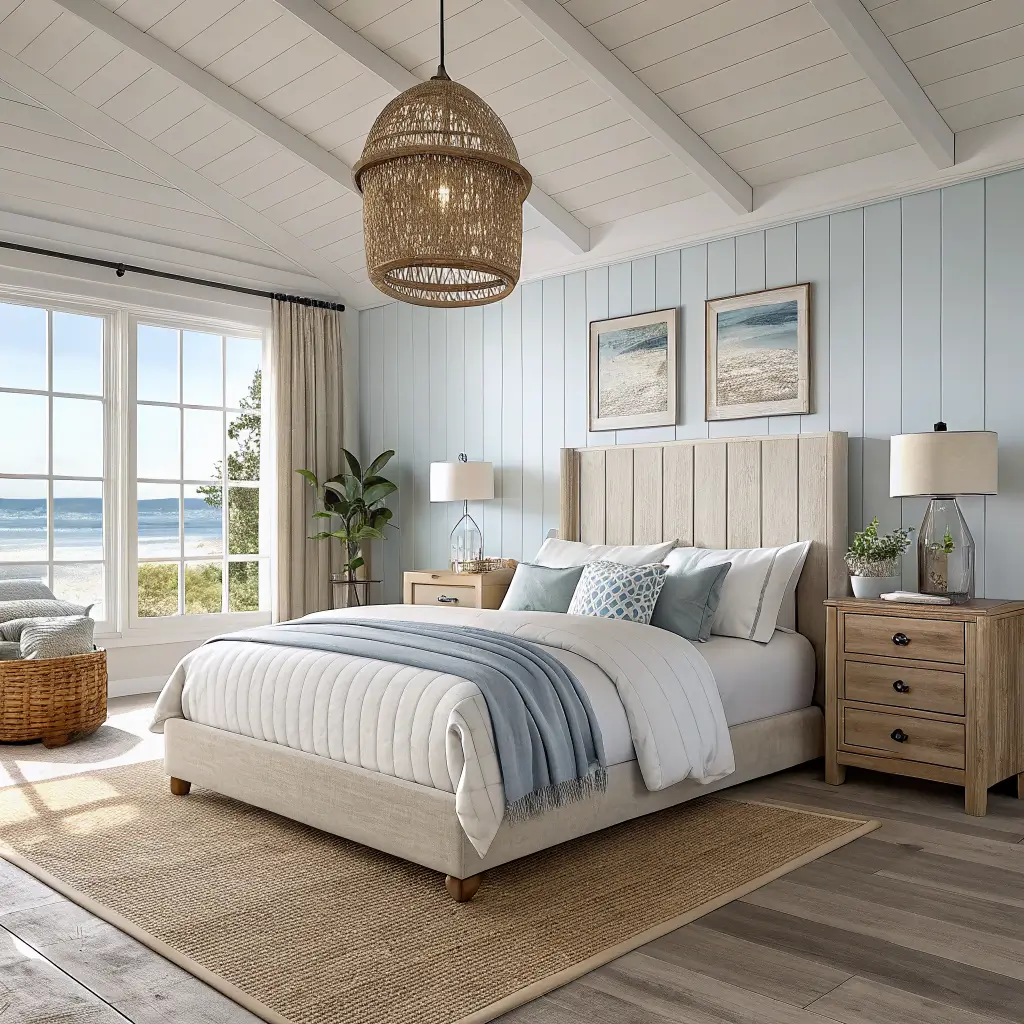
– Woods: light oak, whitewashed pine, weathered/reclaimed wood. Pick one or two finishes and stop there.
– Fibers: rattan, seagrass, jute, sisal, bamboo. Use at least three of these across the room.
– Textiles: cotton, linen, gauzy sheers. Skip anything shiny or heavy.
– Small accents: glass, unglazed ceramic, rope (used with restraint), brass hardware, the occasional capiz shell.
The Hero Pieces
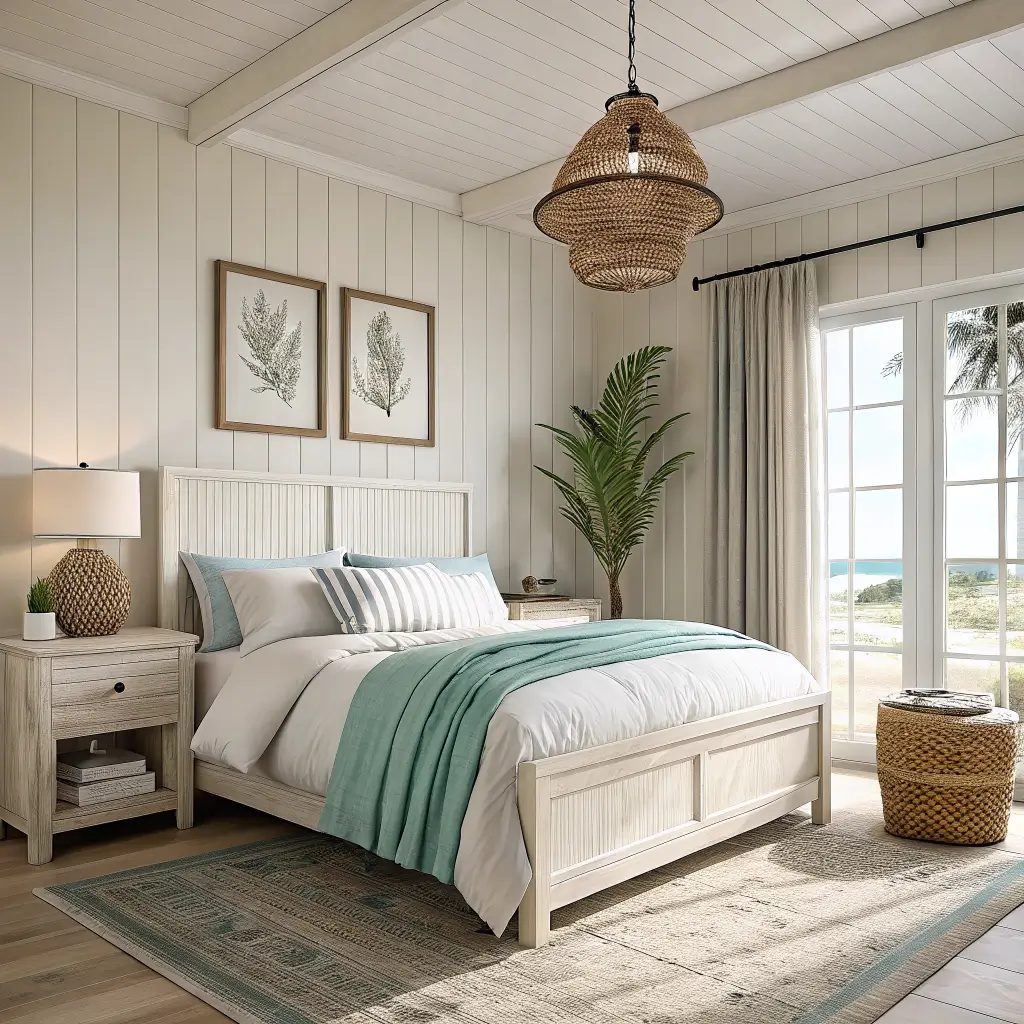
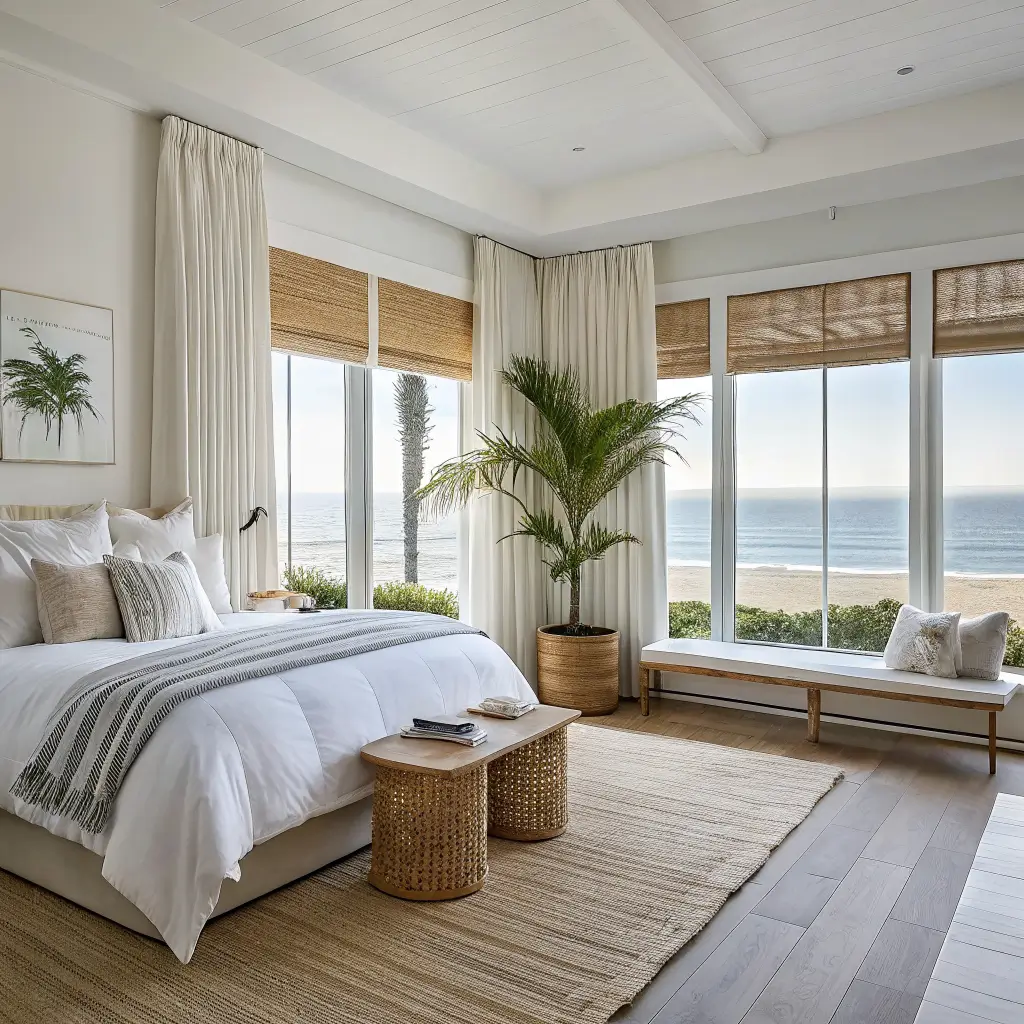
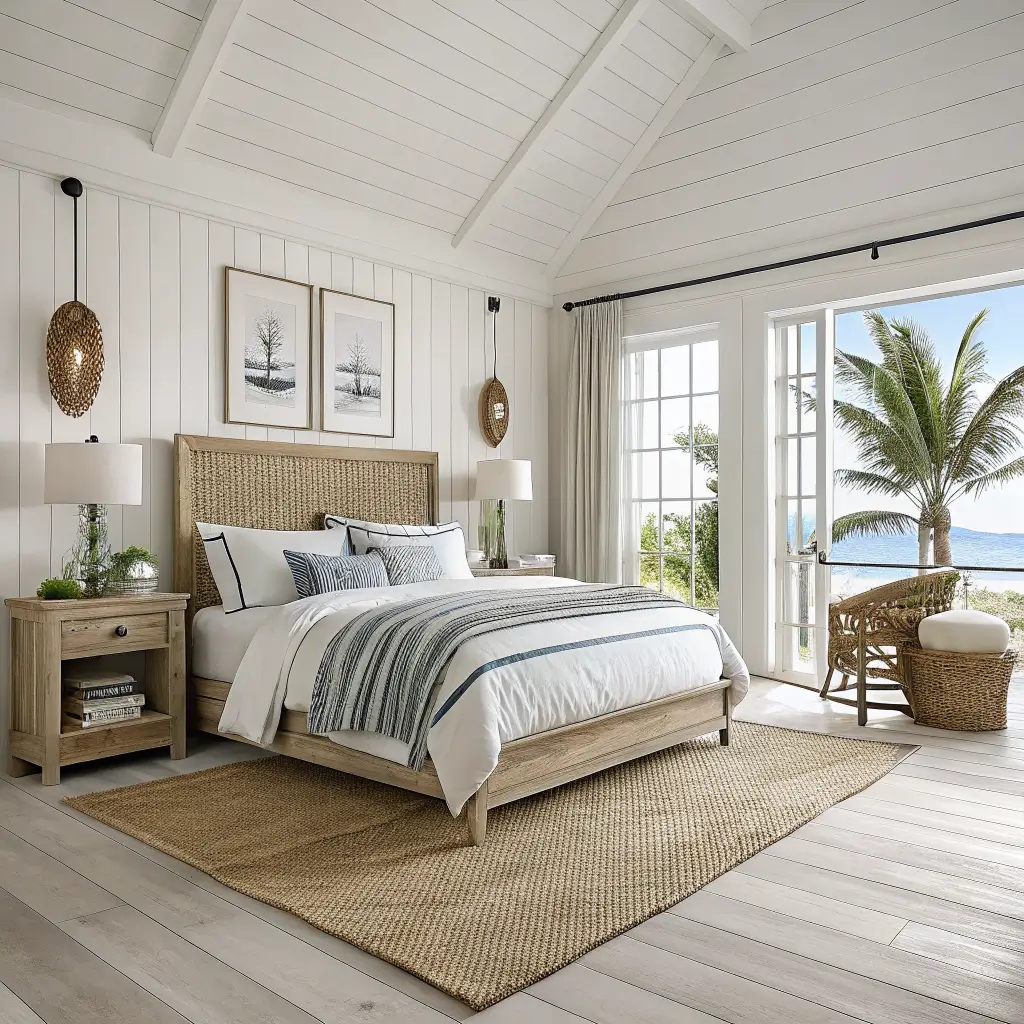
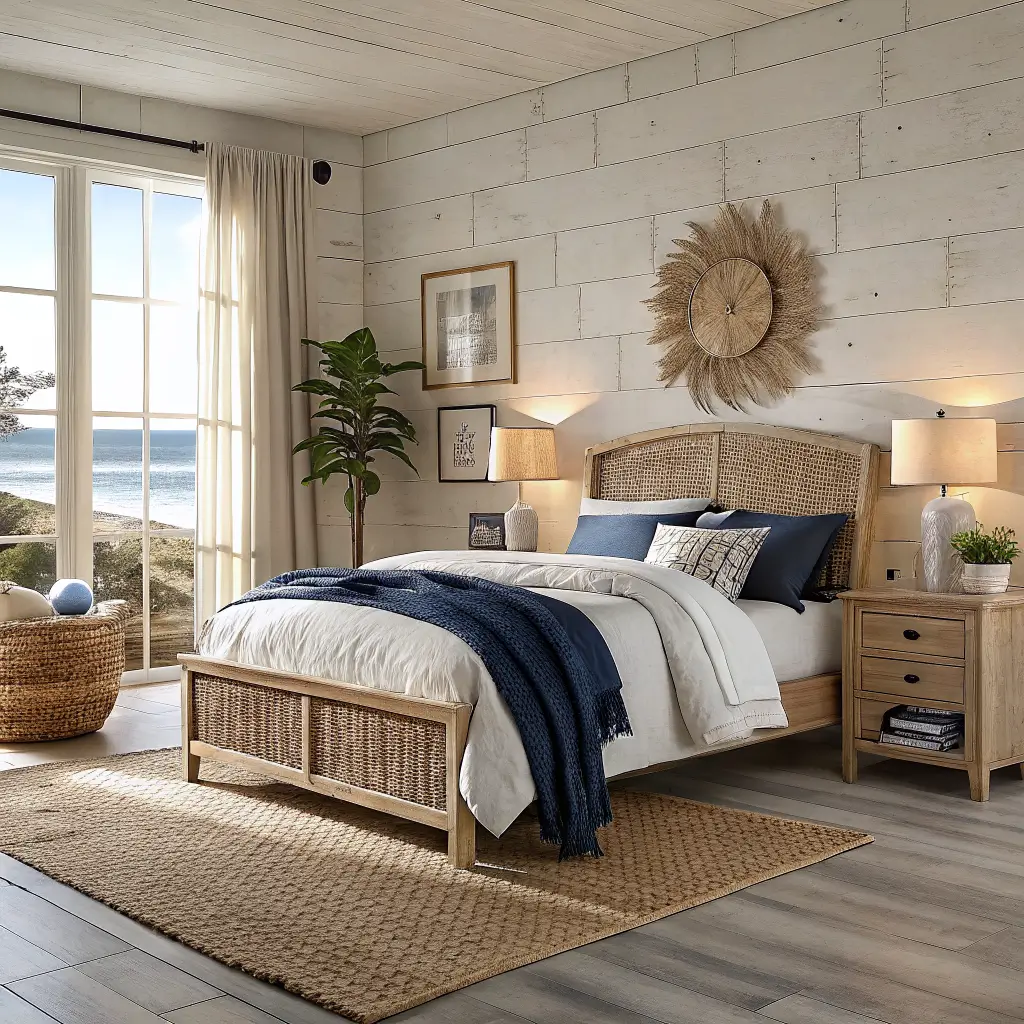
The bed frame. Light wood, whitewashed, or a rattan/woven headboard. A rattan headboard on a queen is the single piece that most quickly signals “coastal” without any decor at all. If you have the budget, a linen-upholstered headboard in seafoam or pale sky blue is the more grown-up move.
The bedding. White or sand base, always. Cotton or linen — linen wrinkles and that’s the point. Layer a soft blue or subtly striped coverlet folded at the foot. Two Euro shams, two standard pillows, one lumbar. Five pillows total is plenty. Seven is a hotel; nine is a problem.
The rug. Jute or seagrass, 5′ x 7′ for smaller rooms, 8′ x 10′ for larger. Pull it under the front two-thirds of the bed with 18–24 inches of rug showing on each side and at the foot. Jute sheds for the first few weeks — vacuum it, don’t panic.
The nightstands. White, light wood, or driftwood finish. Match each other; don’t try to match the bed frame exactly.
Windows, Light, and the Trick Nobody Talks About
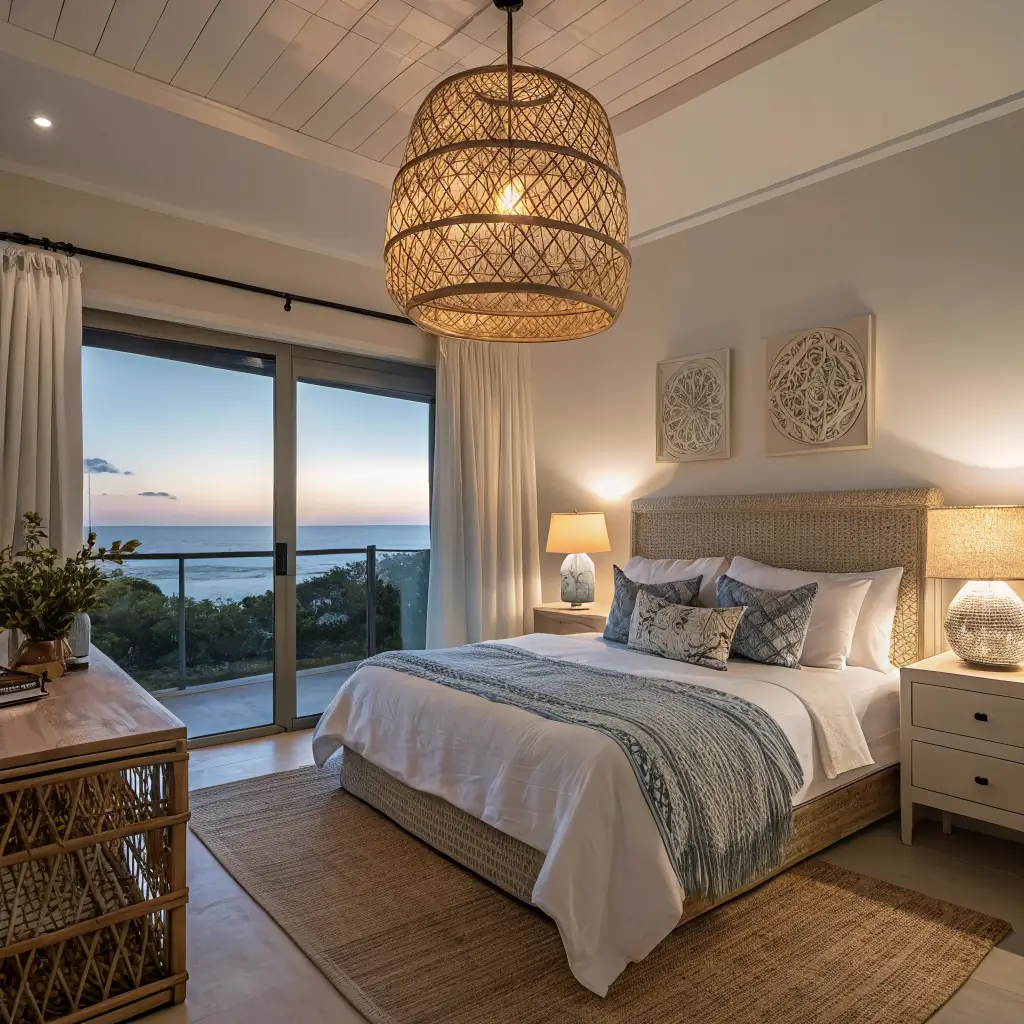
Hang curtains high and wide — as close to the ceiling as you can get, and extending 4–6 inches past the window frame on each side. This makes the window look taller and the ceiling feel higher, which is the difference between “beach house” and “beach motel.”
Sheer white or off-white linen curtains as the main layer. Bamboo or woven wood shades behind them for privacy and daytime light control. That double layer is the secret; skip it and the room looks flat.
Kill any dark, heavy drapes you currently have. They fight everything you’re trying to do.
Lighting
Overhead: a woven rattan pendant or a simple bamboo drum shade. If your ceiling is under 8 feet, use a semi-flush mount so nobody hits their head.
Bedside: glass lamps with woven bases, or plain white ceramic. Lampshade bottom should sit roughly at your eye level when you’re propped up reading — usually 24–28 inches from the top of the mattress, depending on your nightstand height. Higher than that and you’ll get glare in your face every night.
Add a warm bulb. 2700K, not 3000K, and never 4000K. Cool light kills this whole aesthetic.
Signature Accessories, Used Like Salt
Some of these, sparingly:
– One glass jar of shells you actually collected (not a bag of bleached shells from Michaels — trust me, they read as fake)
– A piece of driftwood as a shelf object or over-mirror detail
– One ocean landscape or palm photograph above the bed — either a large single piece (roughly two-thirds the width of the headboard) or a pair
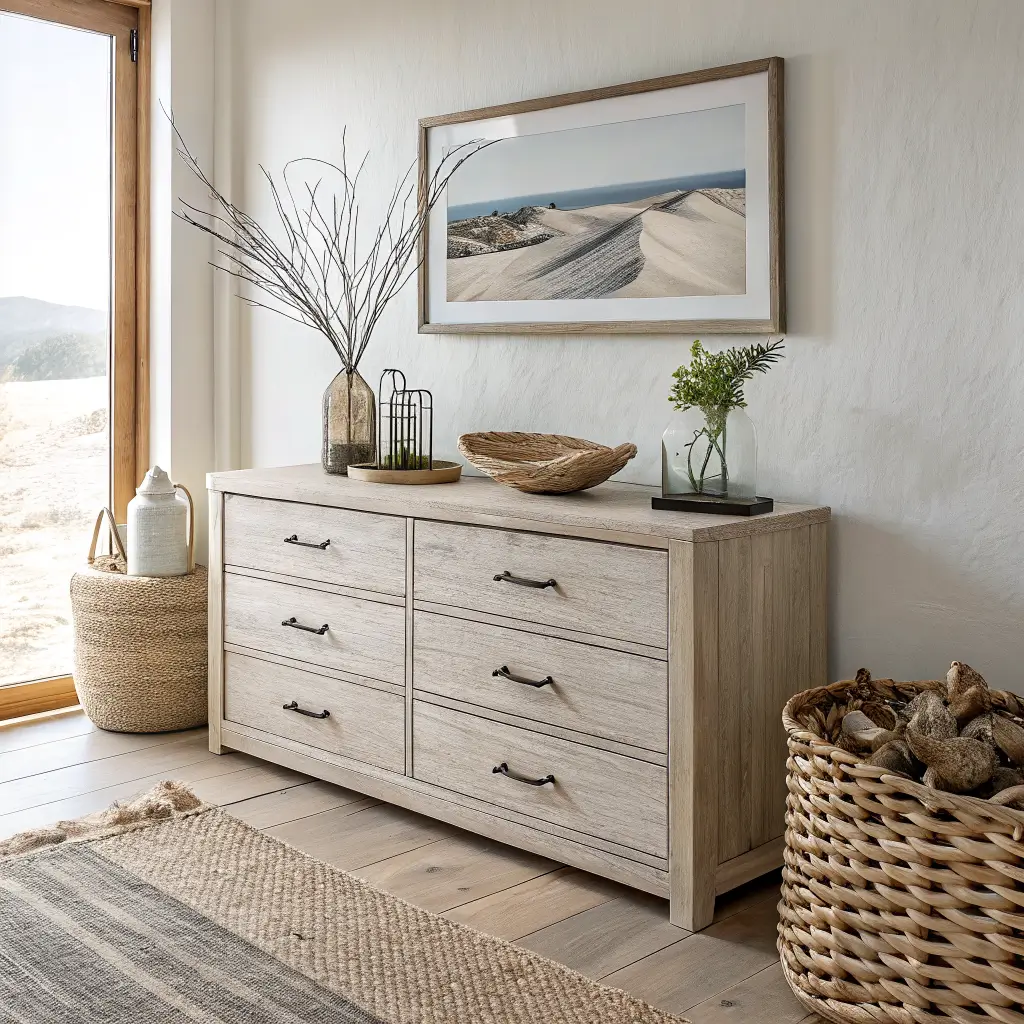
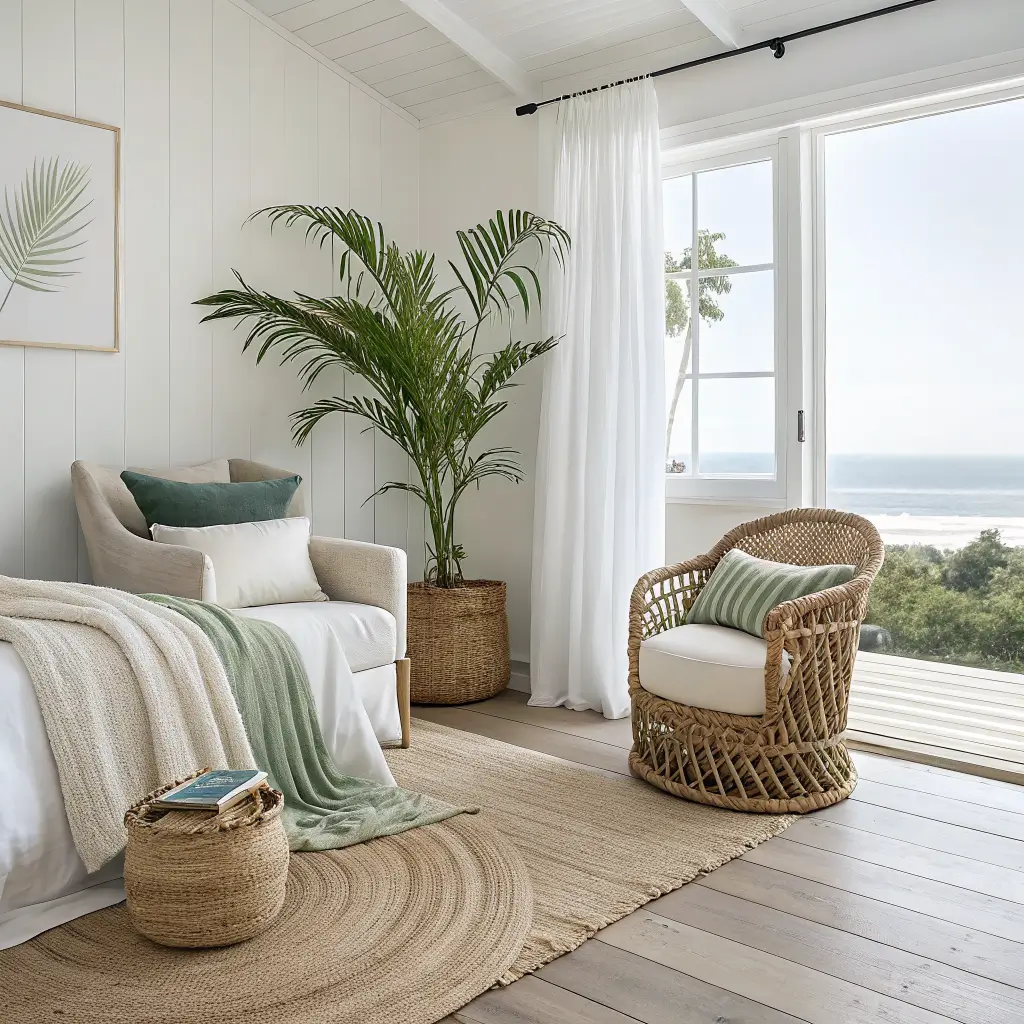
– A single potted palm or a leafy plant in the corner past the dresser
– A woven basket at the foot of the bed for extra blankets
Skip: rope-wrapped anchors, wooden signs with beach quotes, starfish in shadowboxes, that ubiquitous ceramic coral. Every one of these was in my first attempt. Every one of them went to the thrift store.
Building the Room, In Order
Do it in this sequence and it will come together. Do it out of order and you’ll be moving furniture at midnight.
1. Paint first. Walls before anything else enters the room.
2. Bed and rug next. Set the biggest pieces to lock the layout.
3. Bedding. Base sheets and duvet, layer the coverlet, then pillows.
4. Nightstands, styled simply. Lamp, small stack of two books, one small object — a shell bowl, a mini plant, a framed photo. That’s the whole formula.
5. Art over the bed. Center it. The bottom edge should sit 6–10 inches above the headboard, not floating awkwardly high.
6. Window treatments. Sheers first, shades behind.
7. Accessories and greenery, last. A potted palm in the empty corner, a basket at the foot of the bed, maybe one styled tray on the dresser.
One statement per zone. Bed wall gets the art. Dresser gets one tray or mirror. Corner gets the plant and maybe a chair. Don’t compete with yourself.
The Mistakes I Made (So You Don’t Have To)
Going too literal. The starfish, the anchor, the “Life’s a Beach” sign. Read as a costume, not a room. Fix: color, texture, landscape imagery. Save the motifs for a bathroom hook.
Overcrowding surfaces. I had 14 small objects on one dresser once. Fourteen. Fix: fewer, larger pieces. Group small things on a tray so they read as one object.
Uncomfortable foundations. A beautiful bedroom over a bad mattress and one dim overhead bulb is a photo, not a bedroom. Get the mattress and lighting right first.
Too much saturated color. Turquoise as a wall color, turquoise pillows, turquoise vase, turquoise rug. Fix: neutrals hold the room; ocean tones are accents.
Mixing five wood tones. Cap it at two. Whitewashed and light oak play well together. Add a walnut nightstand and everything falls apart.
Seasonal Swaps That Actually Work
Spring and summer: palm-print pillow covers, a gauzy cotton throw at the foot, more plants. Maybe a coral lumbar pillow if you’re feeling brave.
Fall and winter: swap in navy and ink-blue pillow covers, add a chunky knit throw over the linen coverlet, bring in a wool-blend layer. If you have limewashed walls, they photograph incredibly well in low winter light.
Pillow covers are the single best budget move, $15–$40 each versus $60+ for whole new pillows. Buy two sets — a warm-season set and a cool-season set — and rotate.
Keeping It From Drifting
Once it looks right, the maintenance rule is simple: anything new has to either reflect nature (in color, material, or texture) or support calm (soft edges, matte finishes, quiet colors). If it fails both tests, it doesn’t come in.
One-in, one-out on small objects, especially shells and vacation souvenirs. I keep a small basket in the closet for “things I like but don’t have room for” and rotate them seasonally. It saves me from the slow creep back toward the anchor-and-starfish era.
The room I have now cost me about $1,400 the second time around — after I’d already spent maybe $600 on the version I hated. Getting it wrong once was the actual education. The good news is you don’t have to.