The Black and White Living Room: How to Make It Feel Warm, Not Sterile
The black and white living room is the one people warn you looks cold, until it does not. A warm wood floor and one soft rug fixed the temperature.
A black and white living room sounds simple until you actually try to put one together and the whole thing reads like a dentist’s waiting room. I’ve been there. My first attempt had a white sofa, a black-and-white striped rug, black frames on the wall, and it felt like nobody lived there — including me.
The palette isn’t the problem. The execution is. Done right, this look is one of the most flexible in decorating: it flexes modern, farmhouse, glam, even coastal, and it costs less than most schemes because you’re not chasing a specific trend color.
Here’s what I’ve learned actually making it work.
Who This Style Is For (and Where It Shines)
If you like a clean base with room to play — swapping in art, plants, seasonal textiles — monochrome gives you a canvas without locking you into a mood. It suits:
Small living rooms that need visual breathing room (white expands, black defines edges)
Open-plan spaces where you want the seating zone to feel structured
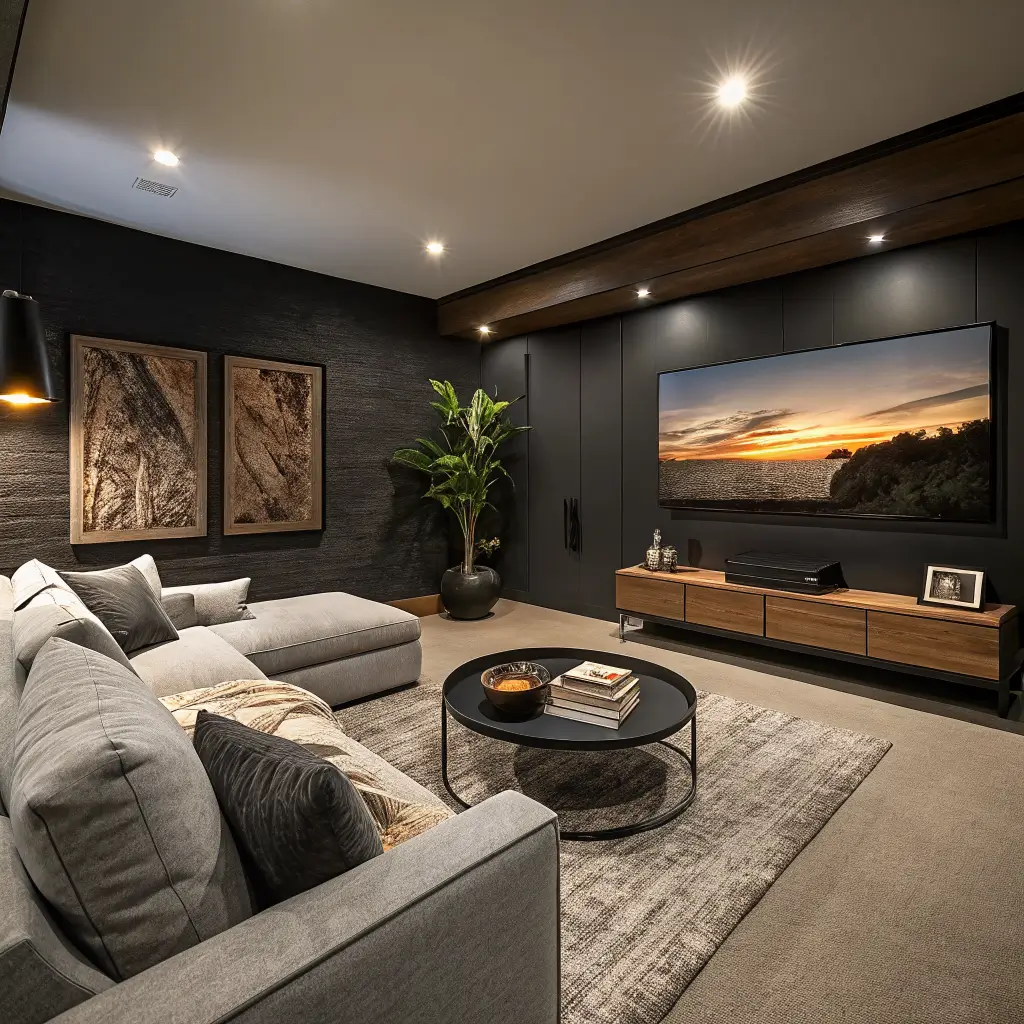
Media rooms, because a dark wall or dark cabinetry lets the TV disappear
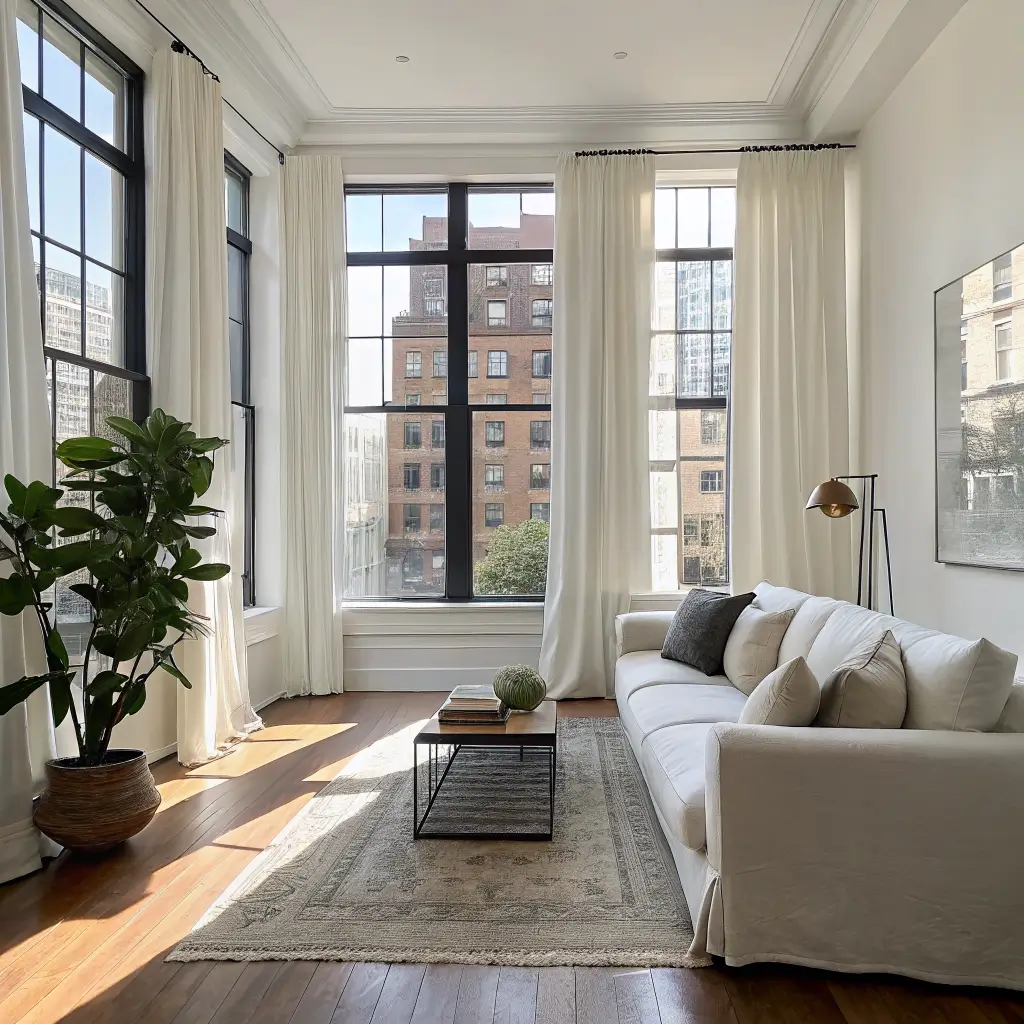
Rentals with white walls — you’re already halfway there
It’s beginner-friendly if you’re just styling. It gets to intermediate once you pick up a paint roller for an accent wall, and expert if you’re building black shaker cabinets around a fireplace.
Time and Budget, Realistically
A styling refresh — new pillows, art, a lamp, a throw — takes me an afternoon. Two to six hours if you’re being fussy about placement. Cost: $150–$500.
A full room reset with a new rug, curtains, an accent chair, a coffee table, and painting one wall runs $800–$3,500, depending on how much you thrift versus buy new. My last redo landed around $1,900, and the rug alone was $600 of that.
Designer territory — marble coffee table, brass sconces, custom millwork — climbs fast, easily $8,000+. Not necessary. Some of the best black and white rooms I’ve seen were built around a $40 IKEA lamp and a good vintage mirror.
The Core Palette (Stop Using One Black and One White)
The single biggest fix that turned my room around: stop matching.
I used to think black and white meant one black paint and one white paint. It looks flat. Real depth comes from mixing:
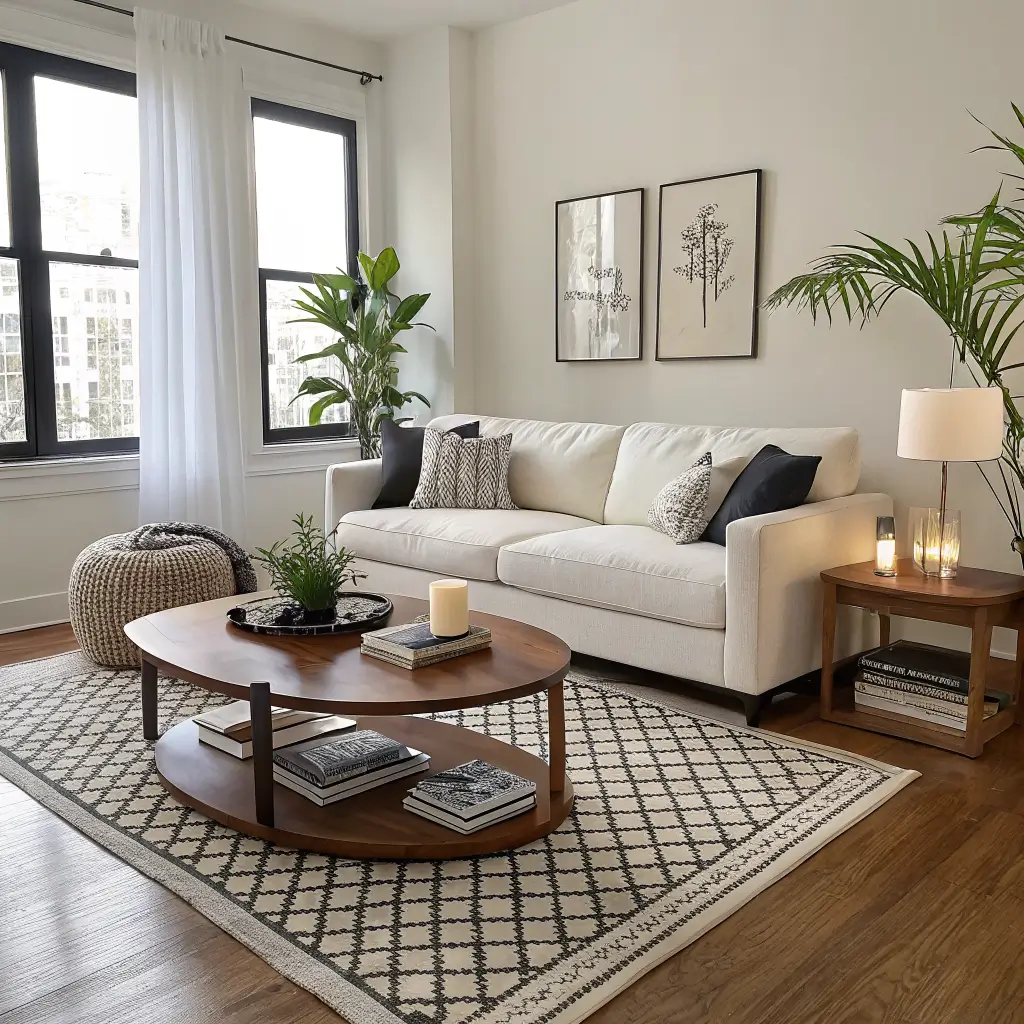
Whites: crisp white walls, an off-white sofa, a chalky bone-colored ceramic
Blacks: true black on a frame, softer charcoal on upholstery, near-black brown on a wood side table
Grays as a bridge: if the contrast feels too sharp, a light greige rug or a charcoal throw calms it down
For paint, I like Benjamin Moore Simply White on walls and Sherwin-Williams Tricorn Black for trim or an accent wall. If you go with a black accent wall, use matte or eggshell — glossy black shows every fingerprint and every drywall imperfection. Learned that one the hard way on a bathroom door.
Then layer in one or two supporting materials:
Warm metals (brass, aged bronze) for glow
Cool metals (chrome, polished nickel) for edge
Natural wood — light oak or walnut — to keep it human
Pick one metal family and stick with it. Mixing brass and chrome in the same room needs a confident hand, and if you’re asking whether this works, it probably doesn’t yet.
The Hero Pieces That Do the Heavy Lifting
You don’t need everything on this list. You need three or four that carry the room.
The sofa.
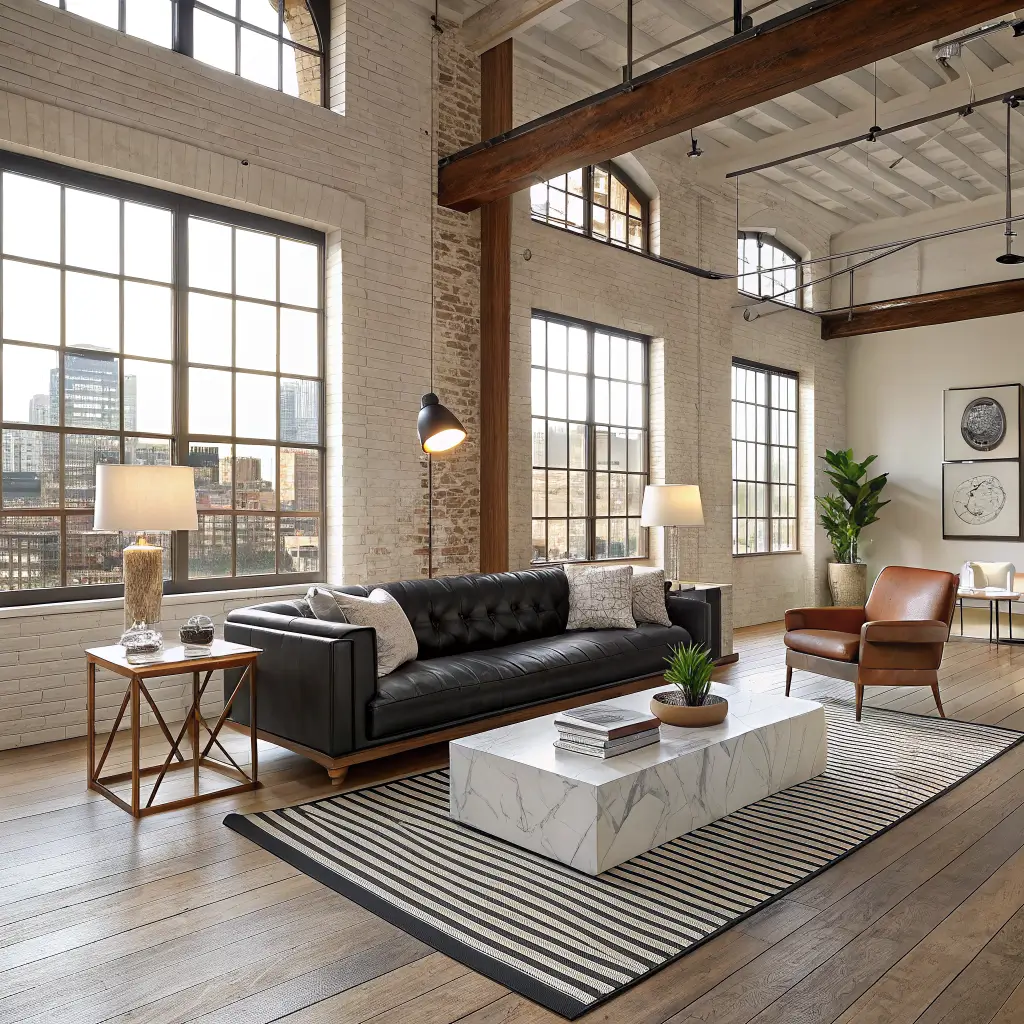
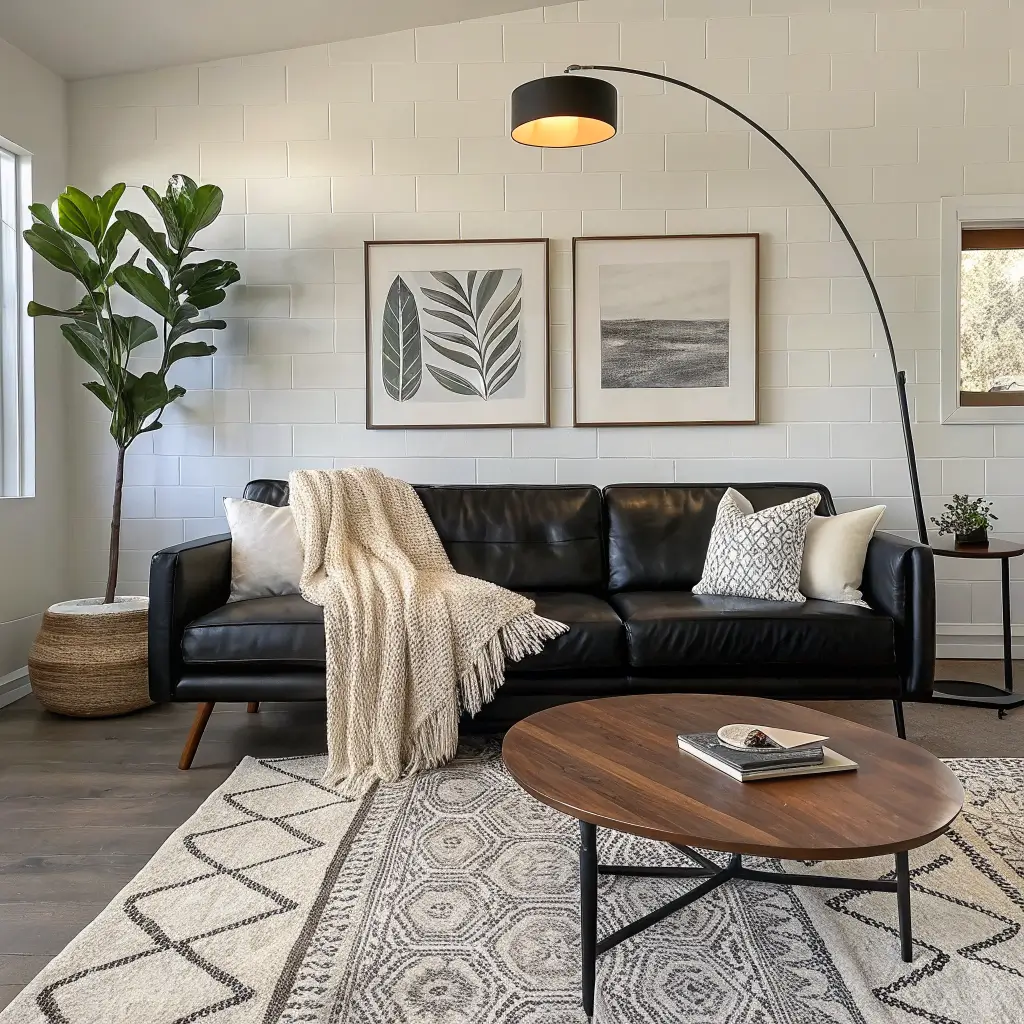
This is your biggest color decision. A white sofa (performance fabric, please — I have a toddler and a black coffee stain taught me this) keeps the room airy and lets you go bolder everywhere else. A black leather sofa anchors the room and takes years of abuse; mine is eight years old and still looks great with a little conditioner twice a year.
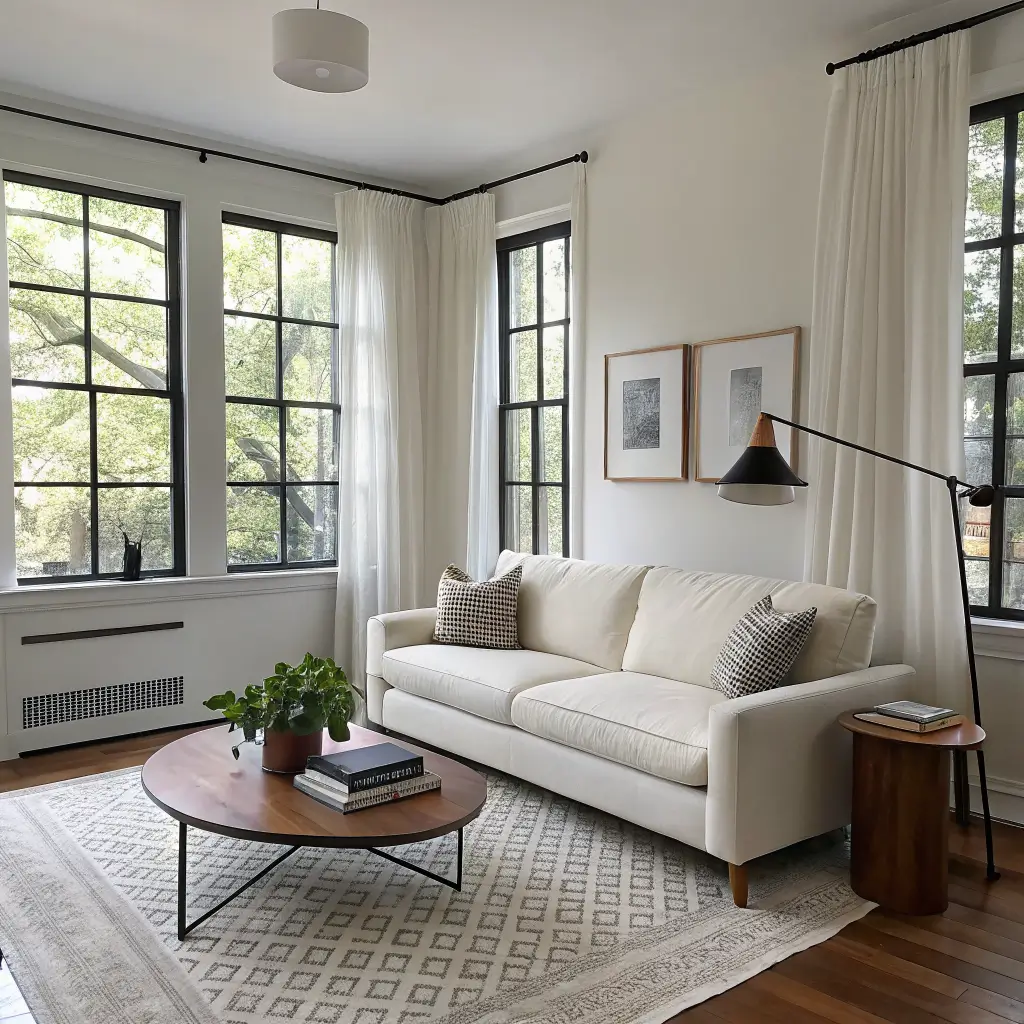
Rule of thumb: if the room is small or low-light, go white sofa. If the room has big windows and you want drama, go black.
The rug.
This is where I’d spend real money. A black-and-white patterned rug — checkerboard, abstract, or a wide stripe — grounds the whole seating area and does more visual work than art. Size it so the front legs of the sofa sit on it at minimum. An 8×10 is the smallest I’d go for a standard living room; 9×12 if you can fit it.
The wall moment.
Pick one:
White walls + a gallery wall in thin black frames
One black accent wall behind the sofa or TV
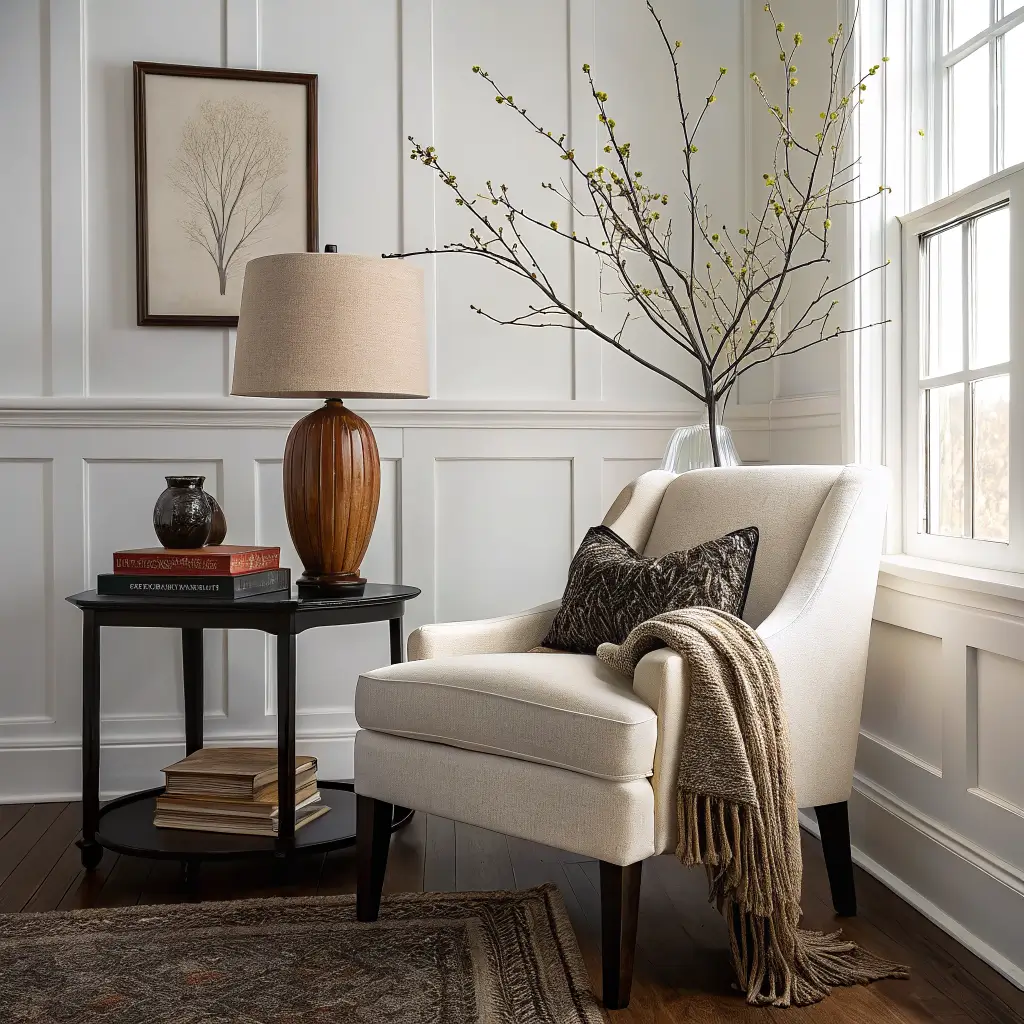
Black-painted trim or wainscoting against white walls (this one is my favorite and adds instant tailoring)
Lighting.
A matte black floor lamp with an arched arm behind the sofa. A pair of white ceramic table lamps flanking the console. A brass pendant or picture light for warmth. Skip cool-white LED bulbs — they make black-and-white rooms feel like a morgue. Use 2700K warm white, always.
How to Actually Put It Together
Start with the anchor and build out.
1. Set the sofa first, floated off the wall if the room allows even a few inches.
2. Lay the rug so the coffee table sits fully on it and the sofa’s front legs land on the border.
3. Coffee table — round or oval works best if your sofa is a straight sectional. All sharp lines make the room feel like a chess set.
4. Two accent chairs or one big lounge chair across from the sofa. Boucle in cream or a black leather sling both work.
5. One tall thing in every corner — a floor lamp, a plant, a leaning mirror, a slim shelf. Empty corners kill a room.
Then style in groupings of 2–4, not scattered individual objects:
Coffee table: a stack of books, a low bowl, a taper candle
Console or mantel: a piece of art, a lamp, one sculptural object
Side table: lamp, coaster, small vase
If you’re counting more than four “styled zones,” you’re probably overdoing it.
The Warmth Problem (This Is Where Most Rooms Fail)
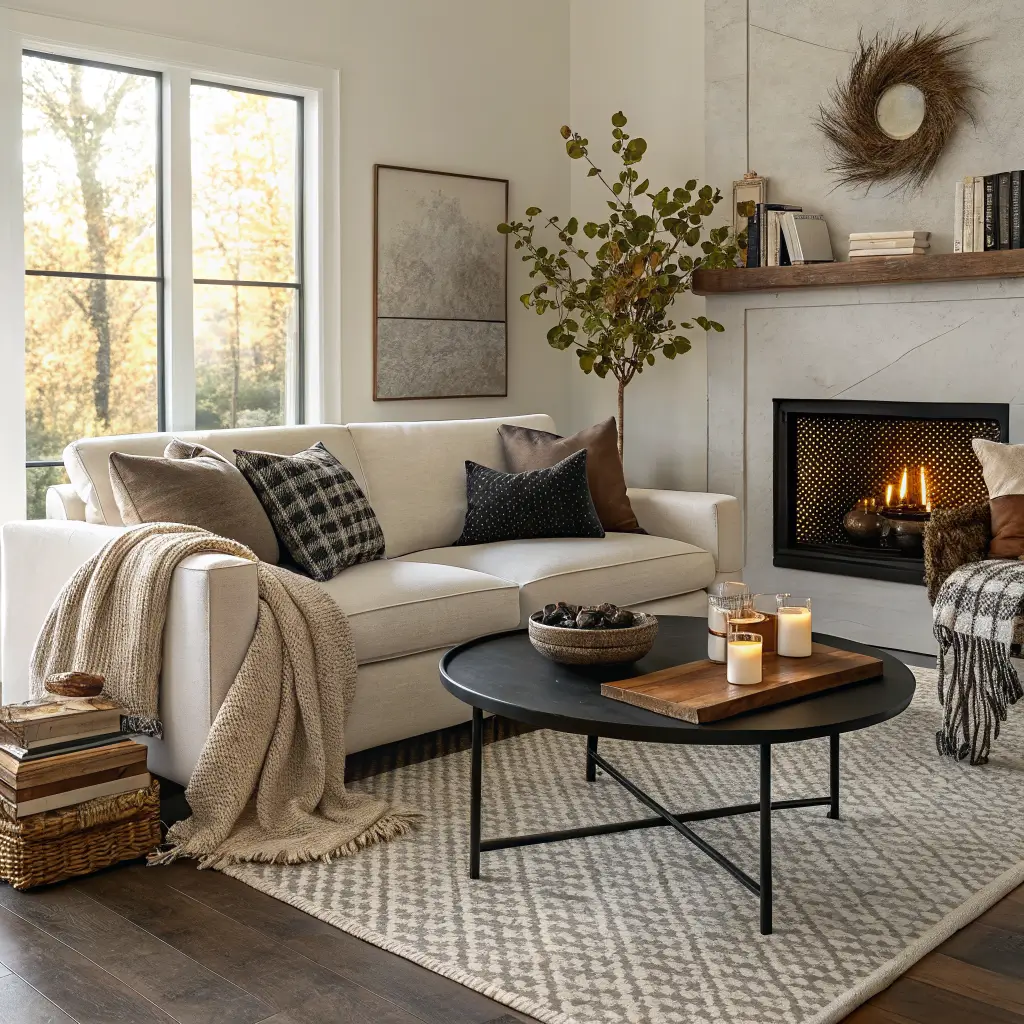
A cold monochrome room is almost always missing three things: wood, texture, and a plant that’s actually alive.
Add these in order:
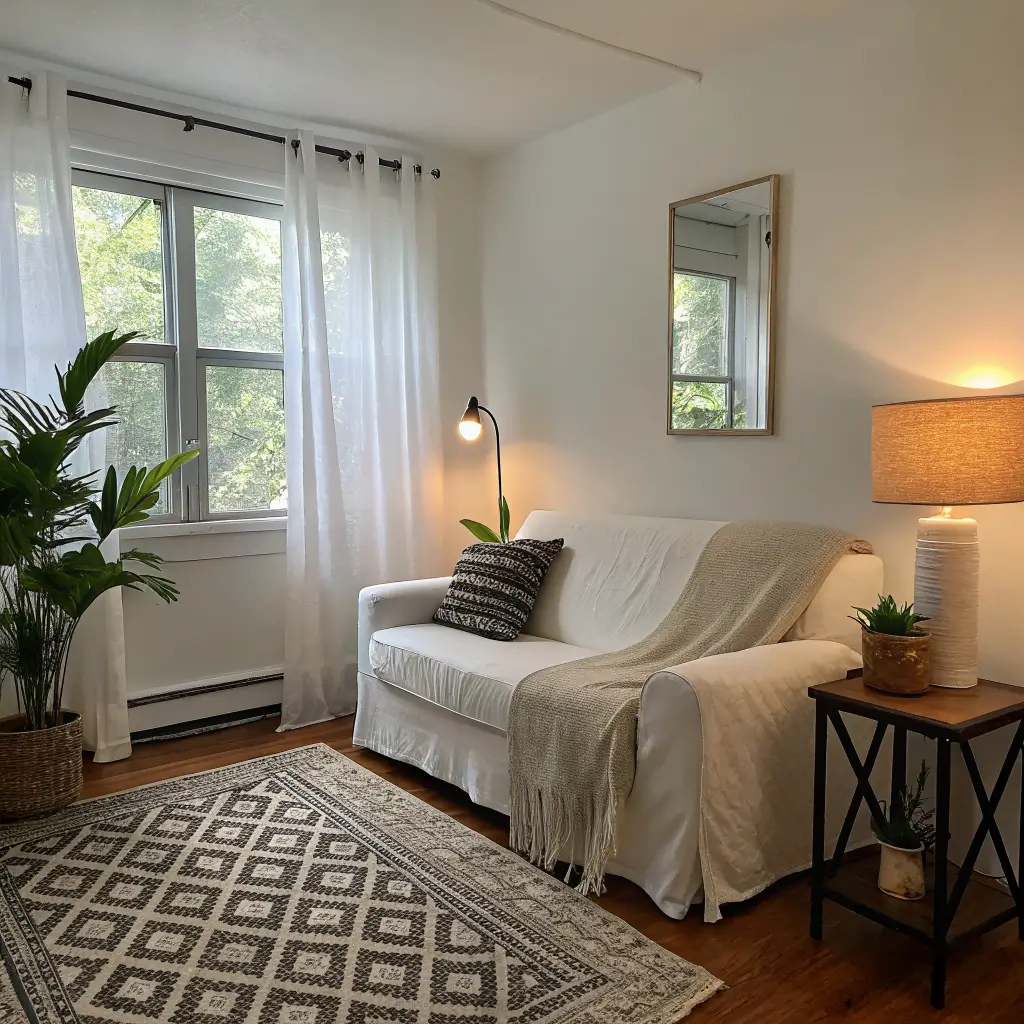
A wood element, warm-toned — a side table, a stool, a bench, or a wood-framed mirror. My best thrift find was a $30 vintage walnut side table that saved my whole scheme.
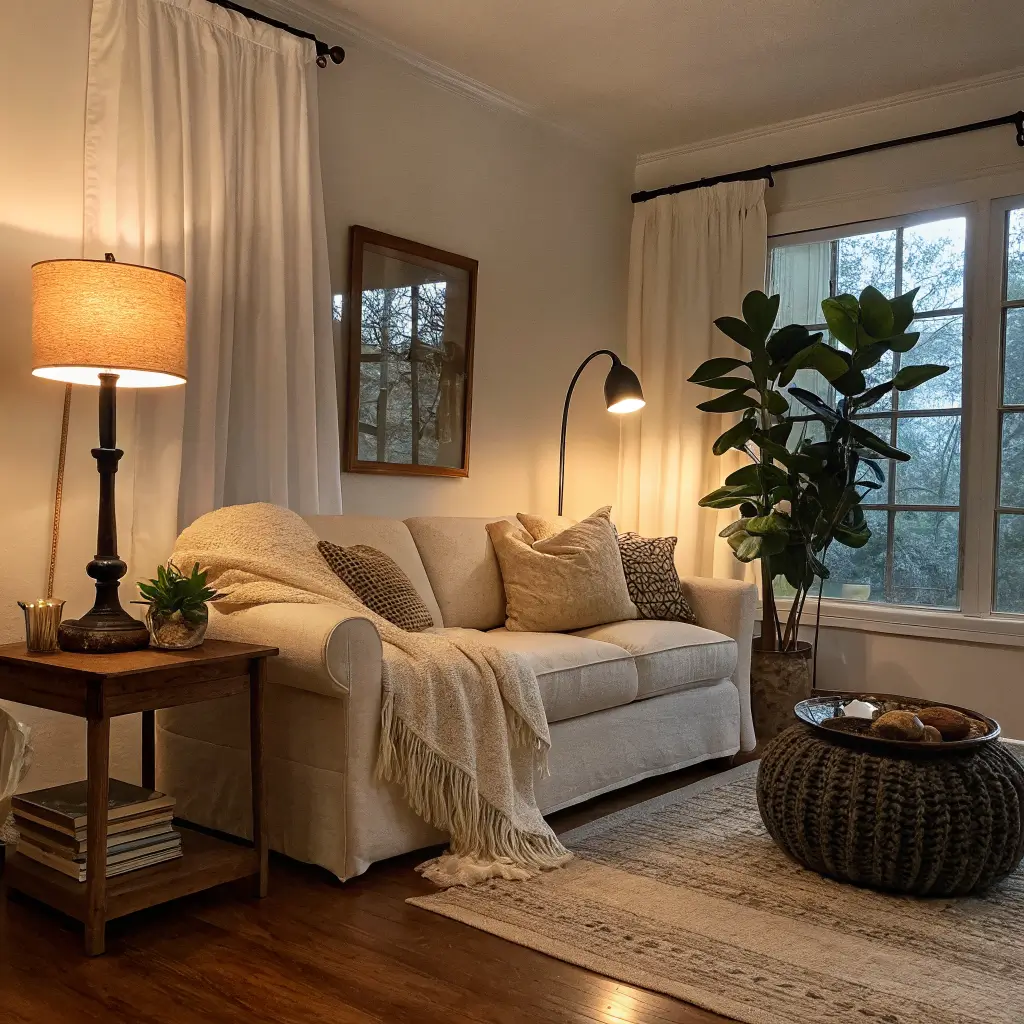
A chunky throw — cream boucle in summer, black knit in winter — draped, not folded like a hotel.
One large plant. A 4-foot fiddle-leaf fig or a snake plant in a matte black planter, tucked in the corner past the sofa. A tiny succulent doesn’t count.
Curtains that puddle slightly — floor-length linen in white or black, hung wide and high (rod 8–12 inches above the window frame, extending 6+ inches past each side).
Warm bulbs, warm materials, one living thing. That’s the formula.
Common Mistakes I’ve Made or Watched Friends Make
50/50 black and white with no lead color. Pick one to dominate — usually 70% white, 30% black, or the reverse. Even splits look like a referee’s jersey.
Too much pattern. One patterned rug plus striped pillows plus checkered art is chaos. Let the rug lead and keep everything else calm.
Cheap black frames. The plastic ones with the slightly-glossy finish read as dorm room. Spend $15–25 per frame instead of $5 and get matte wood.
Forgetting the ceiling and trim. If everything on the walls is high-contrast but the trim is builder-beige, the room feels unfinished. Paint trim crisp white or, if you’re bold, the same black as the accent wall for a wraparound effect.
Under-lighting. One overhead light isn’t enough. You want at least three light sources at different heights: overhead, table, and floor.
Seasonal Swaps That Actually Change the Mood
The whole point of a neutral base is that small changes shift the feel.
Spring: swap in a linen pillow cover in bone or oat, add branches of eucalyptus in a tall vase
Summer: thinner cotton throws, more greenery, open the curtains fully
Fall: velvet pillows in charcoal, a rust or camel throw as your accent color, add candles
Winter: faux fur throw, warmer bulbs, a black wool blanket over the sofa arm
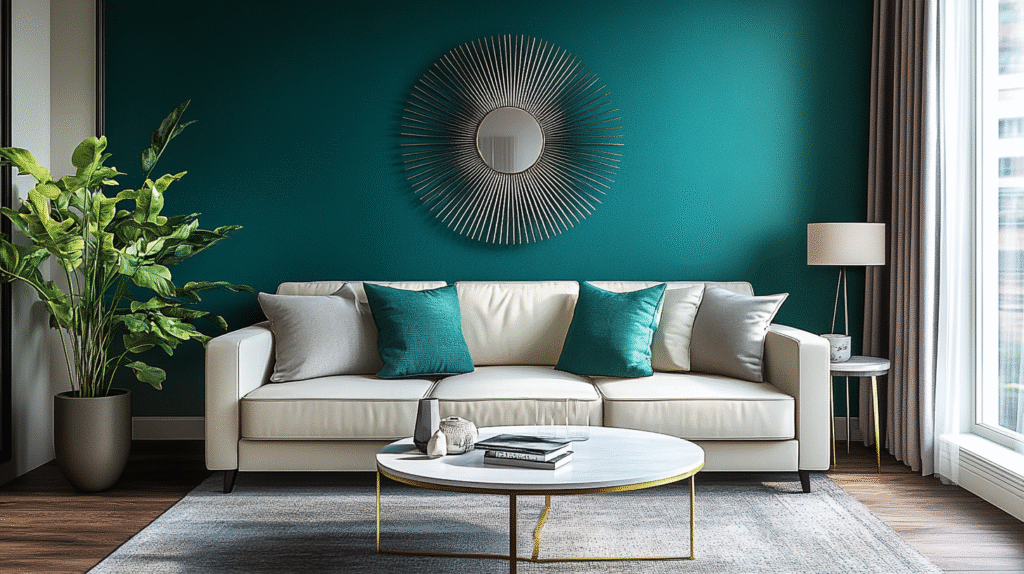
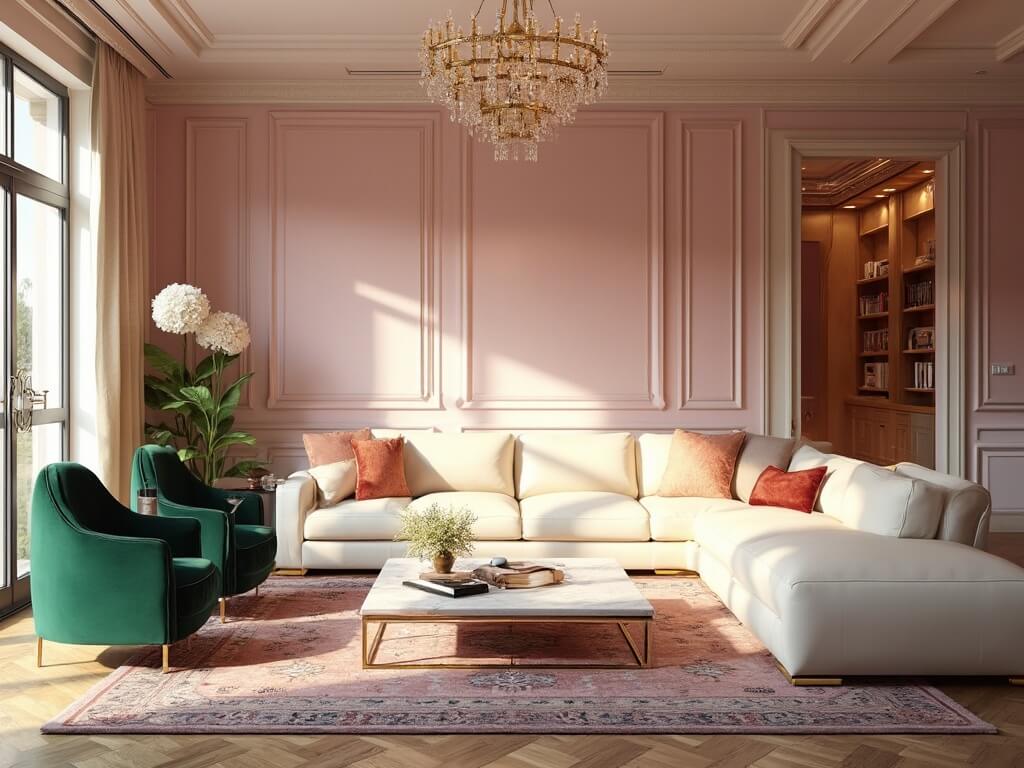
If you want an accent color, the ones that play best with black and white are: warm camel, deep forest green, terracotta, and blush. Pick one per season, not all four at once.
Where to Spend, Where to Save
Spend on:
The rug (you look at it constantly)
The sofa (it has to survive real life)
One good light fixture
Save on:
Frames — IKEA Ribba in black, done
Pillow covers — H&M Home and Amazon both have $15 options that pass for much more
Vases and bowls — thrift stores are packed with black ceramic if you look
The room I like best in my house cost under $2,000 total, and half of that was the sofa. The $30 walnut side table gets more compliments than anything else in there.
Get the base right, layer in warmth, and edit ruthlessly. That’s the whole trick.