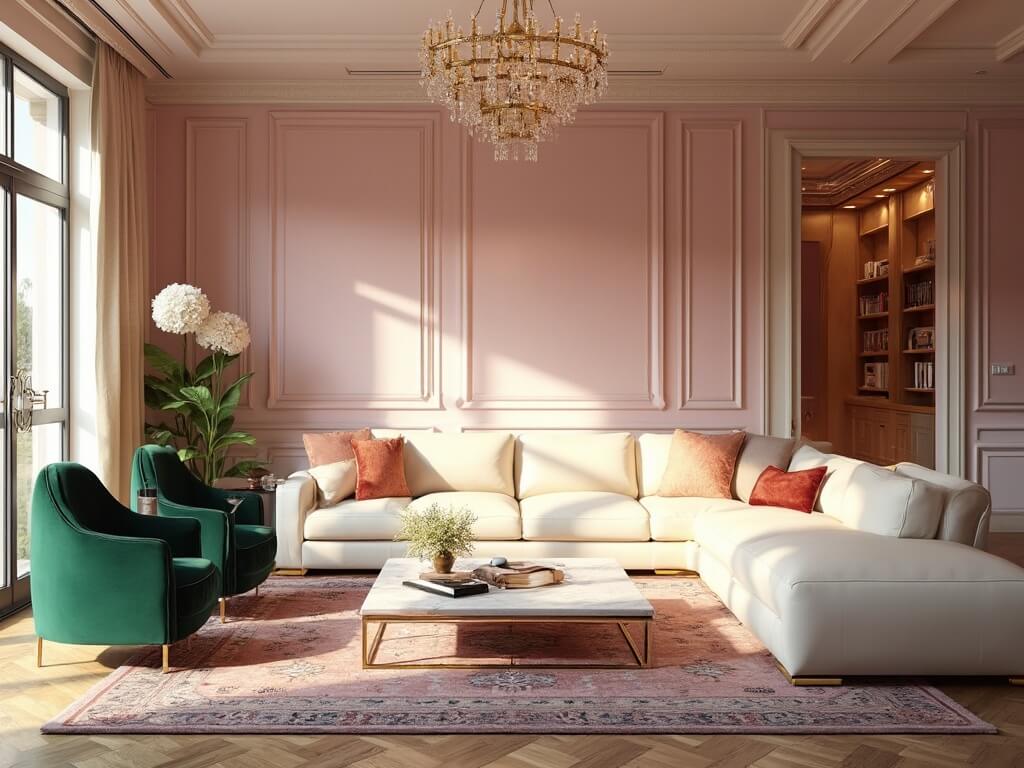
The nursery for a girl was the room I kept from going too pink. A dusty rose and one linen curtain made it feel gentle, not loud.
If I were starting over tomorrow, I’d build the room around warm neutrals with one strong personality wall. Think oatmeal walls, natural oak crib, a bouclé glider in cream, and then a botanical mural or a moody floral wallpaper behind the crib doing the heavy lifting. That’s it. That’s the formula.
It works because the expensive pieces — crib, dresser, glider, rug — stay neutral and grow with her. The personality lives in the wallpaper, art, and textiles, which are cheap and easy to swap when she suddenly has opinions about mermaids at age four.
A few directions I’d sign off on:
– Modern romantic: scalloped shelves, arched mirrors, dusty rose, floral prints, brass hardware.
– Nature-botanical: a leafy mural, oak furniture, muslin textiles, a woven pendant light.
– Celestial neutral: cream walls, a moon-and-stars mural in taupe/blush, plaster wall sconces.
– Warm Scandi: white and greige, light wood, minimal decor, a single big piece of art.
This suits parents who want a calming sleep environment and — importantly — a room that converts into a toddler room without a full teardown. If your instinct is “not everything has to be pink,” you’re already on the right track.
Budget: Where I’d Actually Spend
Total nursery costs run wide. Here’s how I’d break it down honestly.
Budget build ($700–$1,500)
– Crib: $120–$250 (the IKEA Sniglar at ~$120 is genuinely fine; I’ve slept a baby in one.)
– Dresser + changing pad on top: $150–$350
– Glider or upholstered rocker: $200–$500
– 5×7 washable rug: $60–$200
– Curtains, lamp, art, mobile, baskets: $100–$250
Mid-range ($1,800–$3,500)
– Designer crib in oak or with acrylic panels: $450–$1,000
– Solid dresser: $300–$700
– Reclining swivel glider with ottoman: $500–$1,200
– Peel-and-stick mural or premium wallpaper: $150–$600
– Art, lighting, decor: $250–$600
High end: $4,000–$10,000+ once you’re into custom built-ins, hand-painted murals, and designer textiles.
Spend on the glider. This is the one I got wrong the first time. I bought a $220 “nursery rocker” that felt like a park bench at 3 a.m. Replaced it four months in with a swivel glider around $800 and never regretted it. You will sit in that chair more than any piece of furniture you have ever owned.
Save on the crib and dresser. Babies do not care. A $150 crib and a $200 dresser look great once you paint the walls well and add a mural.
Save on art. Etsy prints in $30 frames photograph identically to $400 gallery pieces above a crib.
Room Size and Layout
A comfortable nursery is 80–120 sq ft — roughly 9×10 to 10×12. That fits a crib, dresser/changing combo, glider, and a small play zone with room to walk.
If you’re working with something closer to 8×8 (60 sq ft) — my daughter’s first room was 8’6″ x 9’2″ — you can absolutely make it work with a mini crib (24″ x 38″), a slim 36″ dresser, and vertical storage. Skip the full glider; use an armchair you already own.
Rules of thumb I actually follow:
– 3 feet of clear floor in front of the dresser so you can change a baby without doing yoga.
– Crib at least 2 feet from windows, cords, and radiators.
– Nothing heavy hung directly above the crib. A lightweight print or decal only.
– Keep a clean sightline from the door to the crib. You’ll appreciate it during night checks.
The Pieces That Actually Make the Room
Crib
Standard mattress is 28″ x 52″; the crib footprint runs about 30″ x 55–58″. Get a convertible crib if you can — it converts to a toddler bed and saves you buying another piece at 18 months. Natural oak or beech reads warmer than white and hides scuffs.
Dresser as changing station
Skip the dedicated changing table. A 36–52″ wide dresser with a changing pad strapped to the top does the same job and stays useful forever. Confirm the top is at least 18″ deep so the pad doesn’t hang off.
Glider
Non-negotiables after living with one: swivel base, recline, washable or performance fabric, and a matching ottoman. Bouclé looks great but spits up dries into a crust — I’d get performance weave in cream or oat.
Rug
A 5×7 or 6×9 washable rug under the crib and glider ties the room together and softens the floor when she starts crawling. Ruggable and Lorena Canals both hold up to spit-up and blowouts.
Lighting (three layers, always)
– Overhead: flush mount or a woven pendant.
– Task: dimmable floor lamp next to the glider.
– Night: a warm plug-in nightlight at 2700K or lower. Anything cooler than 3000K will wake a baby up.
Window treatments
Sheers plus blackout panels — always both. Or a blackout roller shade with decorative curtains layered over. Naps in July depend on this. I learned this the hard way with sheer curtains that turned a 1 p.m. nap into a 20-minute nap.
Wall decor
One statement: a mural, a wallpapered accent wall, or a single oversized piece above the dresser. Everything else stays quiet. A framed print above the crib should weigh under 2 pounds and hang on a proper anchor, or skip it and use a decal.
Mobile
Ceiling-hung, over the crib. Muslin clouds, felt shapes, or a simple floral. Take it down once she can pull to standing.
Colors I’d Reach For
Pale pink alone reads dated fast. The palettes that hold up:
– Warm white + blush + oak + brass — the safe hit.
– Greige + sage + cream + natural rattan — my personal favorite.
– Oat + dusty rose + charcoal + gold — moodier, works beautifully at night.
– Lavender + warm gray + cream — if you want purple without the Disney energy.
– Cream + rust + slate blue — reads intentional, not baby.
Skip high-saturation pink on the walls. Confine bold color to pillows, art, and one accent surface. If you want pink, go blush with a warm undertone (Farrow & Ball Setting Plaster or Sherwin-Williams Intimate White are both good).
For paint finish in a nursery, use eggshell on walls and satin on trim. Eggshell wipes clean without the plastic sheen of satin. Semi-gloss on trim scuffs less but shows every drip during install.
How I’d Put It Together, In Order
1. Paint or wallpaper first. Let paint cure at least 48 hours before wheeling in furniture. If you’re doing a peel-and-stick mural, wipe walls with a damp cloth, let dry fully, and install with two people.
2. Assemble and place big furniture. Crib against the focal wall, dresser on an adjacent wall so you can see the door while changing, glider in the opposite corner near the window (with the shade drawn during the day).
3. Hang curtains and install lighting. Curtain rods should extend 4–6″ past the window frame on each side and hang 4″ above the frame minimum — higher if your ceilings allow it.
4. Add storage. Baskets under the crib, closet organizer with clear bins labeled by size (0–3, 3–6, 6–9 — you will not remember without labels), a basket by the glider for burp cloths.
5. Style the walls last. Mobile, art, shelf styling. Two books, one small object, one soft item per shelf. Leave breathing room.
6. Soft goods. Rug, cushions on the glider, a throw for you (never in the crib).
Textures to Layer
Sensory variety matters more than matching. Mix:
– Smooth: crib rails, painted walls, glass frames.
– Soft: wool rug, muslin curtains, knit cushion.
– Rough/woven: rattan pendant, seagrass basket, macramé wall hanging.
– Plush: sheepskin at the foot of the glider, faux fur pouf.
One accent wall of pattern, everything else quiet. That’s the rule that separates rooms that photograph well from rooms that feel calm to sit in.
Mistakes I’ve Made or Watched Friends Make
– Buying the theme first. If you buy the unicorn crib sheet in month four of pregnancy, you’re now building a unicorn room. Buy furniture and paint first; theme accessories last.
– Skipping blackout curtains to save $80. Cost me hours of sleep.
– Not anchoring the dresser to the wall. Do it. Anti-tip straps come with most dressers now and take five minutes.
– Hanging a heavy mirror or floating shelf over the crib. Anything over the crib should be lightweight decal or nothing.
– Putting the glider under the window with sheer curtains only. The 4 p.m. sun on a west-facing wall will roast you both.
– Buying too many baskets. Three is enough. Six is clutter with lids on.
Small-Space Version
For rooms under 70 sq ft:
– Mini crib (24″ x 38″) on wheels so you can move it for cleaning.
– Wall-mounted changing pad or a topper on a narrow 30″ dresser.
– Slim armchair instead of a full glider.
– Floating shelves above the dresser for books and decor — vertical storage is your friend.
– Under-crib rolling drawers for out-of-season clothes.
Skip the rug if the floor is already carpeted. Skip the mobile if you have a low ceiling. Ruthless edits.
Keeping It Fresh As She Grows
Because the base is neutral, updates are cheap:
– Around 12 months: swap the mobile for a canopy over a floor cushion reading nook.
– Around 2 years: convert the crib to a toddler bed, add a small floor mirror, replace mobile art with her own scribbles in matching frames.
– Seasonally: swap cushion covers and one piece of shelf art. A cream velvet cushion in winter, a block-print cotton one in summer. Small moves, big shift.
The nursery I’m proudest of isn’t the one with the most stuff in it. It’s the one my daughter is still sleeping in at three and a half, with the same oak crib (now a toddler bed), the same greige walls, the same glider I still read to her in. The mural changed once. Everything else earned its place.