Small Entryway Ideas: How to Make a Tiny Foyer Actually Work
The small entryway is the spot that gets judged in three seconds. A tray for keys and a mirror wider than the door changed how the whole place felt.
Small entryway ideas usually fail for the same reason: people try to cram a full mudroom into 12 square feet. I’ve done it. My first apartment had a “foyer” that was really just the three feet between the front door and the couch, and I spent six months tripping over a bench that had no business being there.
What actually works is picking one job for the space, solving it well, then styling around that. Here’s how I’d approach it now, after redoing my own entry three times and helping two friends fix theirs.
The Look and Who It’s For
A small entryway that works has three qualities: it handles the daily drop of coats, shoes, keys, and mail; it looks like it belongs to the rest of the house; and it doesn’t block the door swing. That’s it.
This setup is for you if:
– Your front door opens straight into the living room with no defined foyer
– You have a narrow hallway entry (3–4 feet wide) that’s currently a dead zone
– You’re a renter who can’t rip out walls or install built-ins
– You have kids or a dog and the shoe pile is out of control
Style directions I’d actually pick from:
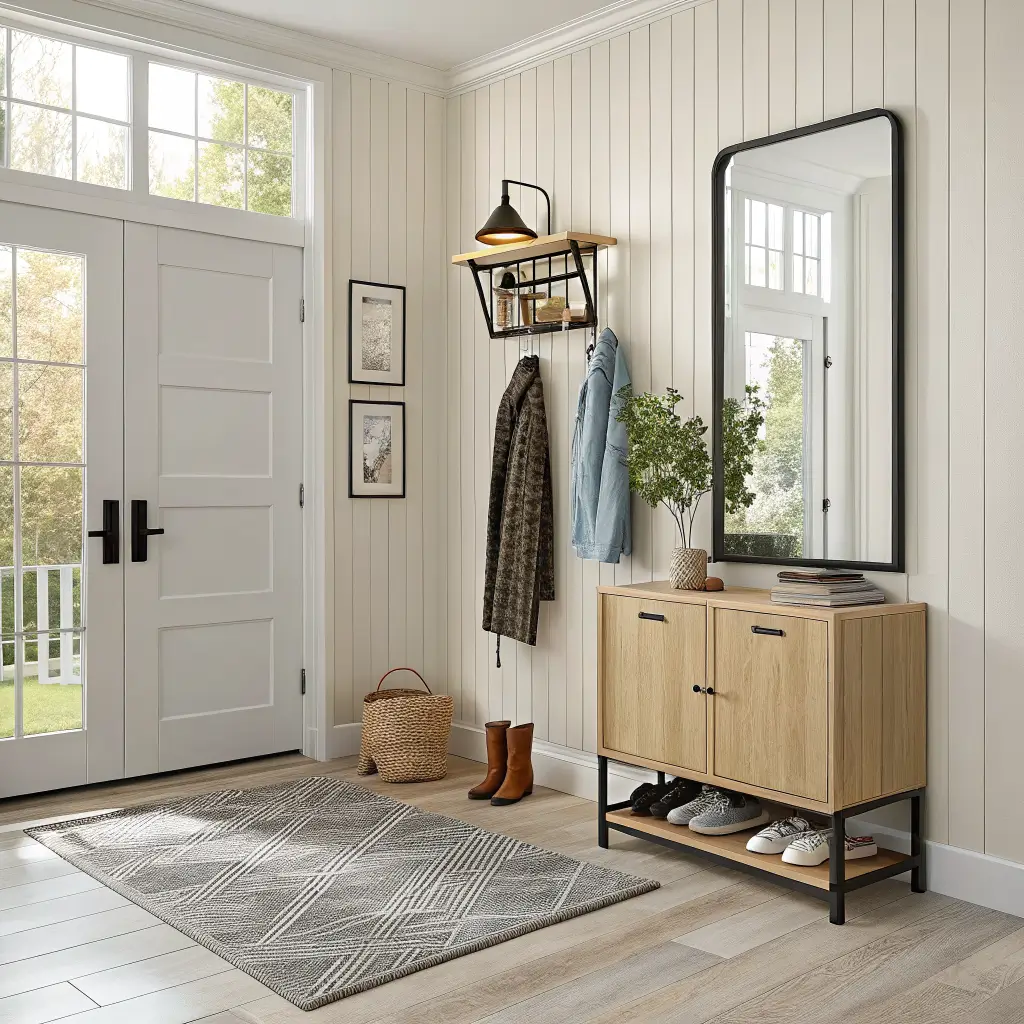
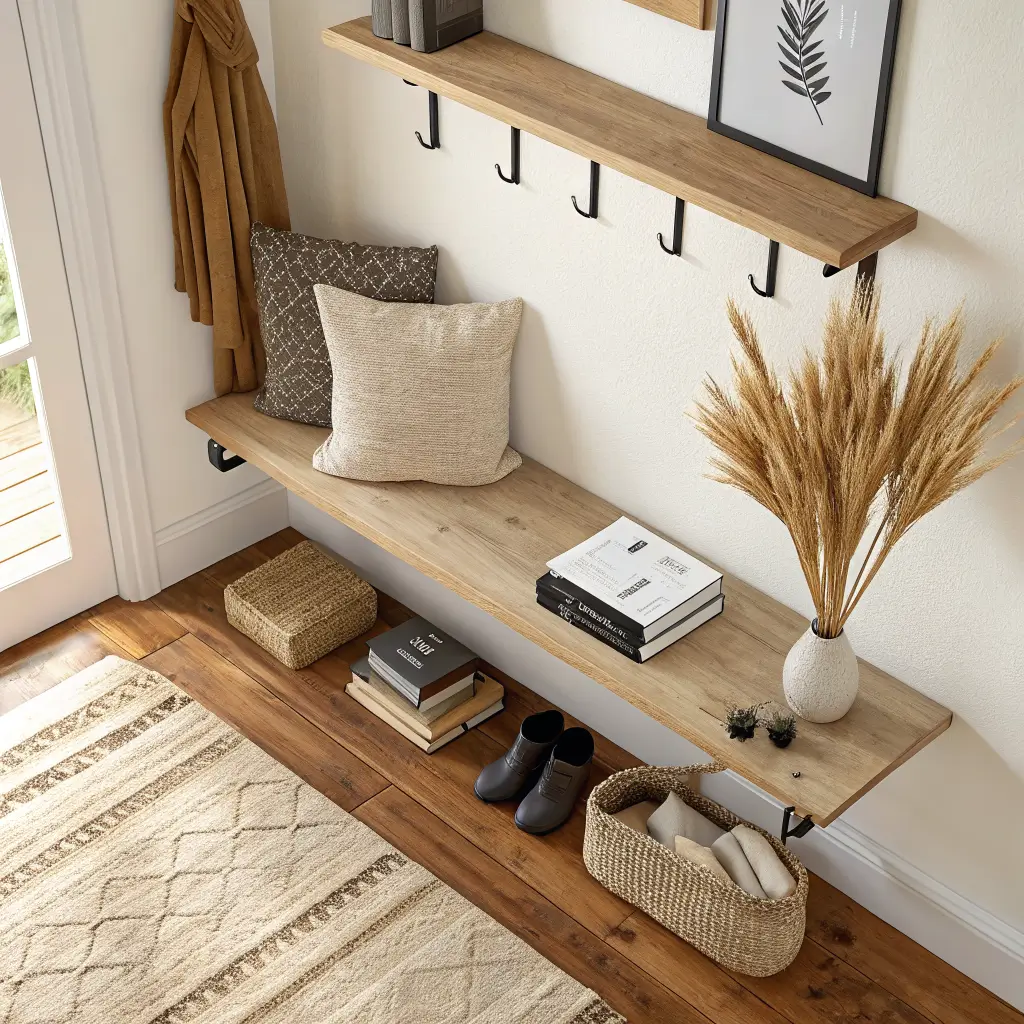
– Warm Scandinavian — light oak bench, off-white walls, jute runner, black peg rack. Forgiving and bright.
– Modern minimal — slim black-framed arch mirror, floating shelf, hidden shoe cabinet, one plant.
– Transitional/farmhouse — shaker peg rail, wood bench with baskets underneath, patterned cotton runner.
– Renter urban — adhesive hooks, a leaning mirror, a slim console you can take with you.
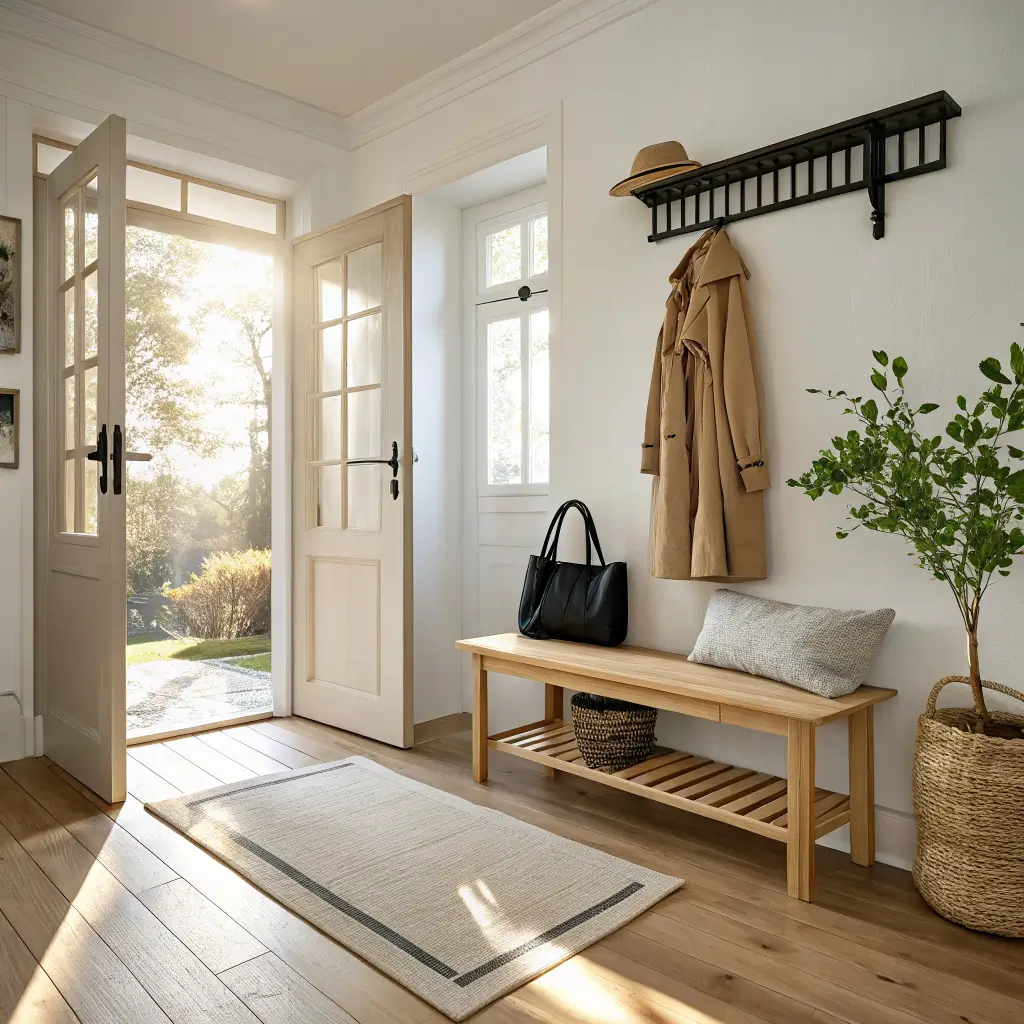
The Pieces That Actually Earn Their Spot
In a small entry, every item has to do a job or it goes. Here’s the hierarchy I use.
Pick ONE hero piece. Not both. This is the mistake I made and the mistake every Pinterest board pushes you toward.
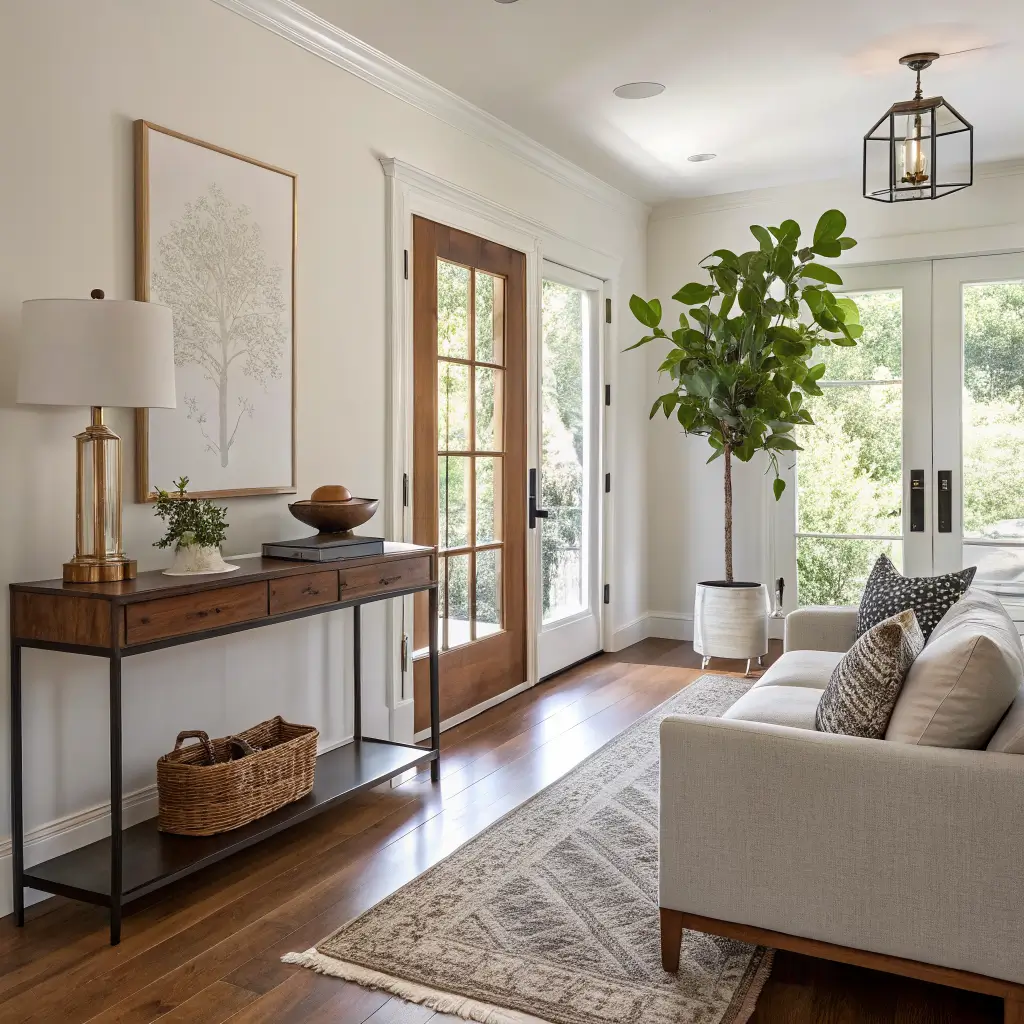
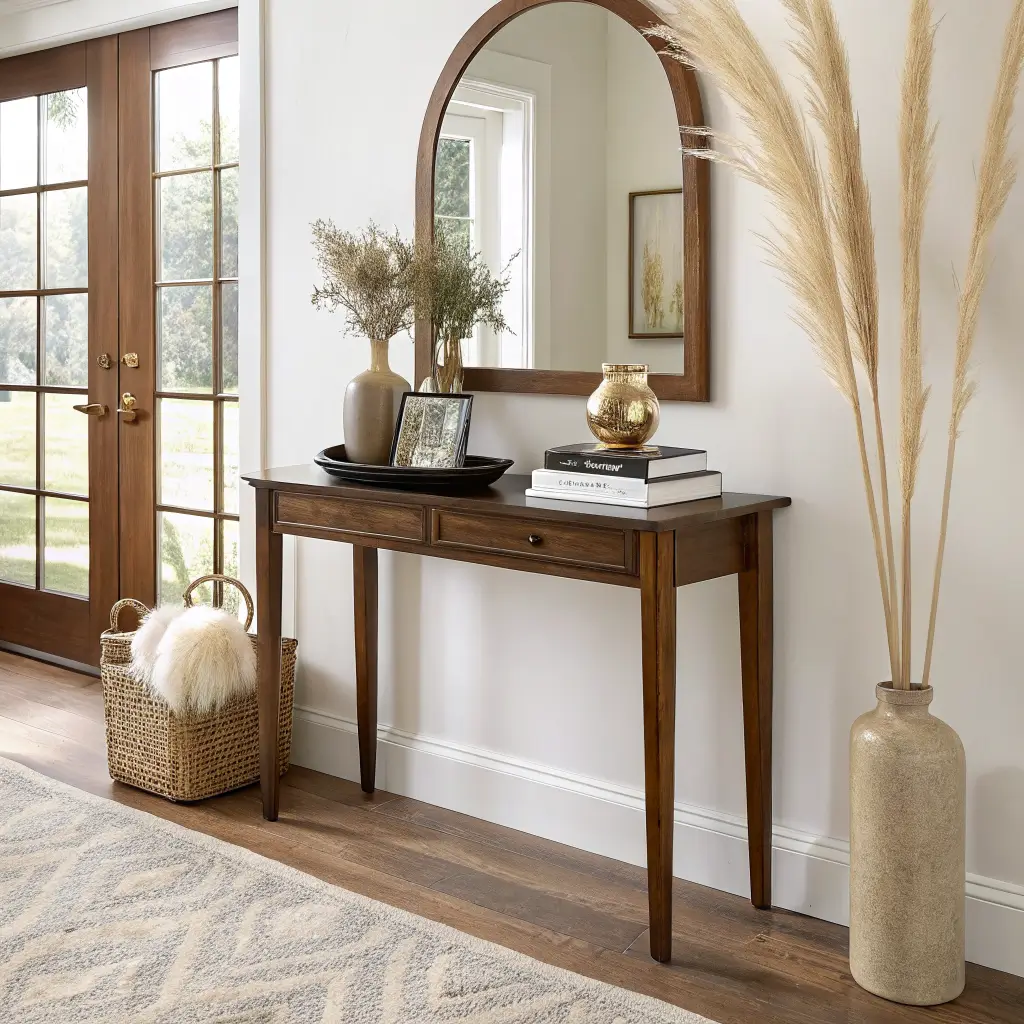
– Slim console table (10–14″ deep, 30–34″ high) if you need a surface for keys, mail, and a lamp. Best when you have zero seating needs.
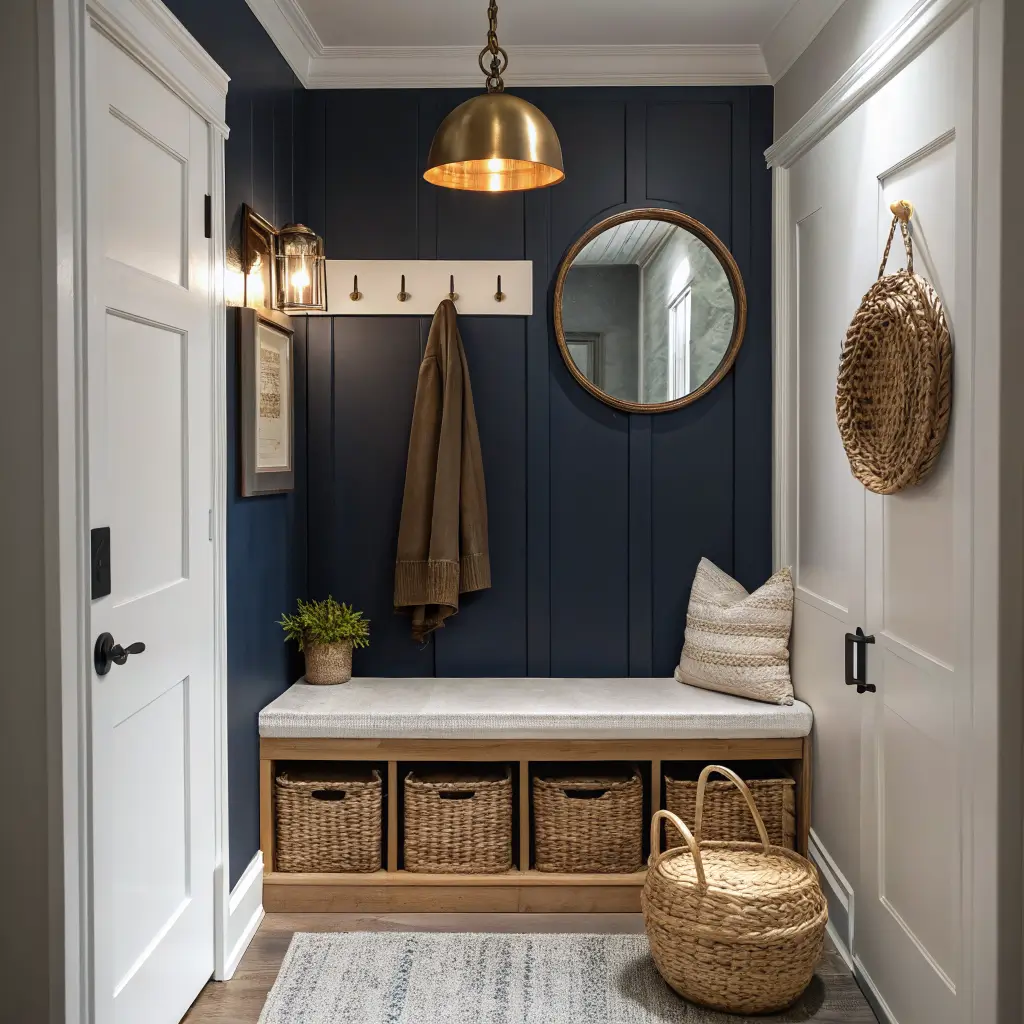
– Storage bench (36–48″ wide, 14–18″ deep) with a lift-top or cubbies if shoes are your main problem or someone in the house needs to sit to put boots on.
– Hall tree (a vertical combo of hooks, a small seat, and a shoe shelf) for entries under 3 feet wide where a bench alone wastes the vertical space.
Then add the supporting cast:
– Wall hooks or a peg rail, mounted at 60″ high for adults, with a second row at 40–44″ if kids use it
– A mirror, ideally 24–36″ across, hung at eye level or leaned if you’re renting
– A runner or small rug (2′ x 6′ for hallways, 3′ x 5′ for wider entries)
– Two baskets max, tucked under the bench or console for shoes and gear
– A tray for keys, wallets, sunglasses — one tray, not three little dishes
That’s the whole list. If it’s not on it, think hard before adding it.
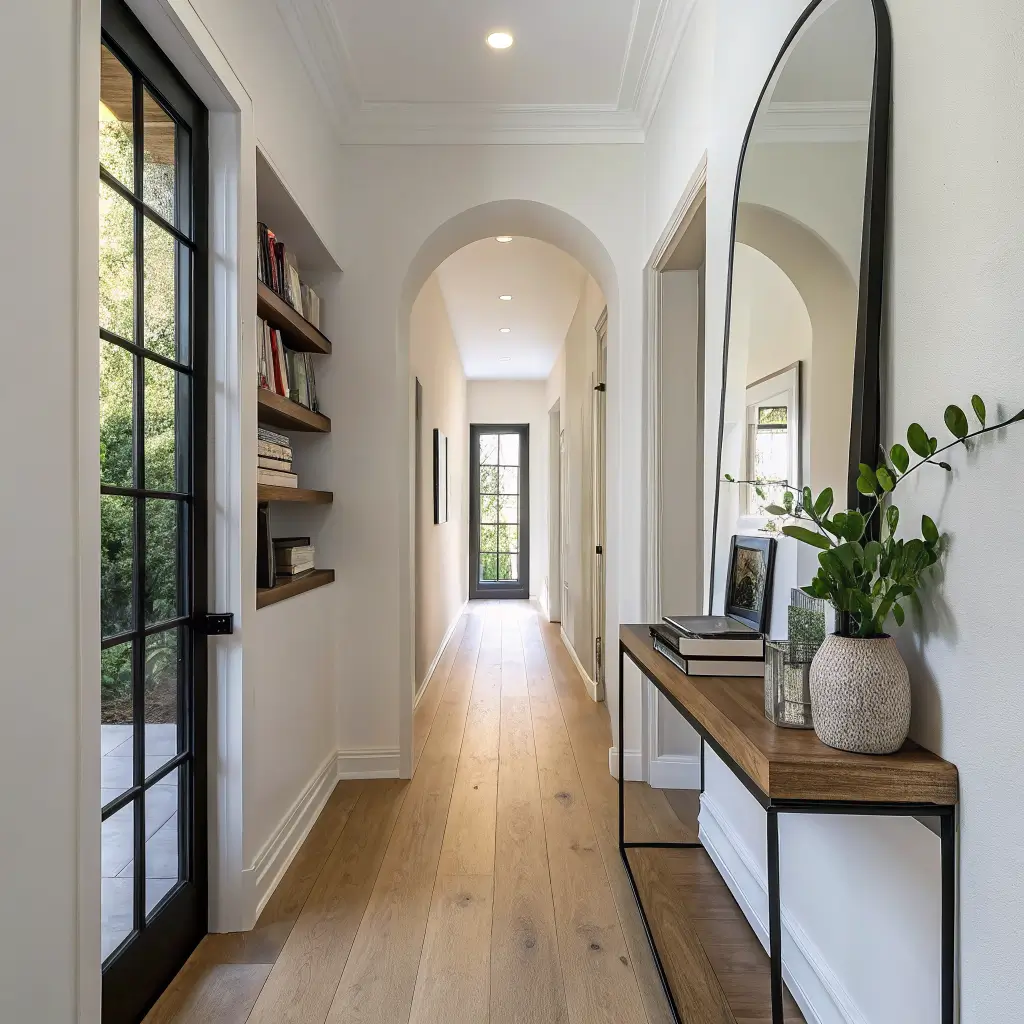
Budget: Where I Spend and Where I Don’t
I’ve done this project on $150 and on $900, and here’s what I learned about where the money actually shows.
Spend on:
– The mirror. A cheap mirror looks cheap from ten feet away. Budget $120–$400 for something 24–36″ with a real frame (arched brass, thick black metal, or a nice wood). This is the piece that makes the space feel finished.
– Lighting. If your entry has one sad boob light on the ceiling, swap it. A small flush mount or mini pendant in the $120–$250 range changes the entire feel.
– The rug, if it’s a high-traffic zone. A washable low-pile runner around $80–$150 will outlast three cheap ones.
Save on:
– Hooks. A set of matte black metal hooks from a hardware store is $15–$40 and looks identical to the $90 designer version once it’s on the wall.
– Baskets. Seagrass baskets are $15–$25 anywhere. Don’t overthink it.
– Console tables. Facebook Marketplace is full of narrow consoles for $40–$100. I found my current one — a 12″-deep walnut piece — for $60 from someone moving.
Rough totals:
– Refresh (hooks, rug, mirror, baskets, tray): $100–$300, one afternoon
– Mini-makeover (add a console or bench and new lighting): $400–$1,200, a weekend
– Built-ins or custom cabinetry: $800–$3,000+
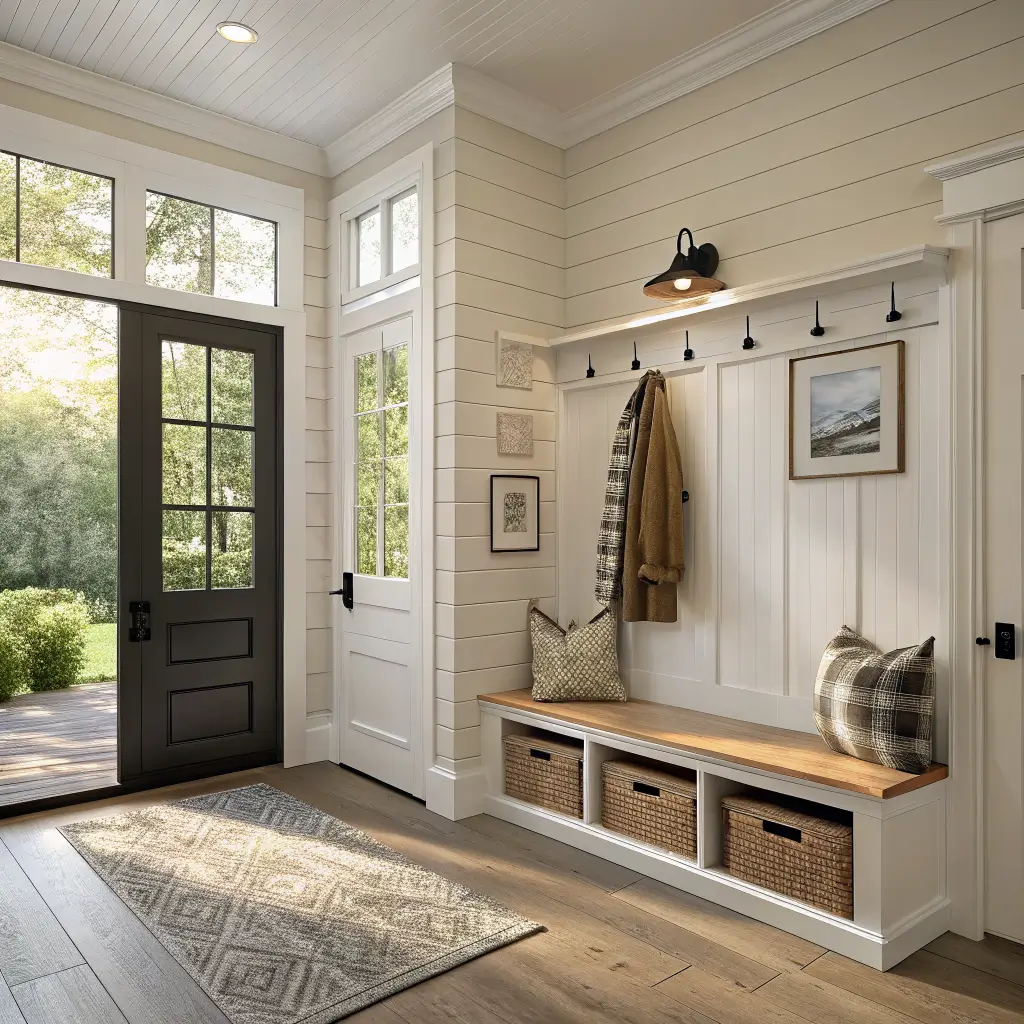
Colors and Materials That Hold Up
Small entries take a beating — dirty shoes, wet umbrellas, backpacks scuffing the wall. I choose materials with that in mind.
Walls: A warm white like Benjamin Moore White Dove or Swiss Coffee keeps things bright without going cold. If your entry gets almost no natural light, warm greige (something in the Accessible Beige family) hides scuffs better than pure white.
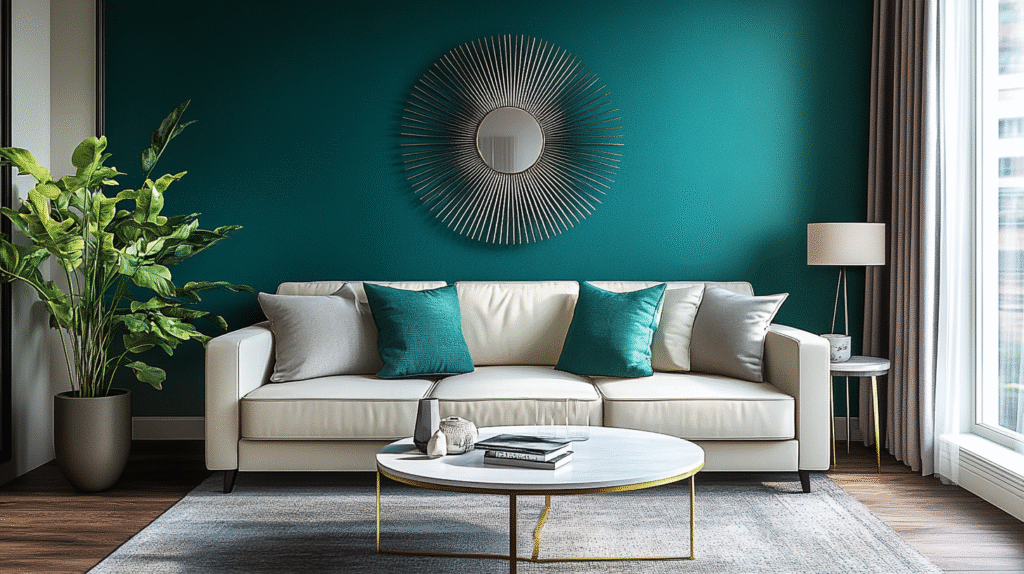
Accent walls that work in small spaces: deep navy, charcoal, or forest green behind the console or bench. Counterintuitive but true — a dark accent wall in a tiny entry reads as intentional and dramatic, not shrinking, as long as you pair it with a big mirror and good lighting.
Materials to combine (pick three, not eight):
– Light wood: oak, ash, or birch for the bench or console
– Black metal: hooks, mirror frame, lamp base
– Natural fiber: jute rug, seagrass baskets
– One soft texture: a linen or bouclé cushion, a wool throw
That’s the whole palette. When I tried to mix walnut, oak, brass, black, chrome, and rattan in one space, it looked like a furniture showroom threw up.
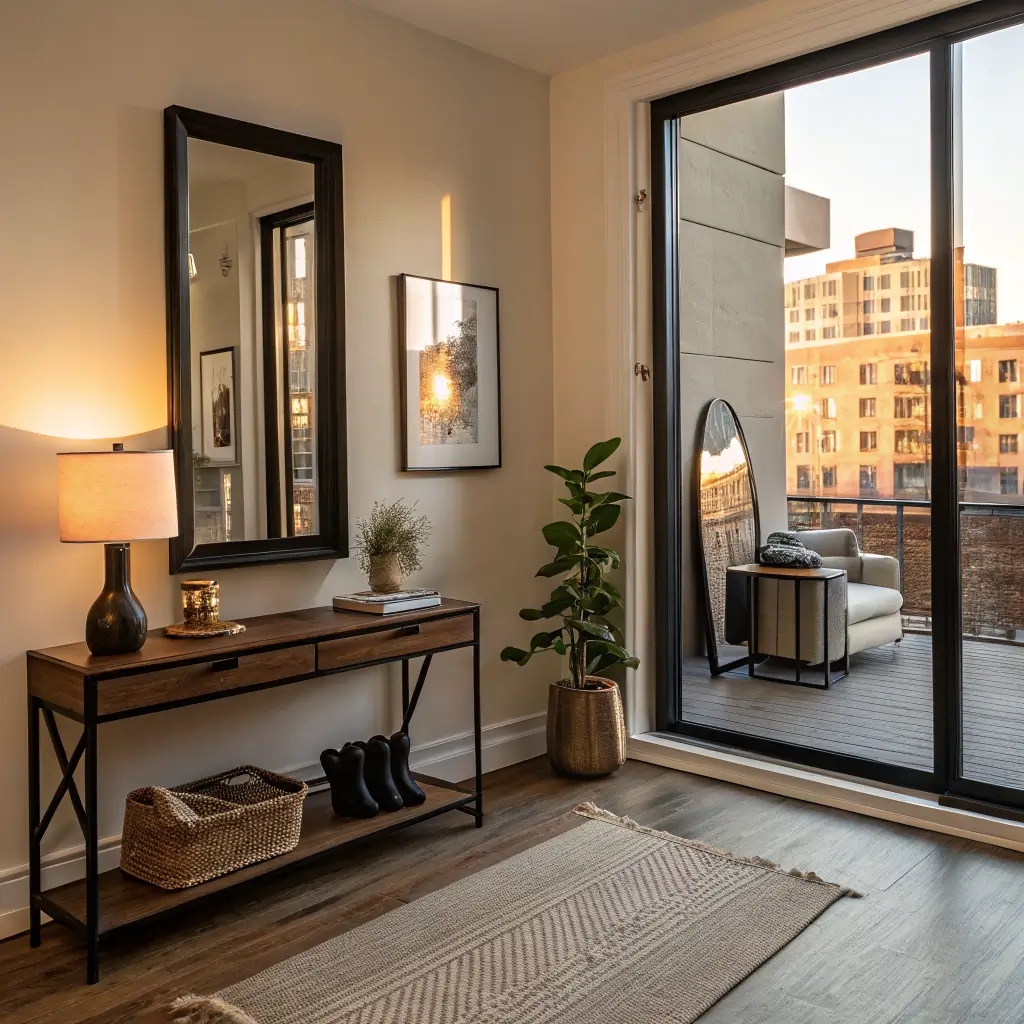
Putting It Together
Here’s the order I install things in, because doing it out of order means drilling extra holes.
1. Solve function first. Hooks and shoe storage go up before anything decorative. If coats and shoes don’t have a home, no amount of styling saves you.
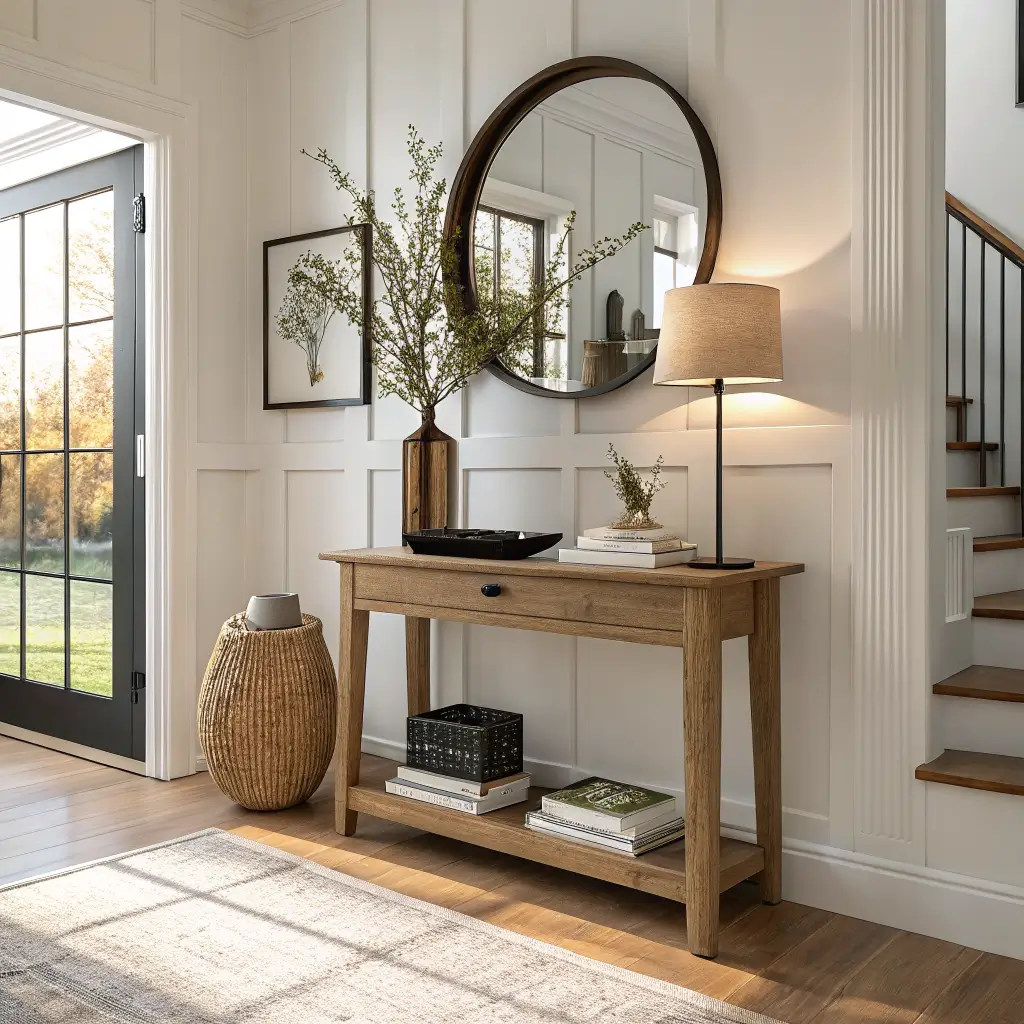
2. Add the surface. Mount a floating shelf at about 48–52″ from the floor, or slide in your console. Top it with a tray, a small stack of two books (not three, not five), and one object — a ceramic vase, a candle, a small sculpture. Stop there.
3. Hang the anchor. Center the mirror above your console or bench. If your entry is opposite a window, this is where you double the light in the room for free. I hung mine across from a west-facing window and the whole hallway went from cave to glowing in the afternoons.
4. Lay the rug. Leave a few inches of floor showing on all sides. A rug that touches every wall makes a small space feel smaller.
5. Add one personal thing. A framed photo, a piece of art that echoes a color from the next room, a plant. One. Not a gallery wall of twelve frames — that’s for bigger walls.
6. Remove something. Step back, look at it, and take away one decorative item. I do this every single time and every single time it looks better.
The Mistakes I See Constantly
Both a bench and a console in a 4-foot-wide entry. Pick one. The other goes to a bedroom or gets sold.
Ignoring the wall above 60 inches. Tall cabinets, a high shelf for baskets, hooks at multiple heights — vertical space is free real estate. A pegboard on the back of the door is a renter’s best friend for hats and bags.
A dozen small accessories. Three tiny frames, four little bowls, two mini plants. It reads as clutter, not styling. One large art piece and one substantial vase always beats six small things.
Dim lighting. The overhead builder-grade fixture plus zero secondary light is why your entry feels like a closet. Add a small lamp on the console, or a cordless puck-style sconce (the rechargeable ones from Amazon around $40 are genuinely good for renters), and the space transforms.
No drop zone. If keys don’t have a specific home within three feet of the door, they end up on the kitchen counter forever. One tray, one hook, one shelf. Done.
Entry that doesn’t match the next room. If your living room is warm and layered and your entry is stark modern, it feels like two different apartments. Pull one color and one material from the adjacent room into the entry — a throw pillow in the same fabric, a wood tone that matches your coffee table.
Renter-Friendly Versions
Every piece of advice above works without a drill:
– Command-strip hooks in matte black hold real coats if you use the right weight rating. I have four holding winter coats through two winters, no wall damage.
– Leaning mirror against the wall instead of hung — a 30″ x 65″ leaner is often cheaper than a hung mirror anyway.
– Peel-and-stick wallpaper on one wall behind the console. I did a small entry in a beadboard-look peel-and-stick and it came off cleanly when I moved out.
– Freestanding shoe cabinet with flip-down fronts (6–11″ deep) — no wall mounting needed and it holds 12–15 pairs.
– Cordless sconces with rechargeable batteries — real light, no electrician.
Seasonal Swaps Without Redoing Everything
Keep the furniture and layout the same year-round. Change these:
– Doormat (rich rust and olive for fall, natural jute for spring/summer)
– Bench pillow cover (linen in summer, bouclé or chunky knit in winter)
– Stems in the vase (branches with buds in spring, eucalyptus in fall, evergreen in December)
– Wreath or a small piece of seasonal art on the wall
That’s the whole rotation. Ten minutes, maybe $30 a season, and the entry never feels stuck.
A Note on the “No Entry” Entry
If your door opens directly into the living room — no walls, no defined foyer — you’re not stuck. You’re just defining the zone yourself. A 2′ x 6′ runner perpendicular to the door, a slim console floating behind the sofa or against the nearest wall, a pendant light overhead, and a tall plant or screen to soften the transition. That combo creates an entry without any actual architecture. My friend’s studio uses exactly this setup in about 20 square feet and it reads as a real foyer the second you walk in.
The whole trick with small entryways is restraint. Fewer pieces, better pieces, one clear job each. Get that right and a 3-by-4 nook works harder than most full-size foyers.