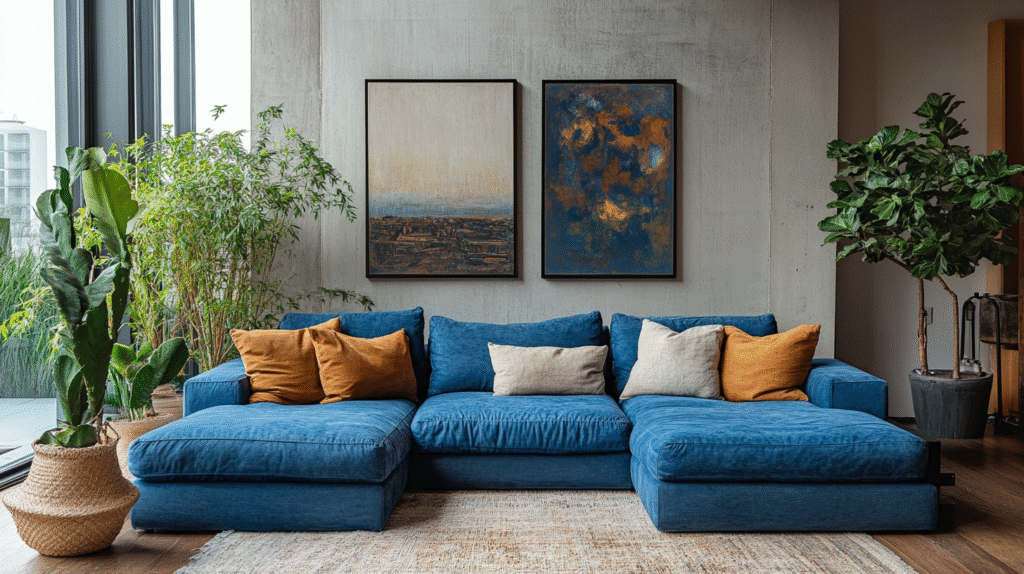
The transitional living room is where traditional and modern actually meet without a fight. I mixed one aged leather chair with a clean-lined sofa and it worked.
Transitional is the blend of traditional silhouettes softened, and modern lines warmed up. Think classic proportions without the carved legs and heavy drapery, and clean-lined pieces without the cold minimalism.
Who it’s for: anyone who wants a room that guests find comfortable and family members actually use. It’s forgiving. It ages well. It doesn’t chase trends.
Where it shines: family rooms, formal living rooms, open-plan great rooms, and anything built around a fireplace. It works in a 10×12 apartment living room and a 20×25 great room — the style leans on furniture choices, not architecture.
Skill level: beginner-friendly. If you can edit and stick to a palette, you can do this.
The Palette: Warm Neutrals, Not Cool Gray
If you take one thing from this article, take this: go warm, not cool. The transitional look right now leans into cream, greige (gray-beige), taupe, warm white, oatmeal, and soft camel. Cool gray-white combos read as modern-cold, not transitional.
My go-to wall color is Benjamin Moore Pale Oak in a matte finish — it reads warm without going yellow. Sherwin-Williams Accessible Beige is another safe pick.
For accents, keep it quiet:
– Sage or olive green
– Dusty or chambray blue
– Muted navy
– Warm brass or brushed nickel (pick one and commit)
– A grounding dark — walnut, black iron, or deep espresso
That last one matters. A room with no dark anchor floats and feels unfinished.
The Core Pieces That Actually Matter
The Sofa
This is the anchor. You want transitional proportions: less ornate than a traditional roll-arm Chesterfield, less severe than a modern slab-sided sectional.
Look for:
– Rolled arms, track arms, or a soft English roll — all of these read transitional
– Neutral upholstery in linen, performance weave, or a low-pile velvet
– Cushions with some give but not sloppy — a bench seat or two-cushion configuration usually looks more elevated than three loose cushions
Budget: expect $800–$1,500 for solid mid-range (Article, Interior Define at the entry price), $2,000–$3,500+ for something you’ll keep 15 years (Crate & Barrel, Room & Board, McGee & Co.).
I have a linen track-arm sofa in oatmeal that I bought four years ago and I’d buy it again tomorrow.
The Rug
Big. Bigger than you think. The front legs of every seating piece should sit on the rug — that’s the rule. An 8×10 is the minimum for most living rooms; 9×12 for anything larger.
Materials that work: wool, wool-jute blends, low-pile performance fiber if you have kids or dogs. Skip anything shag or heavily patterned.
Budget: $150–$400 for washable brands like Ruggable or Tumble, $500–$1,200+ for real wool.
The Coffee Table
The coffee table is where you get to bridge traditional and modern. My favorites:
– A round wood table with a pedestal base (softens a rectangular sofa)
– A stone or travertine oval (adds weight and texture)
– A mixed-material piece — wood top with an iron or brass base
Skip anything too glossy or too rustic-farmhouse. Both push you out of the style.
Accent Chairs
Two chairs, mixed profiles. This is where the “old meets new” gets literal. I have a curvy vintage-inspired wingback in a nubby cream fabric next to a cleaner mid-century walnut chair. They shouldn’t match. That’s the point.
Lighting
One statement piece minimum. A sculptural floor lamp in brass, a black-shaded arc lamp, or a plaster-look pendant over the coffee table if your ceiling allows.
Overhead lighting is not enough. You need three light sources at three heights in every living room — overhead, table, and floor. This single rule fixes more “why does this room feel off” problems than anything else.
Window Treatments
Floor-length linen curtains on a simple rod, hung high and wide. Hang the rod 4–6 inches above the window frame and extend it 8–12 inches past each side. Puddle the curtains slightly or let them just kiss the floor. This one move makes any room look 40% more expensive.
How to Actually Put It Together
Order of operations matters. I’ve rearranged my living room probably five times, and every time I try to shortcut this sequence I regret it.
1. Paint or confirm the wall color first. Warm neutrals only.
2. Lay the rug. It defines the seating footprint.
3. Place the sofa. Anchor to the rug, floating in the room or against the longest wall.
4. Add the coffee table. Roughly 14–18 inches from the sofa. Any farther and it feels awkward to reach.
5. Position accent chairs across from or angled to the sofa, forming a conversation area no wider than 8 feet at the outside.
6. Bring in lighting at three heights.
7. Style the surfaces last — and edit hard.
Texture Does the Heavy Lifting
This is where the gray-Chesterfield mistake taught me the most. In a neutral room, texture is your color. Layer these ruthlessly:
– Bouclé on a chair or pillow
– Linen on curtains and one pillow
– Velvet on a pillow or ottoman
– Wool throw
– Jute or seagrass somewhere — rug, basket, or lampshade
– Cane on a side chair or console
– Stone or ceramic in bowls and vases
– Aged wood on the coffee table or a stool
If everything in your room is smooth, it will read flat no matter how nice the pieces are.
The Mistakes That Kill the Style
– Too many small decor items. Three sculptural objects beat twelve tchotchkes. Edit until it hurts, then edit again.
– Mixing four wood tones and three metals. Pick one dominant wood (I use walnut) and one dominant metal (brushed brass). A second of each is fine as a supporting act.
– Skipping the dark anchor. Without a piece of black iron, dark art, or a walnut table, the room floats.
– Going too formal. Skirted sofas, tufted everything, heavy drapes — that’s traditional, not transitional.
– Going too stark. All-white walls, chrome legs, and one cactus is modern minimalism.
– Undersized rug. The single most common mistake I see. Go bigger.
Where to Spend, Where to Save
Spend on: sofa, rug, one statement light. These get used daily and you’ll see them for a decade.
Save on: pillows, art, vases, side tables, curtains (IKEA Ritva linen curtains are $40 and look great once ironed). HomeGoods and thrift stores are gold for ceramic vases and stone bowls. My favorite object in my living room is a chunky travertine bowl I found at a Goodwill in Ohio for $6.
Seasonal Swaps That Don’t Require a Whole Refresh
You don’t need to redecorate twice a year. Swap the small stuff:
– Spring/summer: linen pillow covers in sage or dusty blue, a lighter cotton throw, fresh eucalyptus or an olive branch in a floor vase
– Fall/winter: wool or mohair throw, rust or deep-olive pillow covers, a stack of vintage books on the coffee table, taller candles
Total cost of a seasonal swap for me runs about $60–$100 if I’m buying new, $0 if I’m rotating what I already own in a bin in the closet.
Quick Answers to the Questions Everyone Asks
Transitional vs. modern: Modern uses harder lines, cooler tones, and less ornamentation. Transitional keeps some softness and warmth.
Transitional vs. traditional: Traditional leans into carved details, symmetry, formal drapery, and layered patterns. Transitional strips a lot of that back.
Can you mix mid-century modern in? Yes, and it’s one of the best pairings. A walnut mid-century chair or credenza reads perfectly at home in a transitional room.
Best sofa for a small transitional living room: A track-arm apartment sofa (72–80 inches) in a light neutral, with legs visible underneath so the room feels less heavy.
Best colors for a transitional living room: Warm whites, greige, taupe, cream, oatmeal, with accents of sage, chambray blue, or muted navy.
Get the sofa, rug, and lighting right, keep the palette warm, and edit the accessories down to what you actually love. The rest fills in on its own.