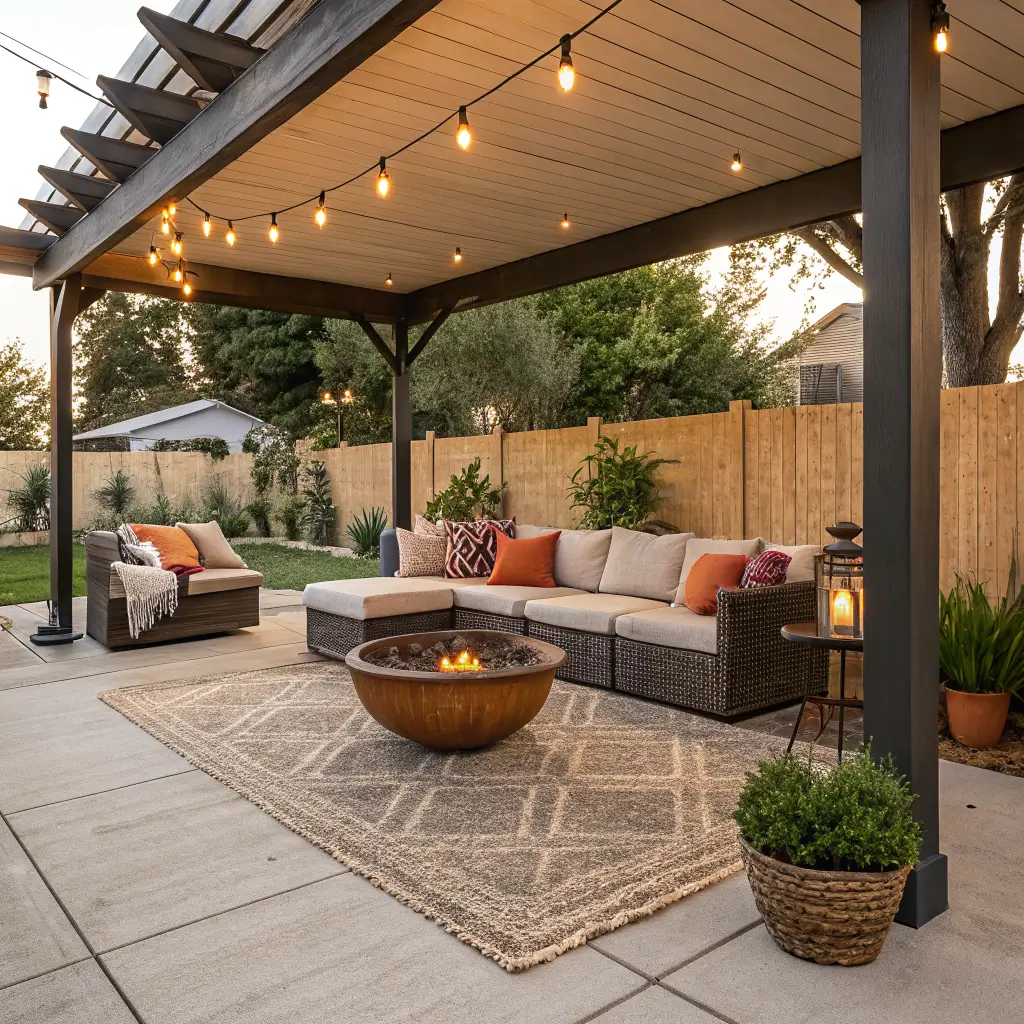
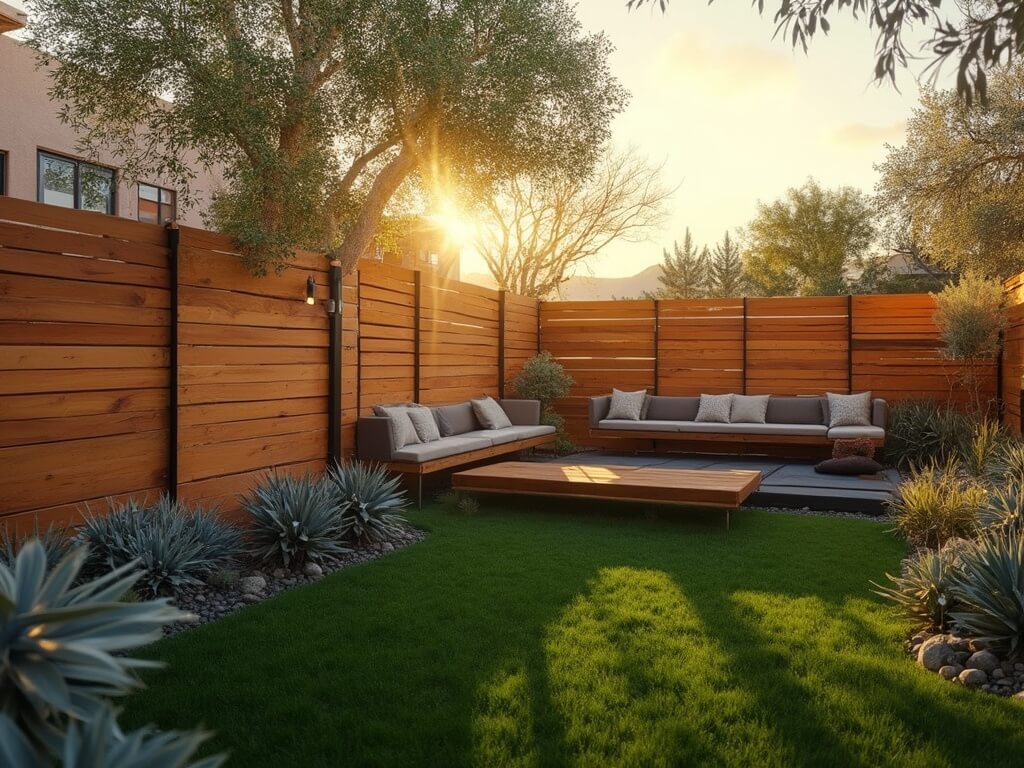
The outdoor patio decor was the project I kept putting off until one warm night. A string of bulbs and a real chair made the slab feel like a room.
The style I keep coming back to is what I’d call cozy outdoor living — a mash-up of modern farmhouse, a little boho, and enough natural texture (wood, rattan, stone, terracotta) to keep it from looking like a showroom. It works for renters, homeowners, small balconies, and sprawling backyards. The ingredients scale; the logic doesn’t change.
If you want to relax, host a few people for dinner, and stay outside past sunset without freezing or squinting, this is the setup.
Time and money, honestly:
– Quick refresh (rug, pillows, lights, a few plants): 2–4 hours, roughly $100–$500
– Full styled patio with furniture: a weekend or two, $500–$2,500
– Adding a pergola, fire feature, or built-ins: multiple weekends, $2,500 and up
Skill level runs from beginner (everything in the refresh column) to intermediate if you’re painting concrete or building a vertical garden.
The Pieces That Actually Do the Work
Skip anything that isn’t on this list until these are handled.
Outdoor rug. This is the single biggest visual upgrade and it’s usually the piece people size wrong. Go bigger than feels right. For a small patio with a loveseat and two chairs, use 5×8. For a standard sectional or a 6-seat dining table, 8×10. For anything larger or when you’re combining dining and lounge, 9×12. The front legs of every piece of furniture should sit on the rug — that’s the rule that makes a space feel anchored instead of floating.
I bought a 5×7 for my patio first. Sent it back. The 8×10 fixed everything.
Seating built for the way you actually use the space. Decide first: is this a dining patio, a lounge patio, or both? A 4-person bistro set and a small sectional are usually mutually exclusive on anything under 200 square feet. Pick the one you’ll use twice a week, not the one you’ll use twice a year.
Cushions and pillows in real outdoor fabric. Sunbrella or a similar solution-dyed acrylic. I learned this the annoying way — a set of “outdoor” pillows from a big-box store turned into gray, mildewed bricks after one rainy week. Cheap outdoor fabric is not outdoor fabric.
Layered lighting. One source is not enough. Aim for three:
– Overhead: string lights (Edison-style bulbs on black cord look best against most fences and pergolas)
– Mid-level: a lantern on the table or a pair on the ground
– Low: flameless candles, a fire bowl, or a small solar path light
Hang string lights at least 8–9 feet up and pull them taut with guy wire if you’re spanning more than 15 feet. Sagging droop reads sad.
Plants at three different heights. Ground level (a big terracotta pot of rosemary or a fiddle-leaf fig if you’re covered), waist level (a plant stand or a bench with clustered smaller pots), and eye level or higher (hanging basket, wall-mounted planter, or a tall olive tree in a 20-inch pot). Same species repeated in different sizes looks more intentional than a random collection.
Shade. A 9-foot cantilever umbrella runs about $150–$400 and moves with the sun. A pergola is a bigger commitment but changes the room. Even a $30 shade sail beats squinting through July.
A focal point. Fire pit, pergola, a wall of climbing jasmine, an oversized planter grouping — pick one. My rusted fire bowl does this job. Everything else in the space defers to it.
How to Put It Together
Order matters. Do it out of order and you’ll be moving furniture around a rug that’s the wrong size.
1. Clean the slab. Sweep, hose it down, scrub the furniture you’re keeping. This alone makes half the difference.
2. Measure. Sketch the footprint. Mark where the sun hits at 5 p.m.
3. Lay the rug first. Everything else responds to it.
4. Place the largest piece of furniture — sofa, dining table, whatever anchors the zone.
5. Add shade before you buy accessories. It changes what colors look like out there.
6. Hang lighting.
7. Bring in plants at varied heights.
8. Finish with small stuff: a tray on the coffee table, a lantern, a stack of books that can handle a little dew.
If your patio is big enough for two zones — dining and lounging — separate them with a second rug or with the way the furniture faces. Two chairs turned toward each other across a small side table reads as “conversation.” Two chairs facing the yard reads as “sunset.”
Color and Texture Without Overthinking It
Pick a base and two accents. That’s it.
– Base: cream, sand, taupe, charcoal, or black
– Accent 1: something warm — terracotta, rust, mustard
– Accent 2: something natural — sage, olive, deep navy
Repeat those colors across pillows, planters, and tabletop pieces. Mix textures aggressively: woven (rattan, jute, wicker), smooth (ceramic, glass, powder-coated metal), and soft (linen-look outdoor fabric, chunky throws for cooler nights). A patio that’s all one material — all teak, all black metal — reads flat outside in a way it wouldn’t indoors, because you don’t have walls doing visual work.
Where to Spend, Where to Save
Spend on:
– Furniture frames (aluminum, teak, or powder-coated steel — plastic wicker over cheap steel rusts through in two seasons)
– Cushions with real outdoor fabric
– One good umbrella or shade structure
Save on:
– Rugs (polypropylene outdoor rugs at $80–$150 look great and hose off)
– String lights (a $25 set from a hardware store is fine; expensive designer sets aren’t obviously better)
– Planters (mix one nice big terracotta or concrete pot with cheaper ones; nobody’s inspecting)
– Tabletop decor (thrift and estate sales — my favorite lantern was $6)
Mistakes I See Constantly
– Furniture that’s too big. A full sectional on a 10×10 patio suffocates it. Measure, then leave at least 30–36 inches of walk-through space around the seating.
– One lonely light source. A single overhead bulb is worse than no light. Layer or don’t bother.
– Indoor pillows outside. They’ll be moldy in a month.
– All plants at ground level. Add height. Every time.
– Trying to combine boho, coastal, farmhouse, and modern on one 200-square-foot slab. Pick two influences, max.
– Skipping the rug because “it’s outside.” The rug is what makes it a room.
Privacy Without Building a Fence
A few things that work if you’re overlooked by a neighbor or a second-story window:
– Outdoor curtain panels on a tension rod or a simple wood frame
– A row of tall grasses (miscanthus, feather reed) in identical planters
– A freestanding trellis with climbing jasmine, clematis, or a fast-growing annual like morning glory
– A bamboo screen zip-tied to an existing railing (renter move, and it works)
Seasonal Swaps That Don’t Cost Much
The bones stay the same. The accents change.
– Spring: swap pillow covers to lighter colors, add a bowl of lemons or a jar of tulips on the table.
– Summer: citronella in decorative pots, a pitcher of something on a tray, brighter throw draped over the sofa arm.
– Fall: darker pillow covers, a wool throw, a fire feature if you didn’t have one, pumpkins if you’re into it.
– Winter (mild climates): pared-back styling, a portable heater, evergreens in the planters, more candles.
Pillow covers alone — not full pillows, just the covers — will change the whole feel of the space for under $60.
Fast Answers to the Things People Actually Ask
What size rug for a patio? 8×10 for most standard setups. Go up to 9×12 if you’re combining zones. Front legs of furniture on the rug.
How do I make a small patio feel bigger? Compact or folding furniture, one large rug (not two small ones), vertical plants instead of ground-level ones, a mirror mounted on the fence, and lighter cushion colors.
Best lighting for evenings? Warm-white string lights overhead (2700K, not the blue-white kind), plus one lantern or candle at table height. That’s the whole formula.
Cozy patio in a weekend on a budget? Rug, string lights, three plants of different heights, two throws, and one good pillow arrangement. Under $300 if you shop carefully.
Best patio plants? Rosemary, lavender, olive tree, boxwood, ornamental grasses, geraniums, and a fiddle-leaf if you’re covered and warm. Herbs in terracotta pots do double duty and smell incredible when you brush past them.
The patio I have now is nothing fancy. Concrete slab, secondhand sectional, a rug that’s on its third summer, plants I’ve killed and replaced twice. What makes it work is that every piece is doing a job — anchoring, softening, lighting, or drawing the eye up. Start there and you can skip most of the trend-chasing.
Outdoor Patio Decor Ideas That Actually Make You Want to Sit Outside
Good outdoor patio decor is the difference between a slab of concrete you walk past and a spot you drag your coffee to at 7 a.m. Most patios fail for the same reasons: the furniture is the wrong scale, there’s no shade, the lighting stops at a single porch bulb, and every plant is sitting at the same height on the ground. Fix those four things and the rest is just styling.
I’ve rearranged my own 12×14 back patio probably five times over three summers. What I have now — a jute-look outdoor rug, a low sectional, a rusted fire bowl I bought off Facebook Marketplace for $40, and two strings of Edison bulbs zigzagged to the fence — is the version I finally stopped fiddling with. Here’s how I’d build it again from scratch, and what I’d skip.