The Minimalist Bathroom: A Real Guide to Getting the Calm, Uncluttered Look
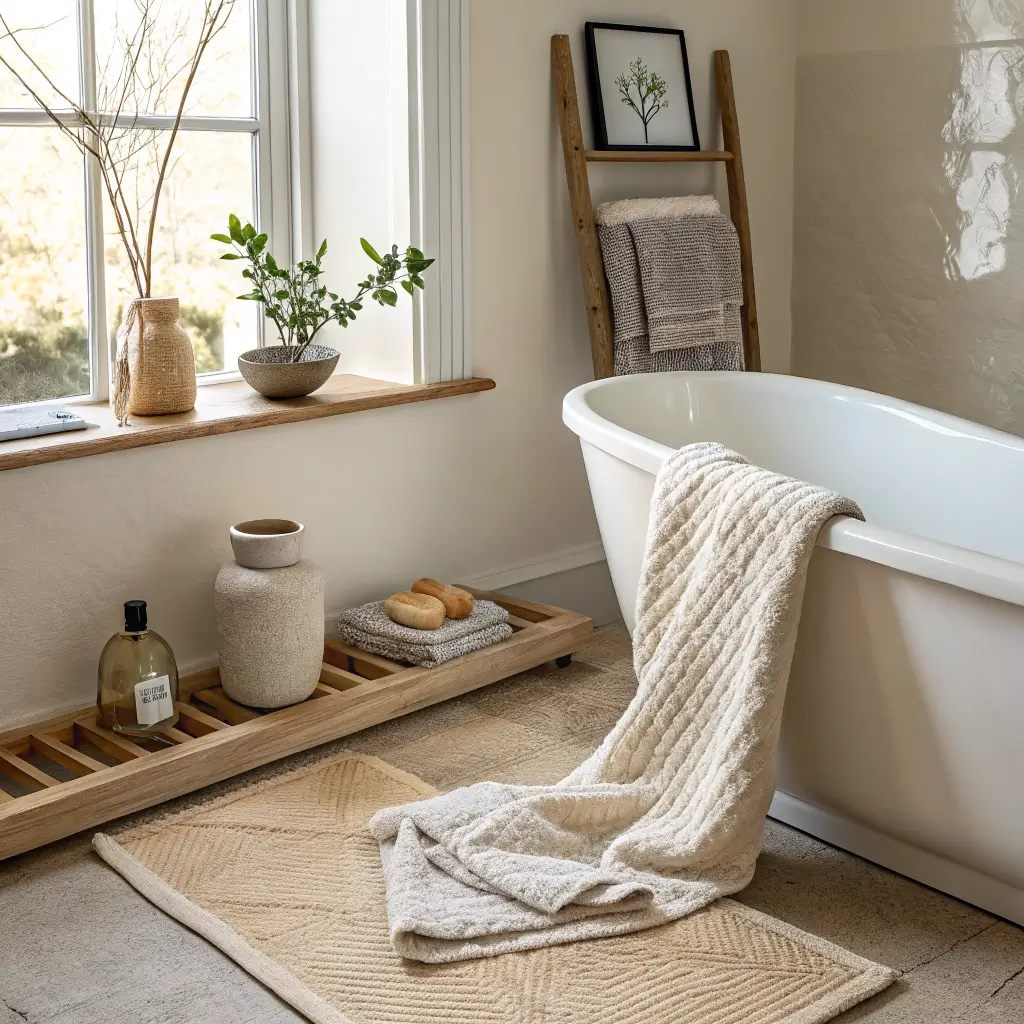
The minimalistic bathroom I redid started with taking everything off the wall. One tray and a mat in the right tone made it feel done, not empty.
Your bathroom feels chaotic and you can’t figure out why — it’s clean, but every surface has three half-used bottles, the towels don’t match, and the whole room reads busy instead of calm. That’s the minimalist bathroom problem in a sentence, and the fix isn’t a full renovation. It’s editing, better storage, and a handful of deliberate choices about materials and light.
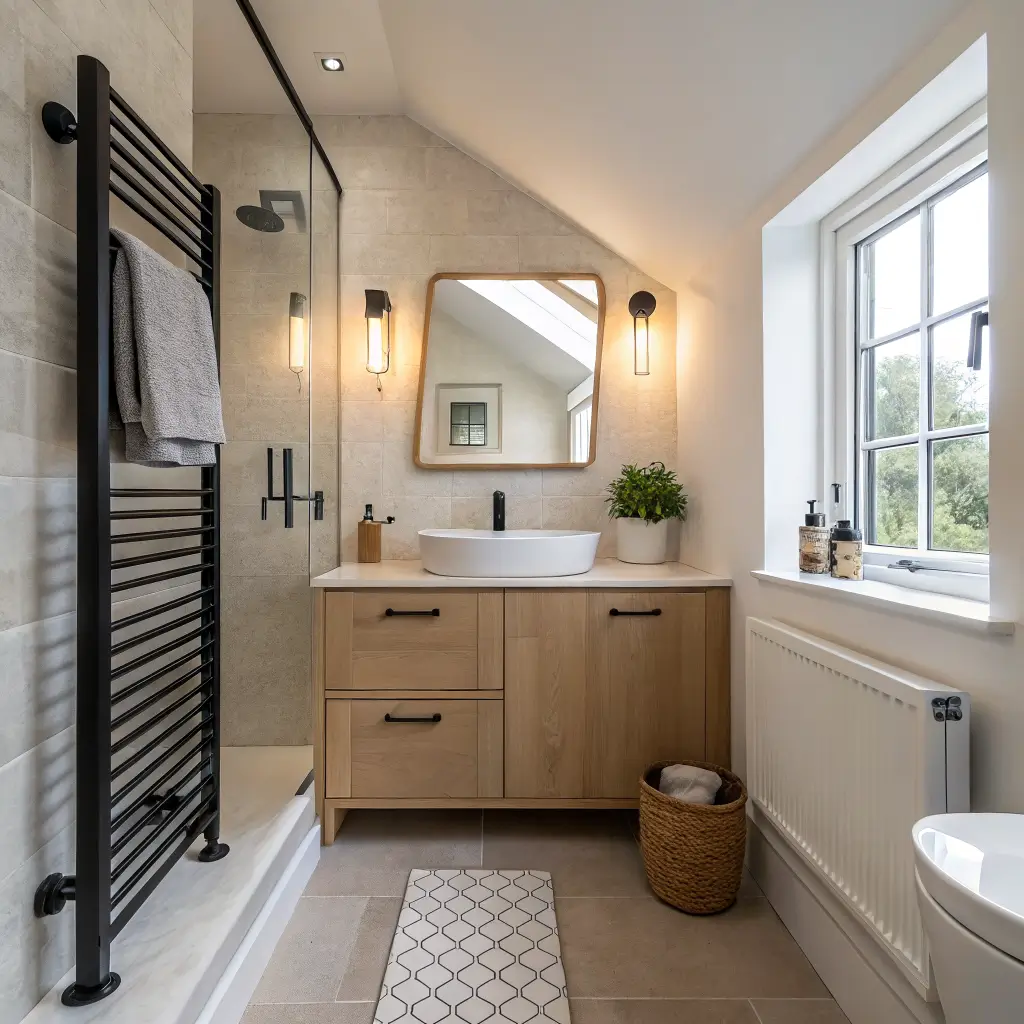
I’ve been through this in two apartments and a house. The first time I “minimized” a bathroom, I ripped out everything and ended up with a cold, echoey box that felt like a dentist’s office. The second time I got it right: warm whites, one oak shelf, black hardware, and enough hidden storage that the counter actually stays clear. Here’s what I learned.
What This Style Actually Is (And Who It’s For)
Minimalism in a bathroom isn’t emptiness. It’s fewer things, better things, and a place for everything you keep. The look pulls from three overlapping traditions:
– Modern/contemporary — clean lines, simple geometry, low-profile hardware
– Scandinavian — light wood, soft neutrals, functional storage baked in
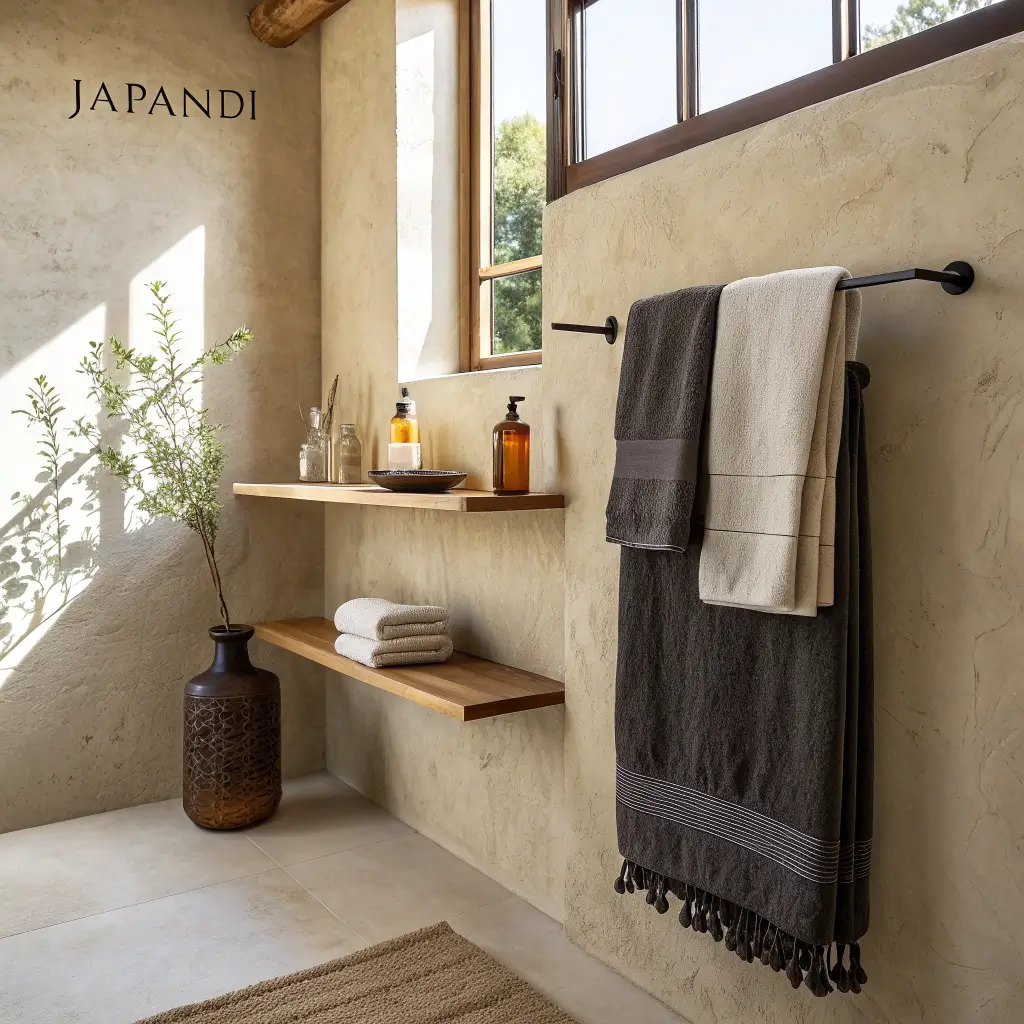
– Japandi — the warmer, more organic cousin, leaning on natural materials and tonal palettes
If you like calm rooms, hate visual noise, or live in a small apartment where the bathroom needs to feel bigger than it is — this style earns its keep. It also suits anyone trying to buy less stuff, since the whole system falls apart the moment you start hoarding product.
Where it works: tiny city bathrooms (25–40 sq ft), standard full baths, ensuites aiming for a hotel feel, and even family bathrooms — as long as storage is serious.
Time, Money, and Skill: What You’re Actually Signing Up For
A weekend refresh (declutter, textiles, storage bins, maybe a new mirror): 4–8 hours, $300–$1,000.
A light remodel (paint, hardware, lighting, mirror swap): 1–3 days, mostly DIY-friendly.
A full remodel (tile, vanity, walk-in shower, fixtures): 1–3 weeks, $8,000–$25,000+ depending on size and finishes.
Real price points I’ve paid or priced recently:
– Matte black faucet set: $100–$400 per sink
– Round frameless mirror, 30″: $80–$300
– Linear vanity light bar: $80–$250
– Ready-made floating vanity: $400–$1,500 (custom pushes $1,500–$4,000+)
– Frameless glass walk-in enclosure installed: $900–$2,500
– Large-format porcelain tile: $3–$12/sq ft before install
– Wall-hung toilet: $400–$1,200 plus install
Skill honesty: decluttering and textile swaps are beginner. Painting, swapping a faucet or mirror is intermediate. Tiling, plumbing changes, glass enclosures, wall-hung toilets — hire a pro. I’ve done my own paint and hardware. I have never once regretted paying someone else to tile.
The Palette: Pick a Temperature and Stick to It
The biggest mistake I see in minimalist bathrooms is mixing warm and cool neutrals in the same room. A bright white towel next to a warm beige tile next to a cool gray floor — it reads muddled, not minimal.
Pick one temperature family and commit.
Warm route: off-white or warm white walls, sand or greige floors, light oak accents, brushed brass or matte black hardware. This is the Japandi lane and it’s what I’d choose nine times out of ten.
Cool route: soft white walls, light gray large-format tile, brushed nickel or chrome, small doses of charcoal.
Then use tonal contrast — light walls, slightly darker floor — instead of high-contrast opposites. And test paint samples in your actual bathroom light. Neutrals have undertones (pink, green, yellow) that only show up under your specific bulbs, and they can wreck the whole scheme.
Rule of thumb I follow: two to three hues max, one primary metal finish, one optional secondary accent metal. That’s it.
The Hero Pieces
You need three or four items to carry the room. Everything else is supporting cast.
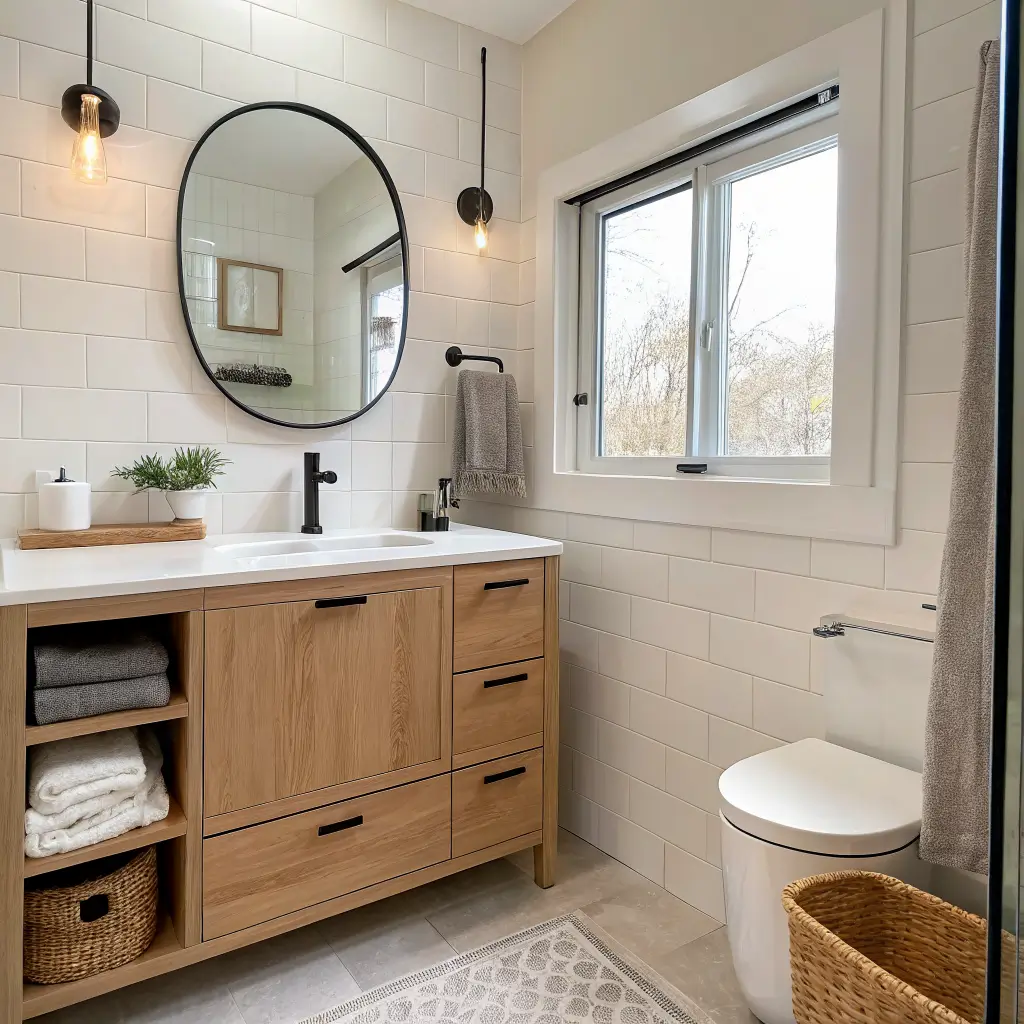
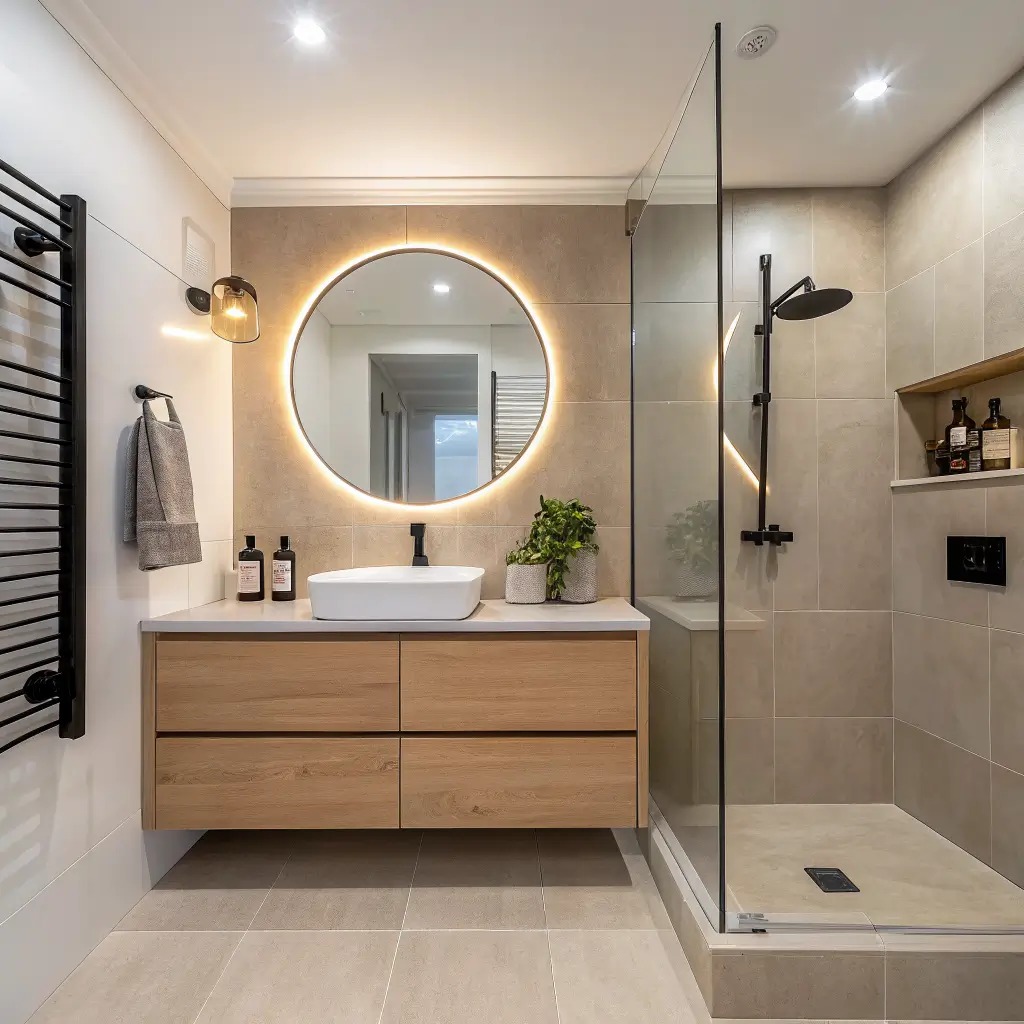
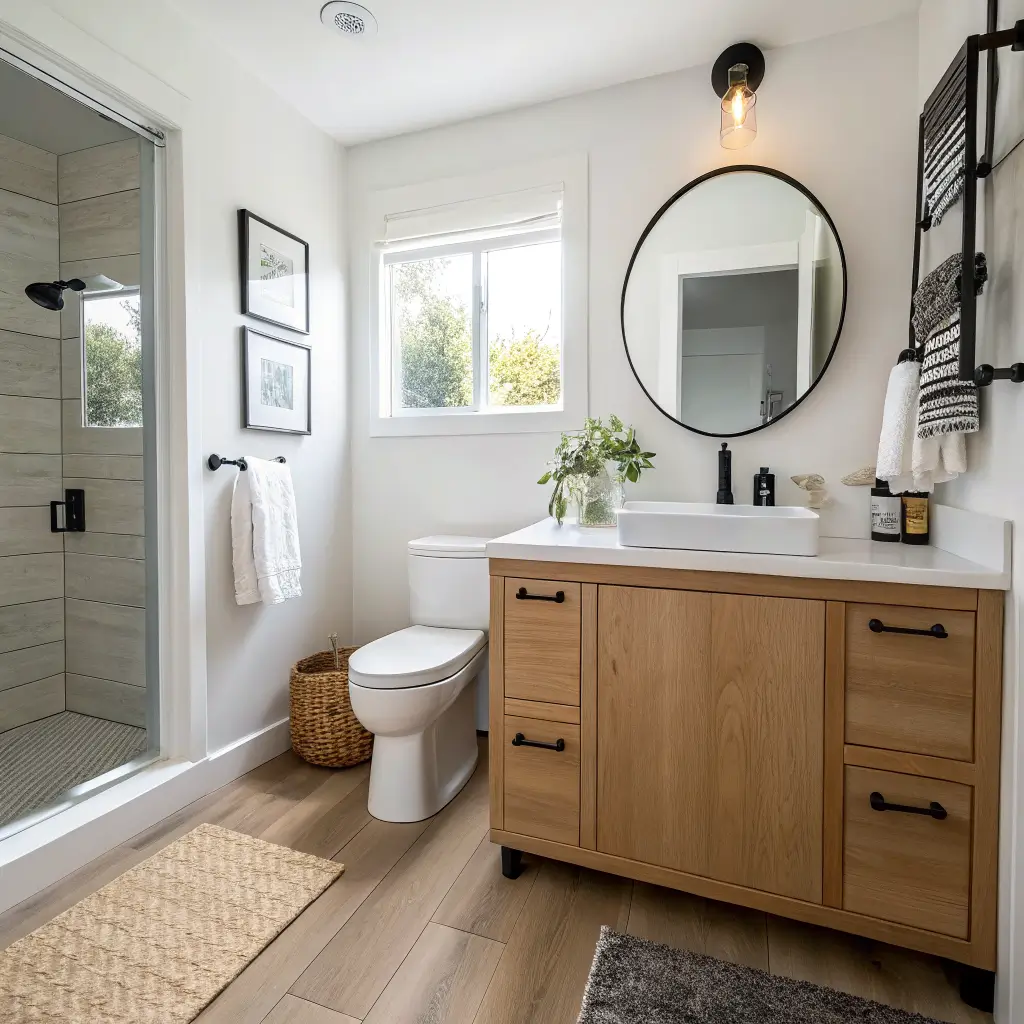
Floating vanity. Getting the cabinet off the floor makes a small bathroom read visibly bigger — I swapped a chunky freestanding vanity for a 36″ wall-hung oak one in my last place and it added what felt like a foot of floor space. Standard widths: 24″, 30″, 36″, 48″. Depth usually 18″–21″.
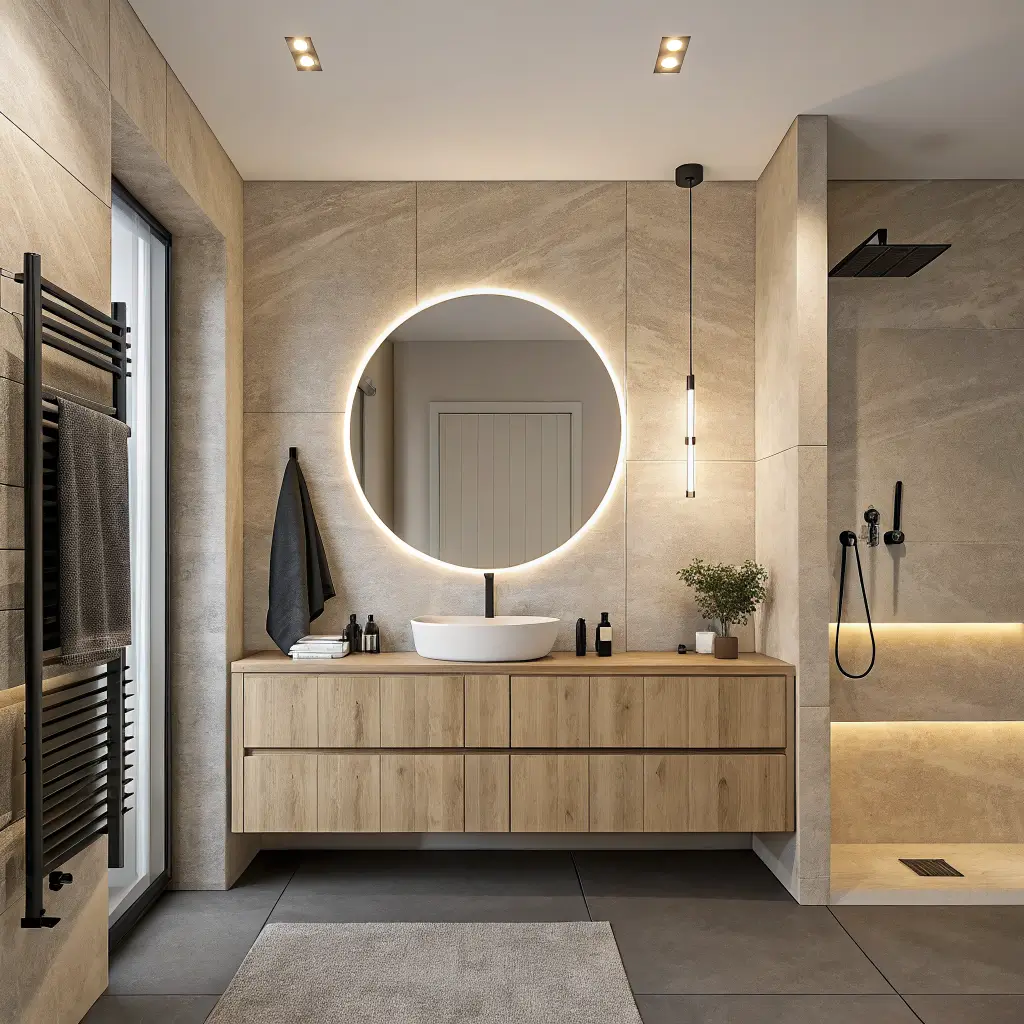
A single, clean mirror. Round or pill-shaped in the 24″–36″ range if you have one sink. Frameless, or a thin matte black frame. Backlit LED versions are worth the extra $100–$200 if you can swing it — the ambient glow at night is the closest thing to a spa moment you’ll get from one purchase.
Frameless glass shower. If you’re renovating, skip the framed enclosure and the shower curtain both. Uninterrupted sightlines are the single biggest visual upgrade in a small bath. If you can’t do glass, a plain white or stone-colored linen curtain is fine — no patterns.
One statement: tub, feature tile wall, or vanity. Pick one. Not all three.
Lighting: The Thing Most People Get Wrong
Warm white light. Non-negotiable. Look for bulbs labeled 2700K–3000K. Cool 4000K+ bulbs are why your bathroom feels like a hospital.
A slim linear vanity bar above the mirror, or two small sconces flanking it at roughly eye level (around 60″–66″ off the floor), plus a few recessed ceiling spots with trim that blends into the ceiling color. That’s plenty.
Bonus move: aim one of the recessed lights so it grazes a textured wall — plaster, ribbed tile, tadelakt. Lighting texture is more interesting than adding another decorative object.
Storage: The Whole Thing Depends on This
Minimalism without adequate storage becomes a game of shuffling clutter around. Before you buy a single accessory, solve storage.
– Recessed shower niche instead of hanging caddies. Retrofit if you can; build it into the tile if you’re renovating.
– Medicine cabinet with a flat mirrored front — hides daily essentials without adding a second mirror to the room.
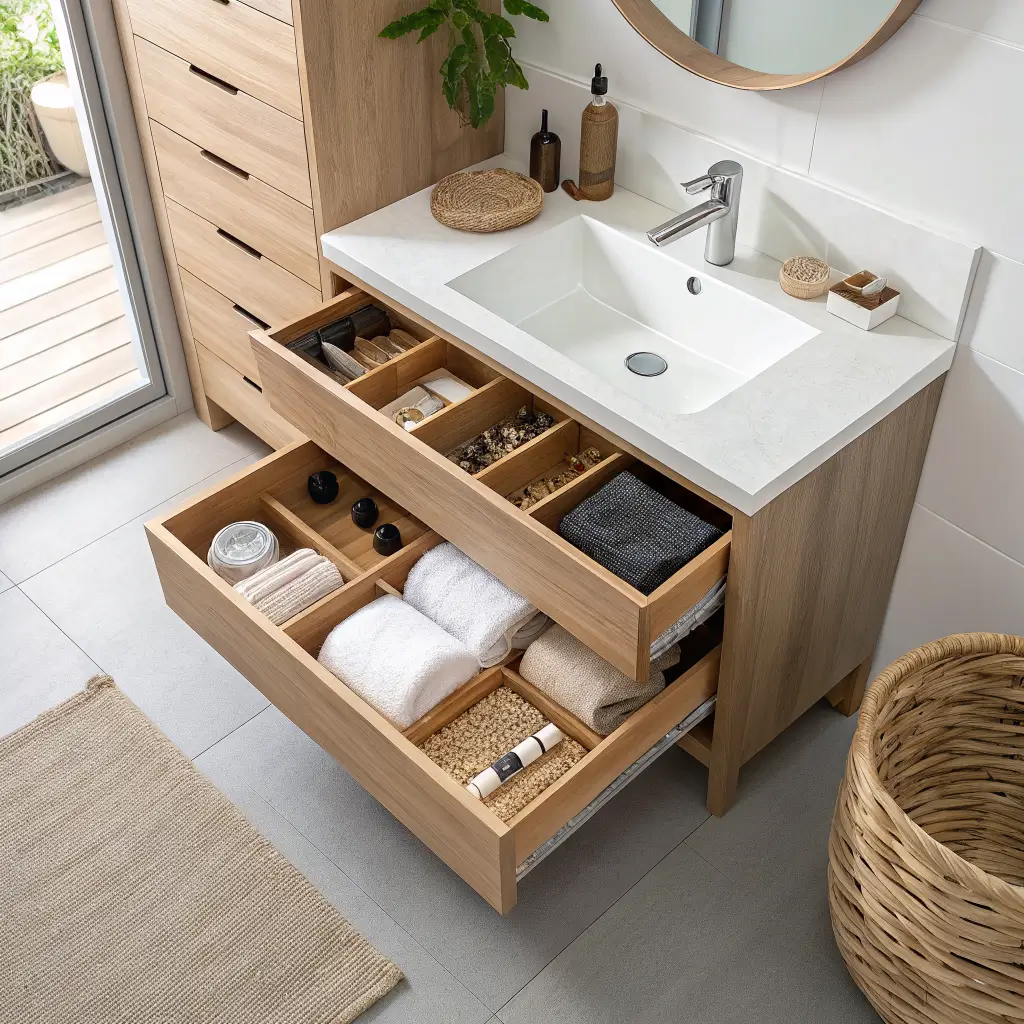
– Under-vanity drawers organized with cheap bamboo dividers. I use three in my main drawer: daily, weekly, backup.
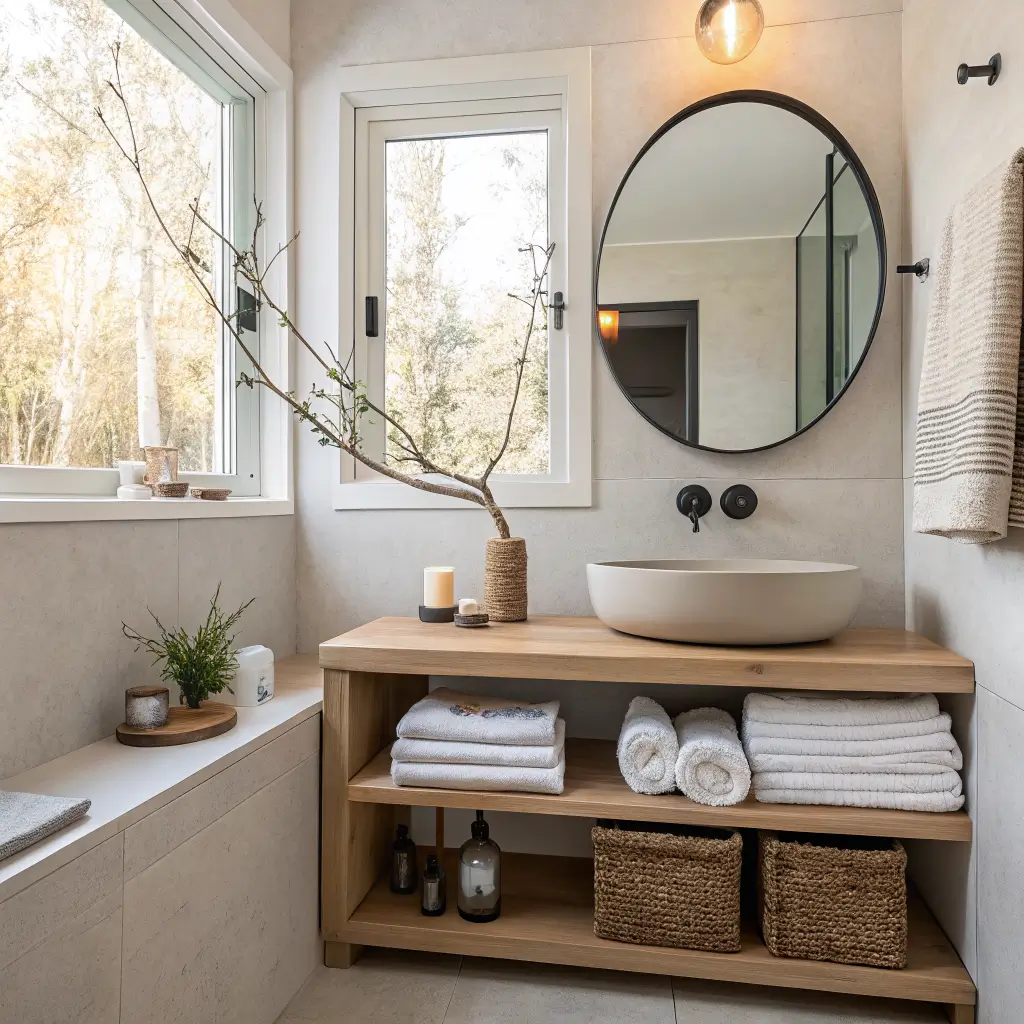
– One open shelf, maximum two. In the same material as the wall or vanity for visual continuity.
– Two lidded woven baskets for toilet paper and laundry.
Then the rule that keeps it working: only what you use daily stays visible. Backups live in a drawer or a labeled bin under the sink. Everything else — old sunscreen, hotel shampoos, the eyeshadow you bought in 2021 — leaves the building.
Textiles and Accessories: Where People Overshoot
Two bath towels, two hand towels, one bath mat, all in the same tonal family. That’s the whole textile budget for a minimalist bathroom. Waffle weave or looped cotton for the mat — the texture does the work, so you don’t need a pattern.
For accessories:
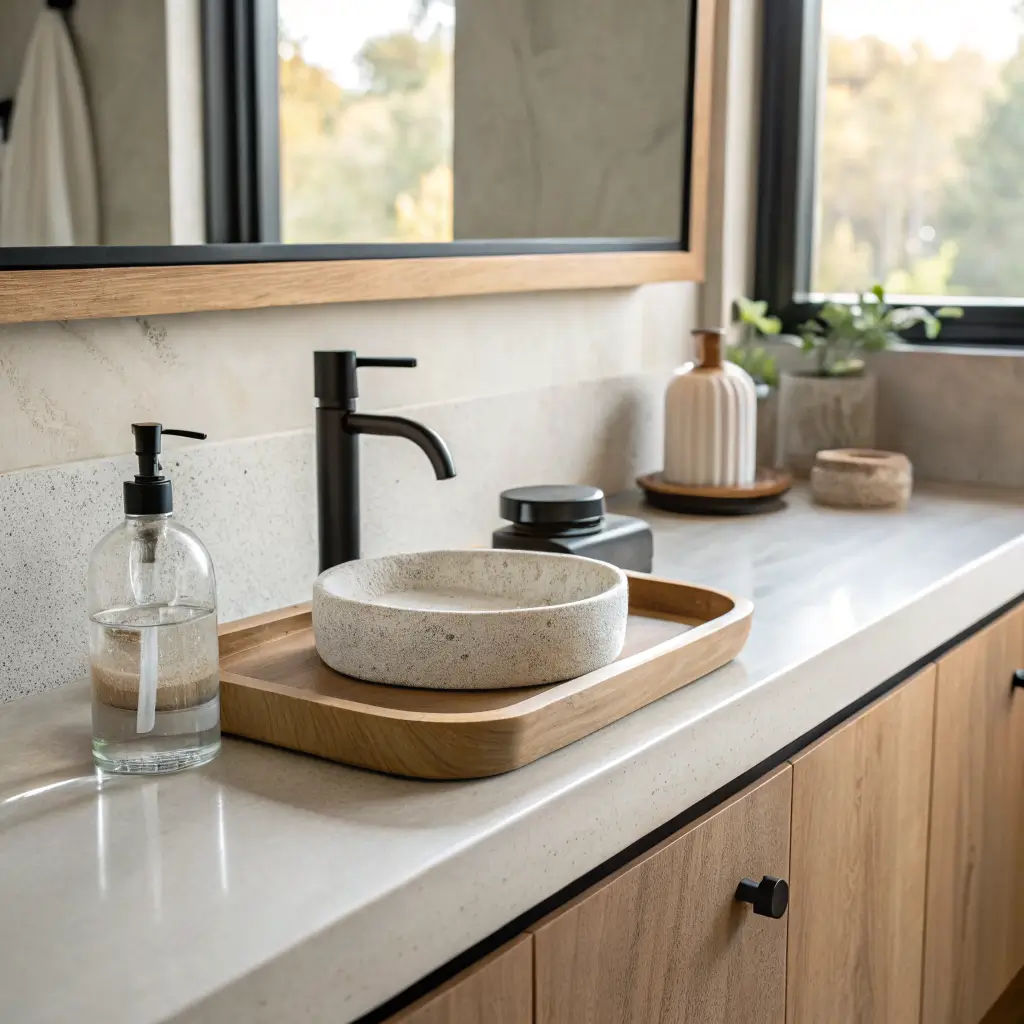
– Refillable soap dispensers in matching glass or ceramic. Label-free. This one swap does more visual work than almost anything else I’ve tried — no more Method bottles and CVS-brand hand soap arguing on the counter.
– One decorative object. A small ceramic vase, a single framed line drawing, a stoneware dish for rings. Not a gallery wall. Not three candles in different sizes.
– One plant. A pothos on a shelf, a ZZ plant in a corner, or a single eucalyptus branch in a simple vase if you don’t get real light. My bathroom has one north-facing window and a pothos that’s been alive for four years — that’s the whole “greenery” plan.
– Slim waste bin in a color that matches the wall or floor so it disappears.
Counter rule: no more than 3–6 visible items total. Count them. It’s usually double what you think.
Putting It Together, In Order
If you’re doing a full refresh, work in this sequence. Skipping ahead is why bathrooms end up feeling half-done.
1. Empty everything. Counters, shelves, medicine cabinet, shower ledges. Group like with like on the bedroom floor. Toss expired and duplicate. Relocate non-bathroom stuff (vitamins, most makeup) to another room.
2. Paint or confirm wall color. Test undertones under your actual lighting for at least 24 hours.
3. Install the functional core. Vanity, mirror, lighting, hardware — all in coordinated finishes.
4. Solve storage. Cabinet organizers, niche, baskets. Give every remaining item a home.
5. Add textiles. Towels and mat in your palette.
6. Place accessories. Soap dispenser, toothbrush holder, one decorative piece. Stop.
Then walk out, walk back in through the doorway, and look at what you see first. That’s your focal point. If your eye lands on a wastebasket or a cluster of bottles, keep editing.
Mistakes I’ve Made So You Don’t Have To
Treating minimalism as emptiness. My first attempt had a white vanity, white walls, white towels, and nothing else. It felt like an unfinished Airbnb. Fix: fewer items, but the items you keep need presence — a real mirror, a real light, good textiles.
Mixing four metal finishes. Chrome faucet, brushed nickel towel bar, matte black hooks, brass drawer pulls. I did this. It looked accidental. Commit to one primary metal.
Underestimating storage. I once installed beautiful open oak shelves and within two weeks they held twelve bottles of half-empty product. Hidden storage first, open shelves as a garnish.
All-white everything with no texture. The room needs something tactile to keep it from feeling clinical — a plaster wall, a wood vanity, a stone soap dish, a waffle-weave mat. Pick at least two texture moments.
Small Seasonal Shifts Without Breaking the Look
The point of a minimalist bathroom is that it doesn’t need decorating. But if you like a small seasonal shift:
– Swap towels between crisper white (summer) and warmer oat or clay (winter) — still within your palette
– Rotate a candle or diffuser: cedar or sandalwood in cold months, bergamot or eucalyptus in warm ones
– Change out the single stem or branch — eucalyptus, olive, cherry blossom in spring, bare birch in winter
That’s it. Don’t add pumpkins.
Keeping It This Way
The monthly reset is what makes the whole system sustainable. Once a month, roughly fifteen minutes: clear the counters completely, wipe everything down, put things back only if they earned their spot, toss anything expired or unused. New arrivals get audited against the palette before they stay.
The habit under all of this is small: every item in the bathroom has a home, and surfaces stay mostly clear by default. Once that becomes automatic, the room maintains itself. That’s the actual point of a minimalist bathroom — not the aesthetic, but the fact that you stop thinking about it.