Moody Bedroom Ideas for Awkward Spaces: How to Make Sloped Ceilings, Alcoves, and Off-Center Windows Work in Your Favor
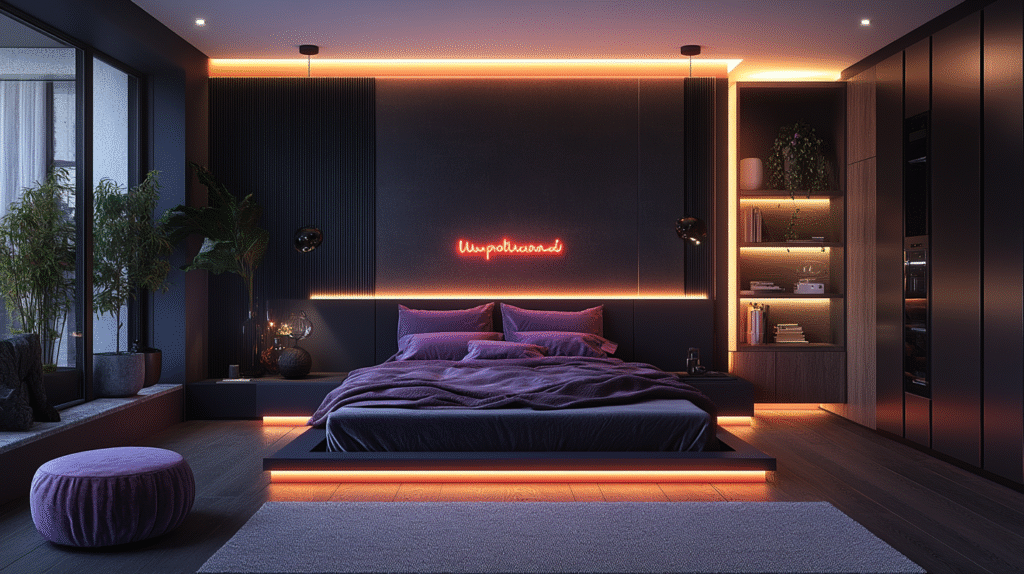
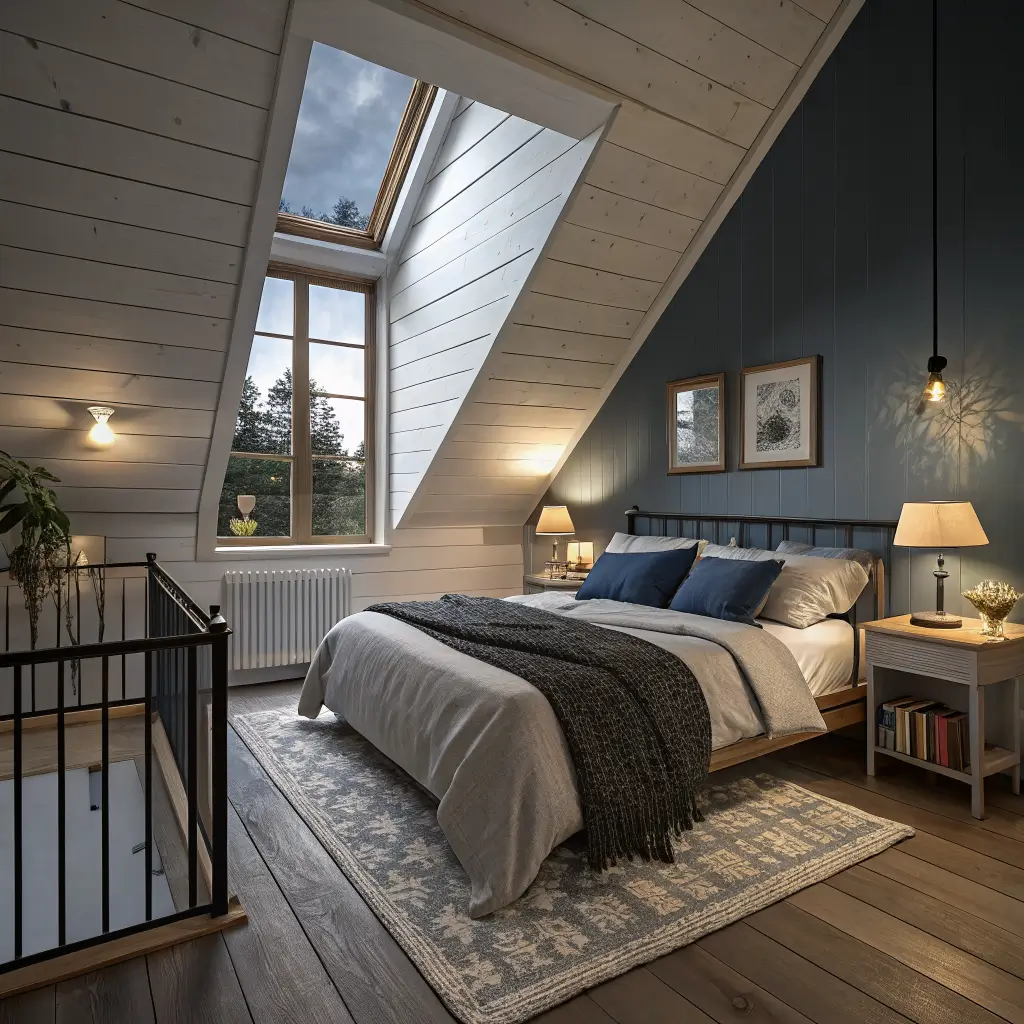
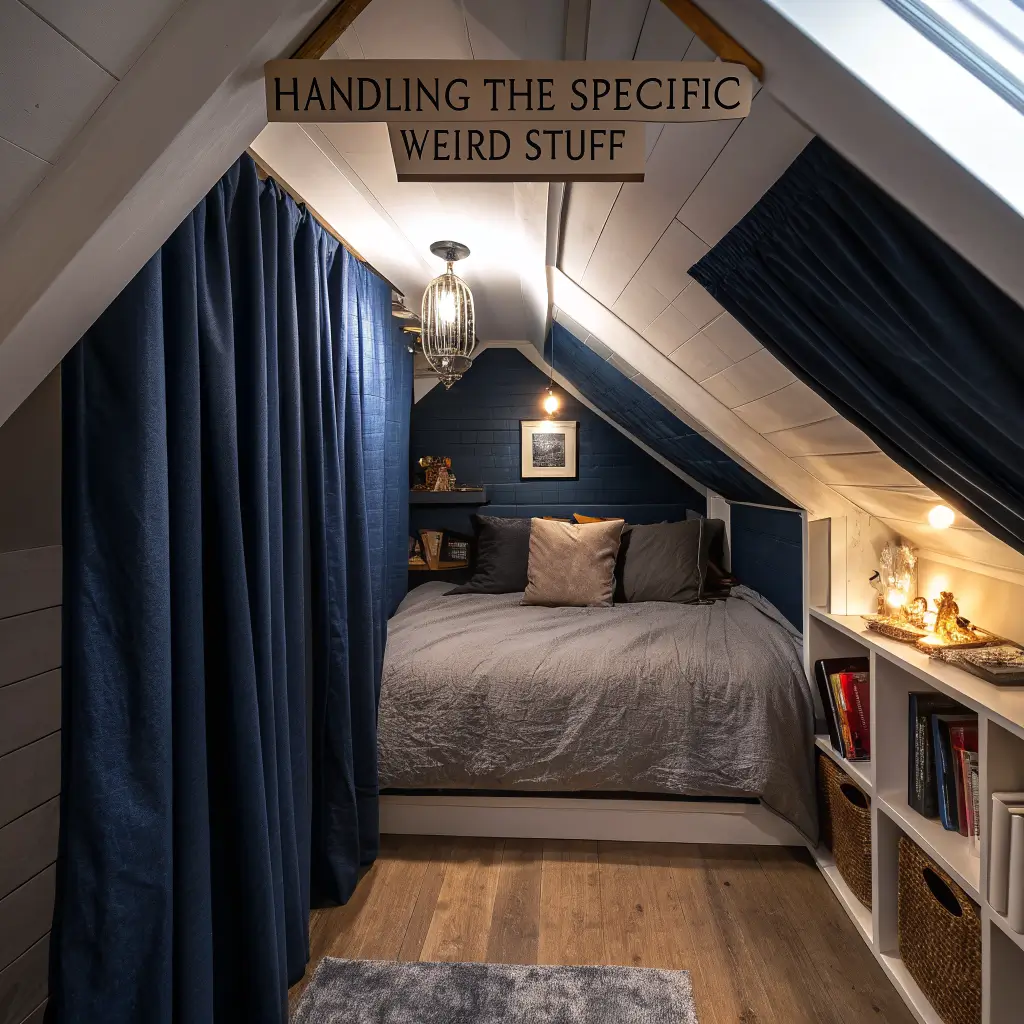
The moody bedroom for an awkward space was the room with the slanted wall I hated. Painting it dark made the angle disappear and the bed became the point.
Moody bedroom ideas are what finally saved my weird, chopped-up bedroom — the one with the window shoved three feet off-center, a radiator eating the only good wall, and a ceiling that sloped down over half the bed. I tried “light and airy” for two years. It looked like a hostel. The second I went dark, all the flaws stopped being flaws and started being atmosphere.
That’s the trick nobody tells you: awkward rooms actually love dark walls. Shadows blur bad angles. Deep color pulls a room inward instead of exposing every off-kilter line. If you’ve got an attic slope, a bed stuck under stairs, or a layout that just feels off, this is the direction to go.
Who This Look Is For
If you’re staring at a bedroom that’s 10×11, has one radiator, half a closet, and a window that isn’t centered on anything — you’re my people. This works for:
– Small bedrooms roughly 8’×10′ to 10’×12′
– Attic and loft rooms with sloped or low ceilings
– Under-stair sleeping nooks, alcoves, and window seats
– Rentals where you can’t touch the walls (skip to the curtain section)
– Guest rooms you want to feel like a boutique hotel instead of a spare room
The style itself sits somewhere between moody modern (clean lines, layered textures) and a little romantic-gothic (dark florals, brass, candles). Pick your lean. I go modern with one romantic corner because full gothic starts to feel like a set.
What It Costs
Rough ranges from what I’ve actually spent and repriced recently:
– No-paint refresh: $150–$500. Bedding, two lamps with warm bulbs, curtains, a couple of candles. This alone changes the room.
– Mid-range with paint or wallpaper: $500–$1,500. Add an upholstered or canopy frame, a 5’×7′ or 8’×10′ rug, and a painted feature wall.
– Full commitment: $1,500+. Built-ins around the slope, custom bed nook, designer sconces at $200–$800 a pop.
For time: a lighting-and-textile refresh is a Saturday. Painting plus rehanging everything is two weekends if you’re honest with yourself about drying time and taping.
The Color Palette That Actually Works
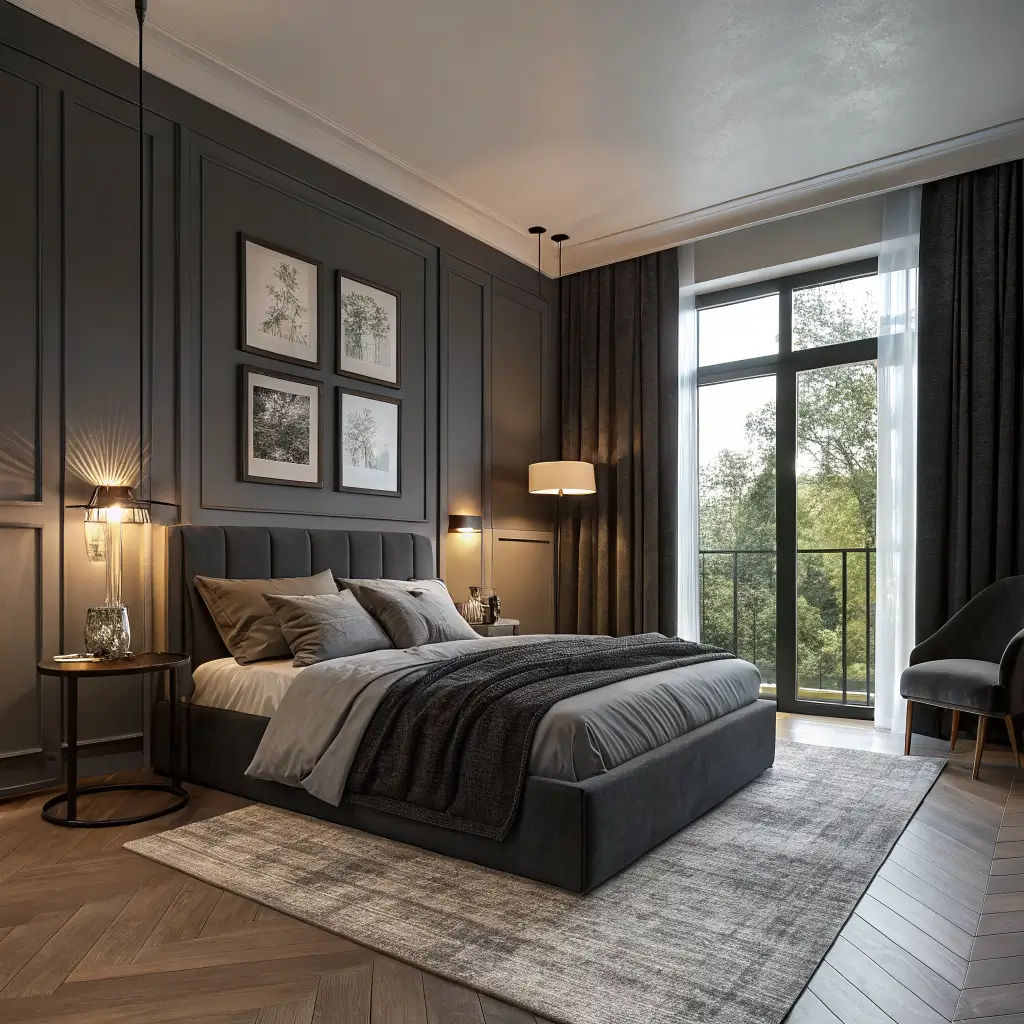
Every moody bedroom I’ve done or admired uses one of these on the walls:
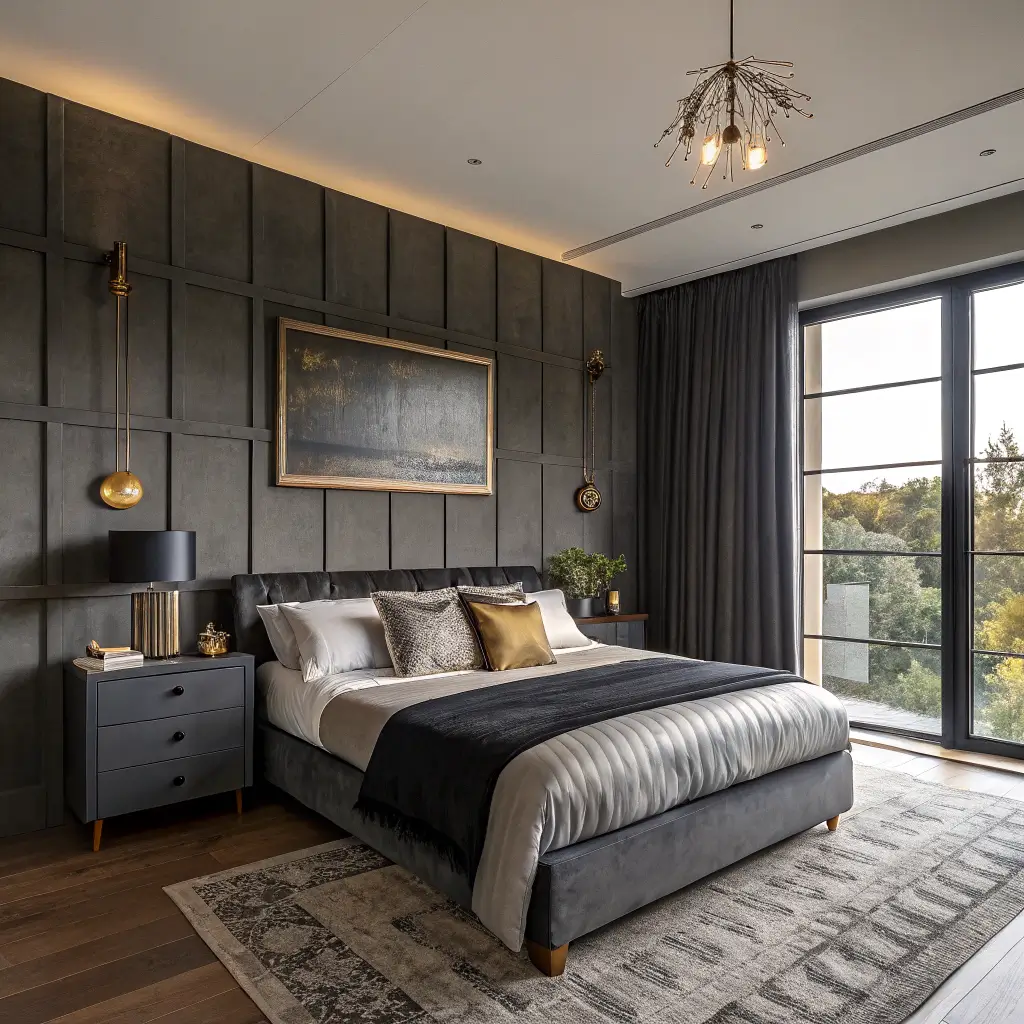
– Charcoal gray (my pick for smaller rooms — reads soft, not aggressive)
– Deep navy (the most flattering to warm wood and brass)
– Forest green (best with vintage furniture)
– Burgundy or oxblood (romantic, harder to pull off — commit fully)
– True black (only if you have decent natural light)
Rule of thumb: pick one dark family and stick to three shades within it. Navy walls, slate bedding, indigo throw. Charcoal walls, graphite curtains, black frames. When you start mixing navy with burgundy with forest green, it looks like a haunted hotel lobby.
For accents, jewel tones do the heavy lifting: emerald, plum, deep teal, inky blue. Skip anything mustard or terracotta unless you want to tip into 70s territory.
The Color-Drench Question
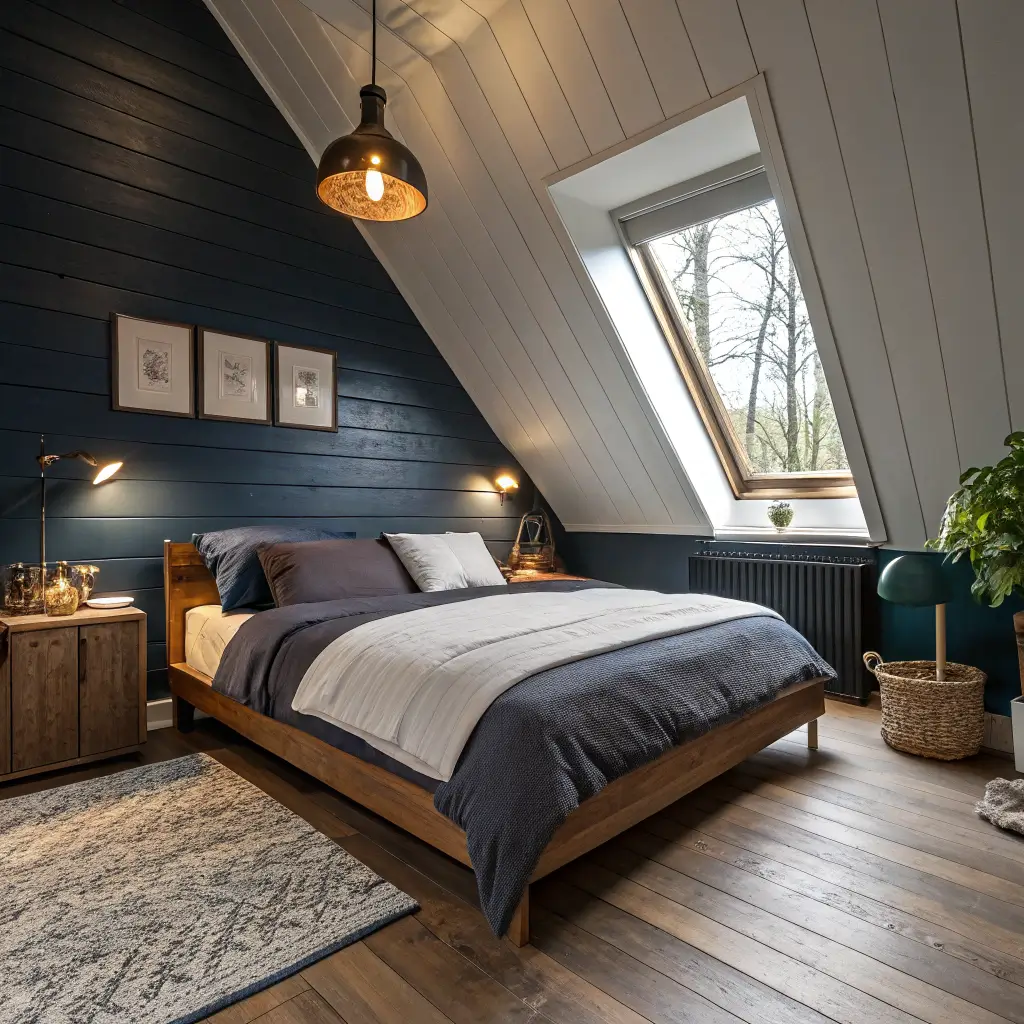
Color-drenching — painting walls, trim, and ceiling the same shade — is the single best trick for awkward rooms. My attic bedroom has a ceiling that slopes from 8′ to about 4’6″ on one side. Painting the slope white made it look like a broken cake. Painting the whole thing Farrow & Ball Railings (blue-black) made the weird angle disappear entirely. You stop reading the line where wall meets ceiling and the room just feels like a cocoon.
If you’re going to color-drench, use matte or eggshell finish on walls and ceiling. Satin on the ceiling will bounce light weirdly and highlight every drywall imperfection.
Hero Pieces That Do the Heavy Lifting
Four things carry a moody bedroom. Get these right and everything else is decoration:
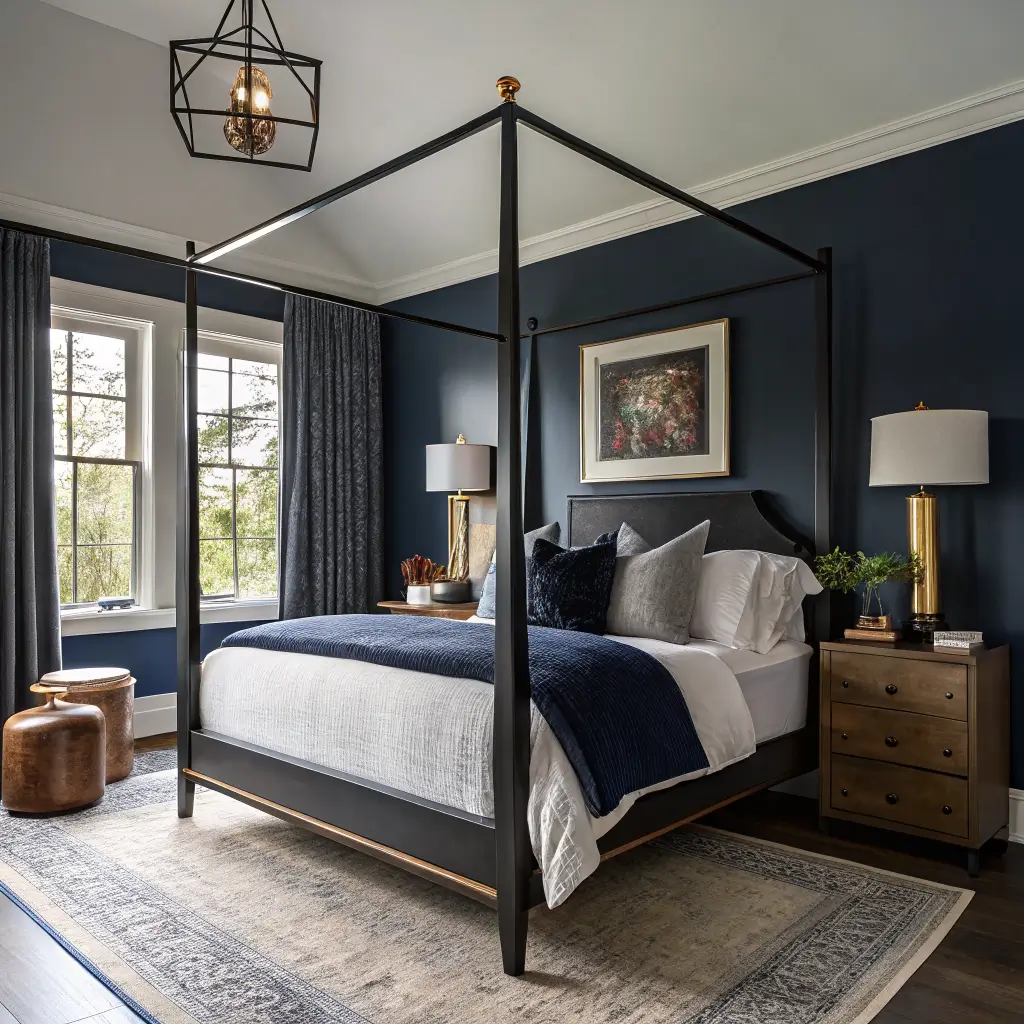
1. A low-profile or compact canopy bed.
In a small room, a tall four-poster in matte black looks incredible if there’s at least 12 inches of clearance around it. If not, go low-slung and upholstered in charcoal velvet or dark linen. Skip anything with a giant tufted headboard — it eats visual space.
2. A rug bigger than you think.
The biggest mistake in small bedrooms is a 3’×5′ rug floating like a bath mat. Get at least a 5’×7′ under the bed, extending 18–24 inches past the sides. In a 10’×12′ room, an 8’×10′ is not too big. Trust me — I returned three rugs before I stopped buying “for the room size” and started buying for the bed.
3. A wall of curtains behind the bed.
This is my favorite renter trick. Hang a ceiling-mounted curtain rod the full width of the wall behind your bed and use floor-to-ceiling velvet or heavy linen panels in the same color family as your walls (or a shade darker). It fakes a canopy, hides an off-center window, and adds acoustic softness. Cost me $90 in curtains and a $22 rod.
4. A single dramatic focal point.
One large piece of art above the bed. Not a gallery wall of eleven small frames. In an awkward room, gallery walls amplify the chaos. One big moody landscape, one oversized abstract, one vintage portrait — pick one.
Lighting Is 60% of the Look
You cannot moody a room with a single overhead bulb. It doesn’t matter what color the walls are — a 4000K ceiling light will make it look like a dentist’s office at midnight.
Here’s the fix:
– Swap every bulb to 2700K. 3000K if you must, never higher. Warm white is the whole game.
– Kill the overhead or put it on a dimmer. In my room I unscrewed the ceiling bulb entirely for six months and never missed it.
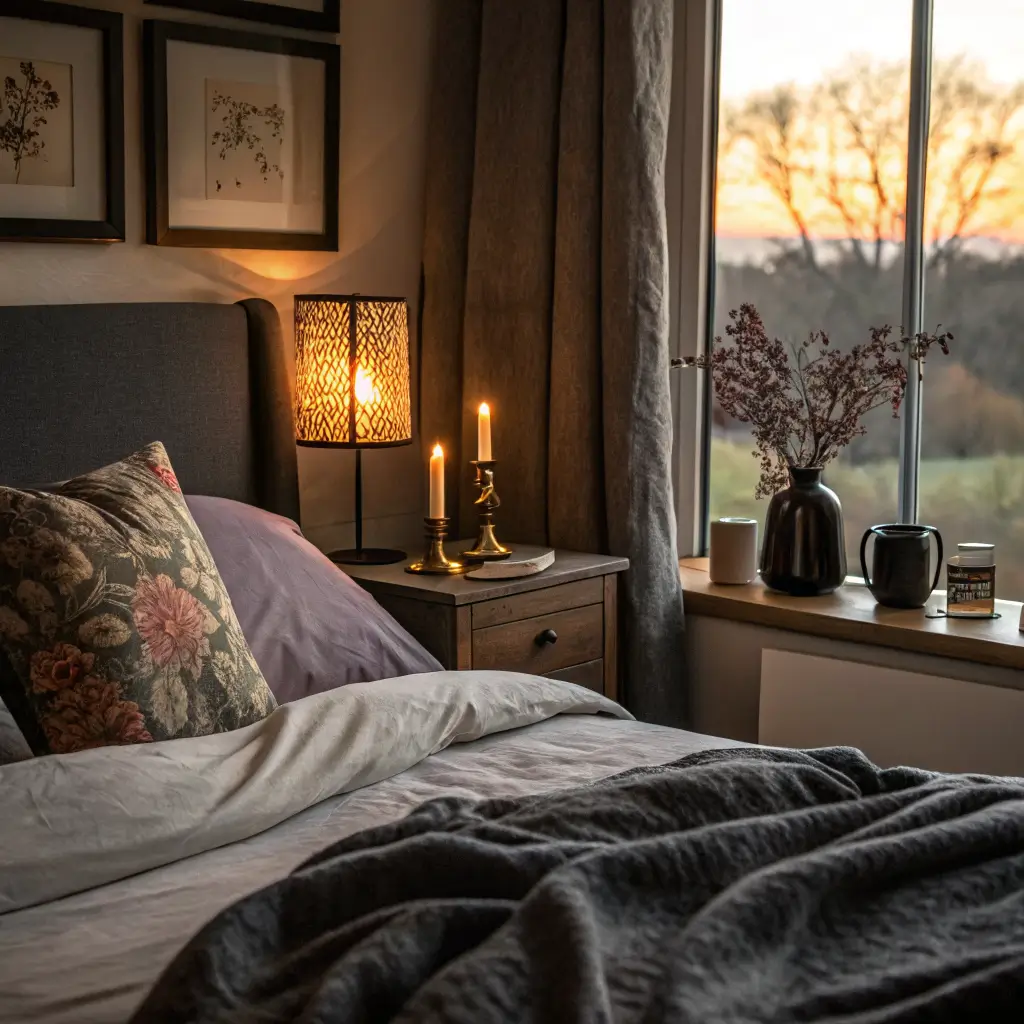
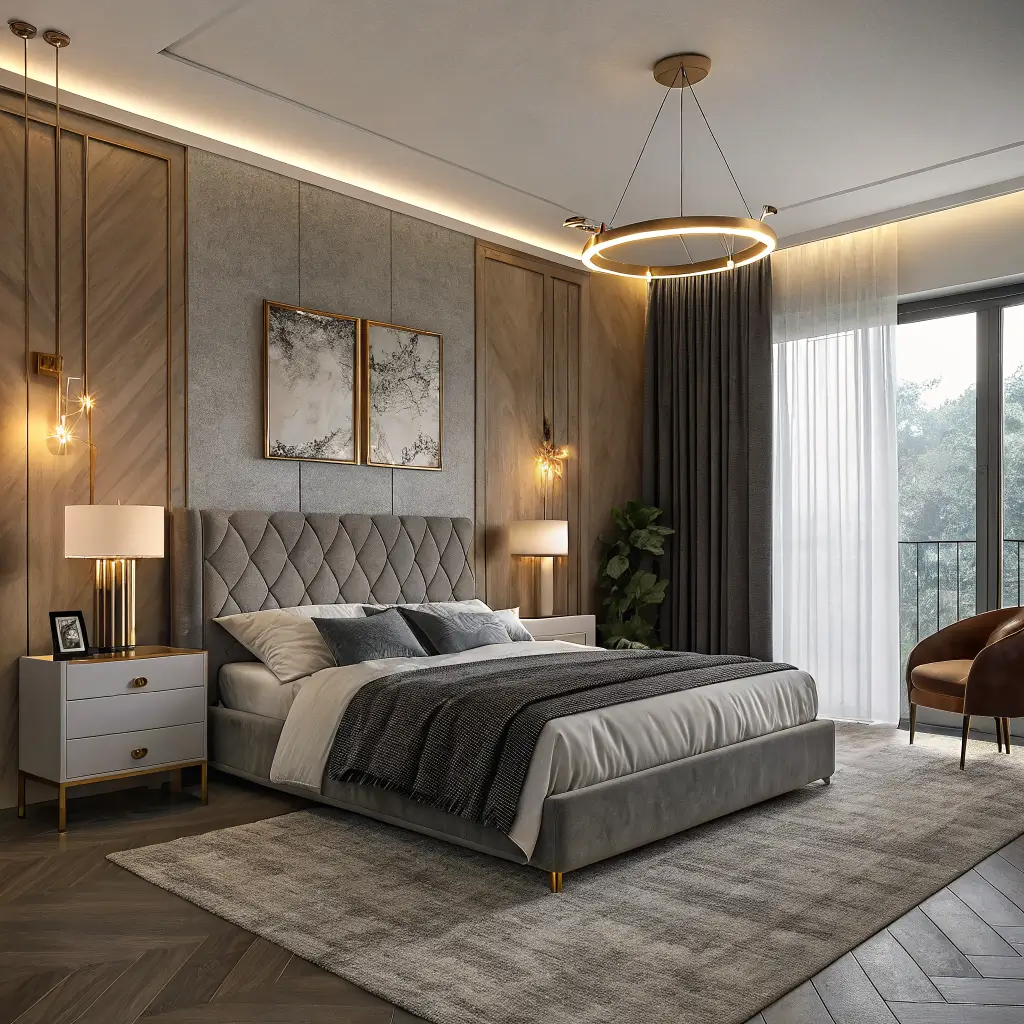
– Three light sources minimum, all below eye level: two bedside (lamps or sconces) plus one across the room (floor lamp in the far corner).
– Add a halo. LED strip lights tucked behind a headboard or along the top of a curtain wall, on the warmest setting, cost $15 and look like a $400 design choice.
Sconces are worth the wiring headache in small rooms because they free up nightstand space. Plug-in versions with cord covers exist and cost around $60–$120 a pair.
Handling the Specific Weird Stuff
Sloped ceilings: Don’t fight them. Push the bed under the low side so the ceiling becomes a canopy. Paint the slope the same color as the walls. Hang a small sconce on the slope itself if you can wire it — it turns the awkward angle into the best part of the room.
Under-stair or alcove beds: Lean into the cave. Line the alcove with cushions or a soft headboard that wraps the walls. A single wall sconce, a narrow shelf for a book and a glass of water, and heavy curtains you can pull across the opening if you want. This is where “sleeping pod” beats “bedroom.”
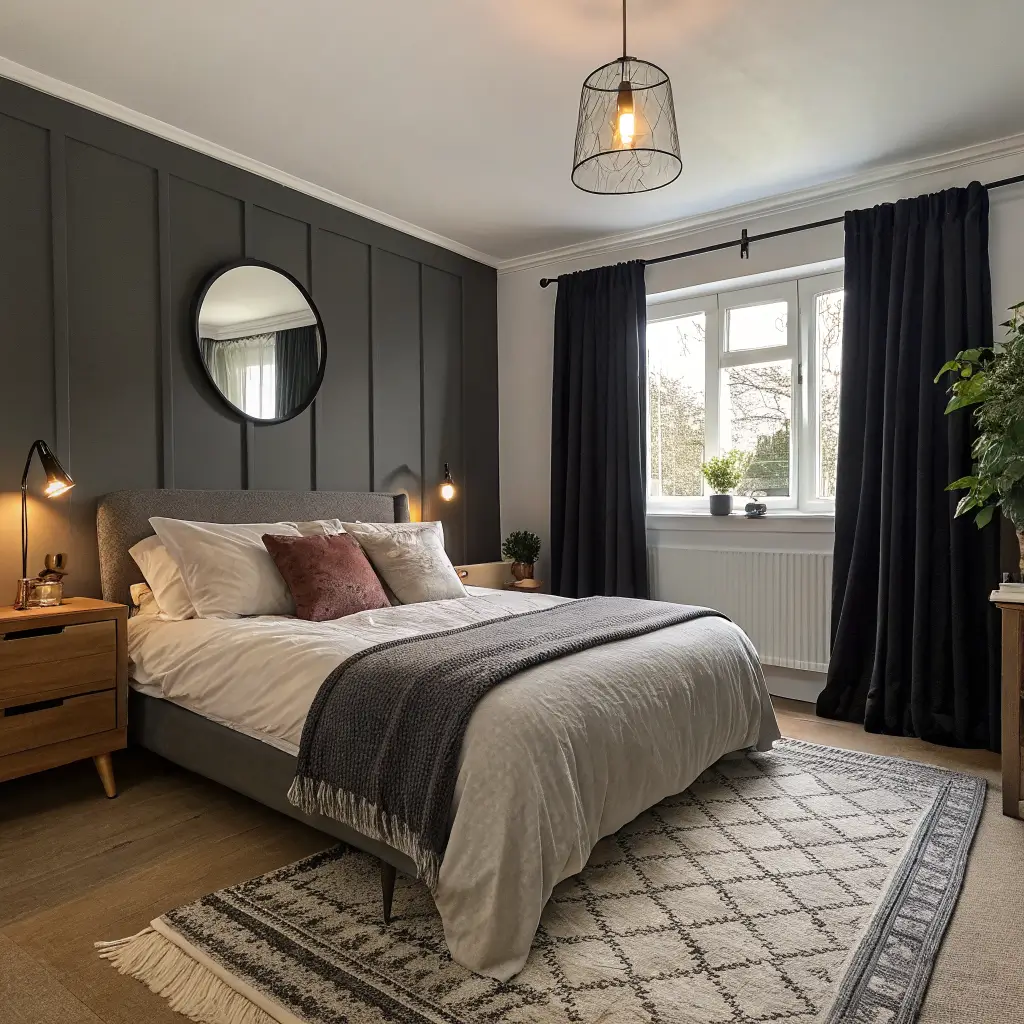
Off-center windows: Curtain the entire wall, not just the window. When the curtains run wall-to-wall, nobody can tell where the window actually is. Center the bed on the wall, not the window. Your eye reads the bed as the focal point and stops caring.
Radiators in bad spots: A slim console or bench in front (with enough clearance — don’t burn your house down) turns it into a styling surface for a lamp and a stack of books.
The Layering That Makes It Feel Expensive
Moody rooms fail when they’re flat. All velvet, all matte, all one texture — reads like a showroom. Mix:
– Smooth against rough: satin pillowcase, chunky wool throw
– Matte against shine: flat paint walls, brass lamp base
– Heavy against light: velvet duvet, crisp cotton top sheet folded down
– Hard against soft: wood nightstand, faux fur at the foot of the bed
On the bed itself: dark duvet, two pillows in matching shams, two Euro shams behind, one accent lump in a different texture. Five pillows total. More than that and you’re just moving them onto the floor every night.
What I Got Wrong Before I Got It Right
My first moody bedroom attempt: black walls, black bedding, black curtains, one small mirror. It looked like a storage closet. I couldn’t figure out why until a friend walked in and said “there’s nothing for your eye to land on.”
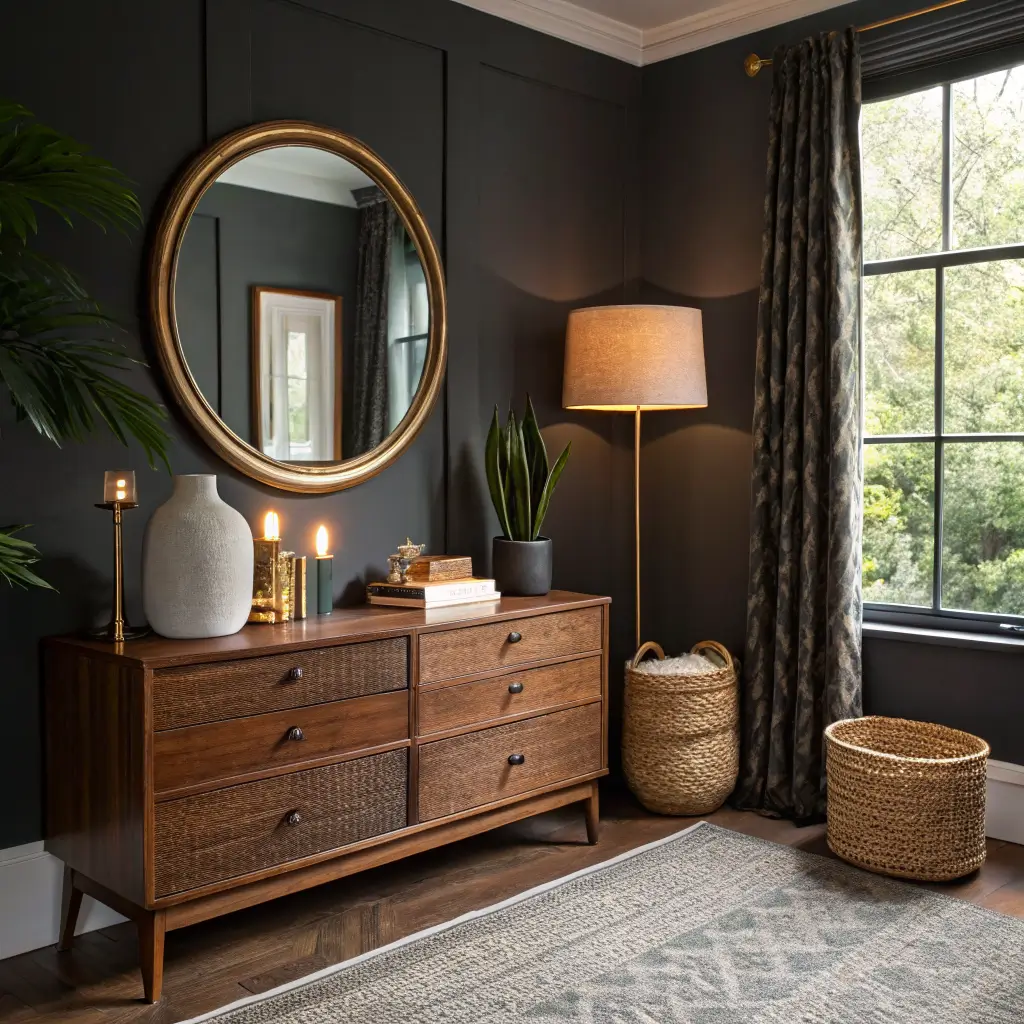
I added: an oatmeal linen top sheet folded down over the black duvet, a large round mirror with a brass frame opposite the window, a cream ceramic lamp, and a snake plant in a matte black pot. Same walls. Completely different room. Dark walls need light and reflection to breathe. That’s the whole balance.
Common Mistakes to Avoid
– All dark, no contrast. You need something lighter — bedding, a rug, a mirror, metal, a plant. Not white necessarily. Oatmeal, bone, aged brass, sage.
– Too much small stuff. In tight rooms, three medium objects beat twelve small ones. Edit ruthlessly.
– Cool lighting. 4000K+ will destroy everything you built. Check the bulb boxes.
– Ignoring the architecture. If your window is off-center, stop trying to make it look centered. Curtain the whole wall or draw attention elsewhere.
– Open shelving by the bed. Visible clutter reads twice as loud against dark walls. Use closed storage, decorative boxes, a lidded basket.
– Matching everything. Two identical nightstands, matching lamps, matching frames — kills the mood. Vary at least one thing.
Seasonal Swaps Without Redoing the Room
Keep the walls and the frame. Change these:
– Winter: faux fur throw, velvet Euro shams, more candles, a heavier rug or layered runner
– Summer: swap to washed linen bedding in slate or olive, pull out one velvet pillow and add a lighter linen one, bring in a fiddle-leaf or fern for green against the dark
The wall color stays year-round. That’s the beauty — moody doesn’t read as “winter” if you handle the textiles right.
If You Want to Cross-Pollinate Styles
– Boho moody: Dark walls, layered vintage rugs, rattan pendant, macramé in charcoal instead of cream, more plants.
– Coastal moody: Deep navy walls, weathered wood, off-white and slate linen, one piece of dark ocean art. No shells. Please.
– Gothic romantic: Dark floral wallpaper (William Morris “Blackthorn” in the ebony colorway is the classic), ornate mirror, candlesticks, oxblood velvet.
Budget Moves That Punch Above Their Weight
If you have $200 and one weekend:
– New warm bulbs in every fixture ($20)
– One dark linen duvet cover from a mid-range brand ($80)
– Two panels of blackout velvet curtains ($70)
– One large mirror from a thrift store, spray-painted matte black ($30)
That’s the whole reset. Paint later, when you’re sure of the color. Buy the frame later, when you find the right one. The bedding and lighting are what your body actually experiences when you walk in and close the door.
That’s the part I care about — how a room feels at 10pm with one lamp on. Moody bedrooms, done right, feel like the room is holding you. Awkward architecture just gives it more corners to do it from.