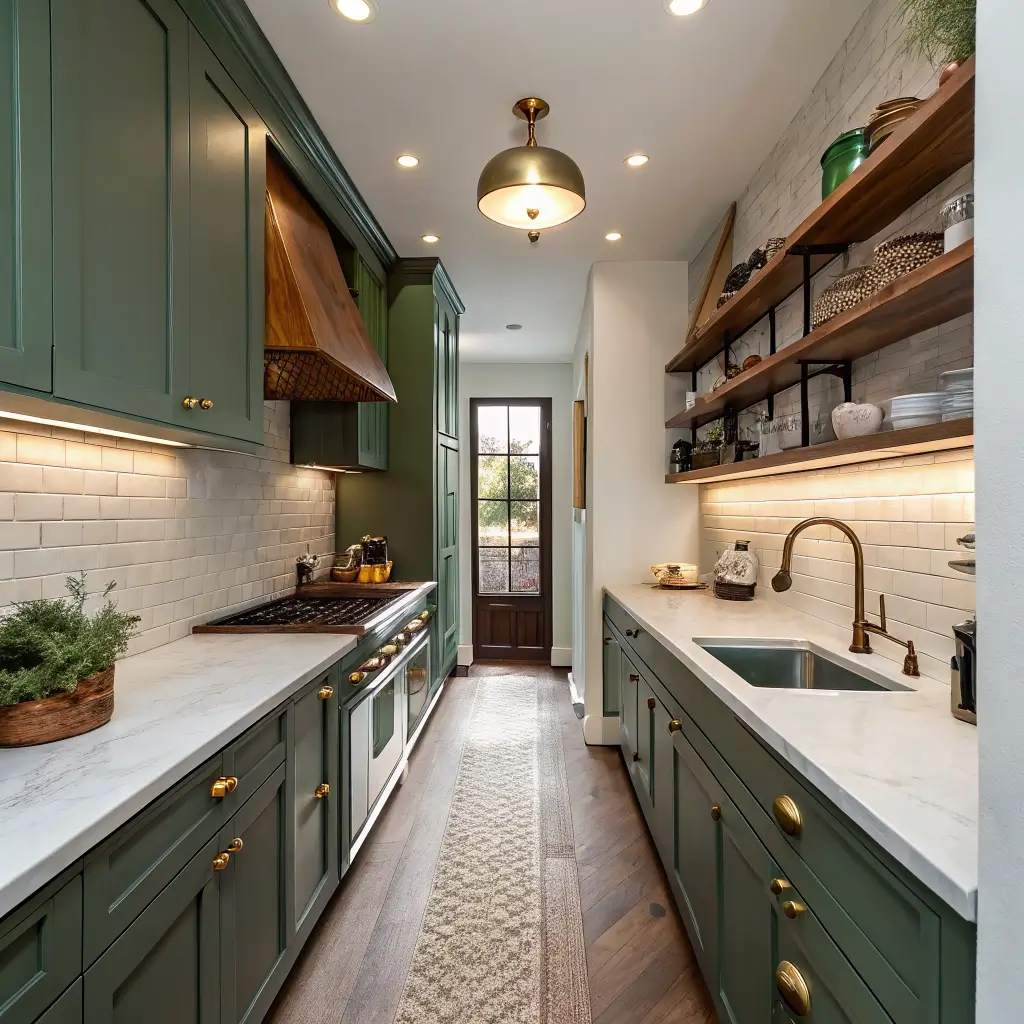
The small moody kitchen was a risk I took with one dark wall and brass pulls. It reads cozy now instead of cramped, which is what I was after.
Think restaurant kitchen at 9 p.m. — dark cabinets, warm pools of light, brass catching a candle flame, a copper pot on the wall. Modern moody, with a vintage streak. Sometimes it leans European (plaster walls, zellige tile, collected ceramics), sometimes industrial (blackened steel, concrete-look counters). Either direction works in a small footprint.
This look is for you if:
– You cook at night and want the kitchen to feel like a room, not a workstation.
– You like collected, imperfect things — thrifted plates, a chipped enamel pitcher, old cookbooks.
– Bright white kitchens make you feel like you’re at the dentist.
It works best in galley kitchens (6–9 ft runs), L-shapes under 120 sq ft, and small open-plan kitchens where a dark palette actually helps carve the kitchen out from the lighter living space next to it.
The Palette I’d Actually Use
Pick one or two hero dark colors, one or two warm neutrals, and one dominant metal. That’s the whole formula.
Colors that read well in low light and small square footage:
– Deep olive or forest green — my pick, and the most forgiving in north-facing rooms.
– Charcoal (warmer than black, less punishing than navy in tight spaces).
– Midnight navy — beautiful, but goes flat if your light is bad.
– Aubergine or deep burgundy for anyone brave enough.
– Espresso, clay, warm mushroom as the neutral partners.
Skip pure black on cabinets in a tiny kitchen with one window. I tried it on a sample door and it looked like a hole in the wall. Charcoal with a green or brown undertone does the same job without vacuuming the light out.
Finish matters more than color. Use a satin or eggshell on cabinets — never flat, which shows every fingerprint, and never high gloss, which reads plastic. On walls, matte or eggshell. Benjamin Moore Advance or Sherwin-Williams Emerald Urethane are the two cabinet enamels I trust.
The Pieces That Actually Do the Work
Dark lower cabinets, lighter uppers or open shelves. This is the single move that keeps a small moody kitchen from feeling like a cave. Dark grounds the room; keeping eye-level lighter keeps you from bumping into the walls with your gaze.
A statement backsplash. In a small kitchen, the backsplash is the whole show — you’re staring at it while you chop. Options I’d actually choose:
– Handmade zellige in deep green or charcoal (uneven, catches light, expensive but you need very little — I spent $340 on 22 sq ft).
– Matte black subway with dark grout for a graphic, near-monolithic look.
– Unlacquered brass sheet behind the range if you want drama and don’t mind patina.
One good pendant. A sculptural dome or globe in aged brass over the sink or peninsula. Budget $80–$250 and you’ll find something decent from CB2, Rejuvenation’s sale section, or a vintage shop. Skip the three-mini-pendants-in-a-row look. In a small kitchen it’s visual noise.
Aged brass or matte black hardware. Twenty to forty pieces at $4–$6 each from Amazon or Home Depot. Don’t cheap out on the finish though — the $2 knobs look like $2 knobs.
A vintage runner. A worn Turkish runner in reds and browns under your feet does more for the mood than any single decor object. eBay and Facebook Marketplace, $80–$160 for something 2.5 x 8.
Budget: Where to Spend, Where to Save
Spend on:
– Cabinet paint and prep (or professional refacing). This is 70% of what you see.
– The pendant light. Cheap lighting looks cheap, every time.
– Hardware finish quality.
Save on:
– Countertops if yours are decent — a good dark paint job on cabinets makes even mediocre counters look intentional. Butcher block sections are $40–$150 from IKEA if you want to swap one run.
– Backsplash, by tiling only the range wall and painting the rest in the same cabinet color for a wrapped, cocooning effect.
– Art. Thrifted still lifes in chunky wood frames, $5–$20 each, beat anything from a big-box store.
Rough total ranges I’ve seen actually work:
– DIY refresh (paint, hardware, one light, textiles): $250–$800
– Mid-range (add counters or backsplash): $1,000–$4,000
– Full renovation of a small kitchen: $5,000–$15,000
Lighting Is Non-Negotiable
If you paint a small kitchen dark and don’t fix the lighting, you’ll hate it in a week. This is where I see people fail.
You need three layers minimum:
1. Overhead ambient — dimmable, on a switch you’ll actually use.
2. Task lighting — under-cabinet LED strips, 2700–3000K warm white. Not 4000K “cool white,” which will kill everything you just built.
3. Accent — a pendant, a picture light over art, or a small plug-in sconce on a shelf.
Bulbs matter. Use 2700K, high CRI (90+) everywhere. The cheap 5000K daylight bulbs that came with the fixture make navy paint look like a bruise. I replaced every bulb in my kitchen for about $60 and it did more than the paint did.
How to Style the Counters and Shelves
Aim for 80% clear counter, 20% styled. In a small kitchen this is the difference between moody and claustrophobic.
Three small vignettes are plenty:
– A wooden board leaning against the backsplash with a crock of utensils and a small bottle of olive oil.
– A coffee corner on a stone or wood tray — grinder, kettle, two mugs.
– A bowl of lemons or a small potted rosemary near the window.
On open shelves, group in odd numbers, stack a few plates flat with a bowl on top, lean a small piece of art behind, add one plant or a bud vase with a single branch. Edit ruthlessly. If it isn’t beautiful or used weekly, it goes in a cabinet.
Mistakes I Made So You Don’t Have To
– Painted the ceiling white. It made the dark walls stop abruptly and the room felt shorter. I repainted it a warm off-white (Farrow & Ball’s Slipper Satin) and the room breathed.
– Bought a matte black faucet before choosing hardware. Then went brass on the hardware. Now it looks like two decisions instead of one. Pick your dominant metal first — I’d pick brass every time in a moody kitchen — and let the faucet follow.
– Cluttered the open shelf with too many mugs. Small kitchens punish clutter fast. Half of what was on that shelf is now in a drawer.
– Skimped on primer over the old oak cabinets. The tannins bled through the green after two weeks. Use a stain-blocking primer (Zinsser BIN shellac-based) on any wood cabinet, always.
Easy Seasonal Swaps
The dark bones stay. The soft stuff changes.
– Fall/winter: heavier runner, dark taper candles in brass holders, a eucalyptus branch on the shelf, wool tea towels.
– Spring/summer: swap in a lighter linen runner, a bowl of stone fruit, fresh herbs in terracotta, striped cotton towels.
For under $50 twice a year, the kitchen feels new without touching the paint.
Cross-Style Variations
If straight modern-moody feels too austere:
– Boho moody: Add layered rugs, more ceramics, macramé nowhere, but a woven pendant shade yes. Deep greens and browns instead of black.
– Coastal moody: Muted navy cabinets, pale oak floor, mushroom walls, unlacquered brass. Reads like a Cornish pub, not a beach house.
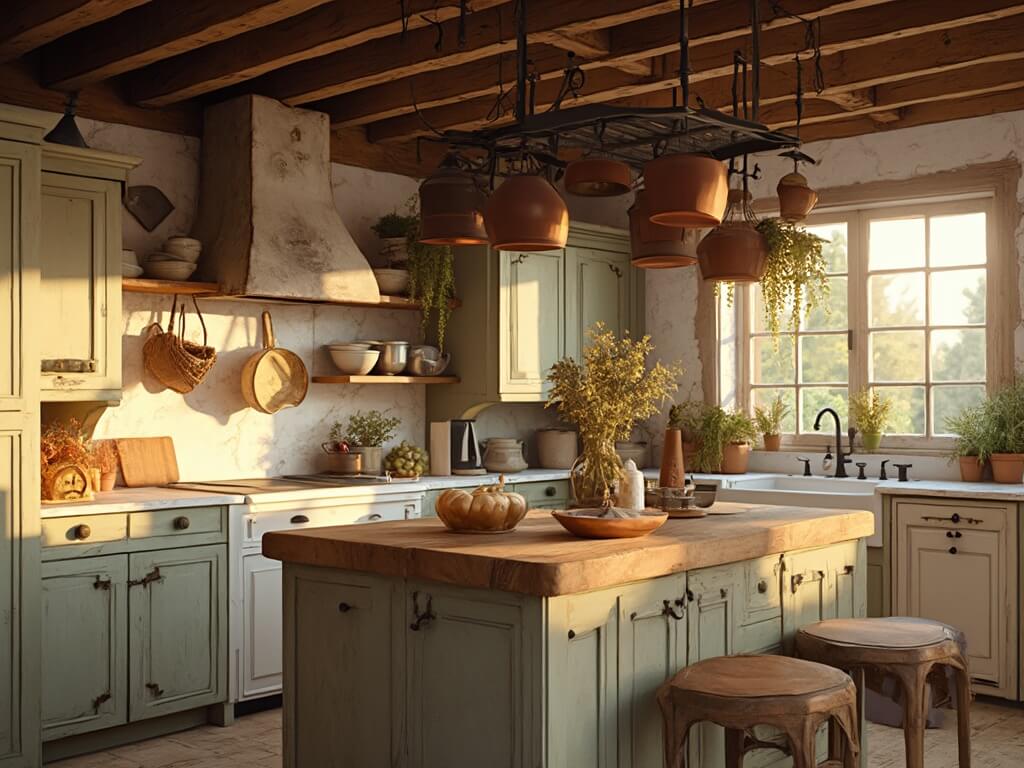
– Rustic moody: Walnut open shelves, blackened steel brackets, plaster walls in warm charcoal, one big cutting board always out.
The rule underneath all of them is the same: pick a tight palette, layer your lighting, keep counters mostly empty, and let a few real, used, slightly imperfect objects do the talking.
That’s the whole thing. A small kitchen isn’t a problem to solve with white paint. Dark it down, light it well, and it starts feeling like the best room in the house.