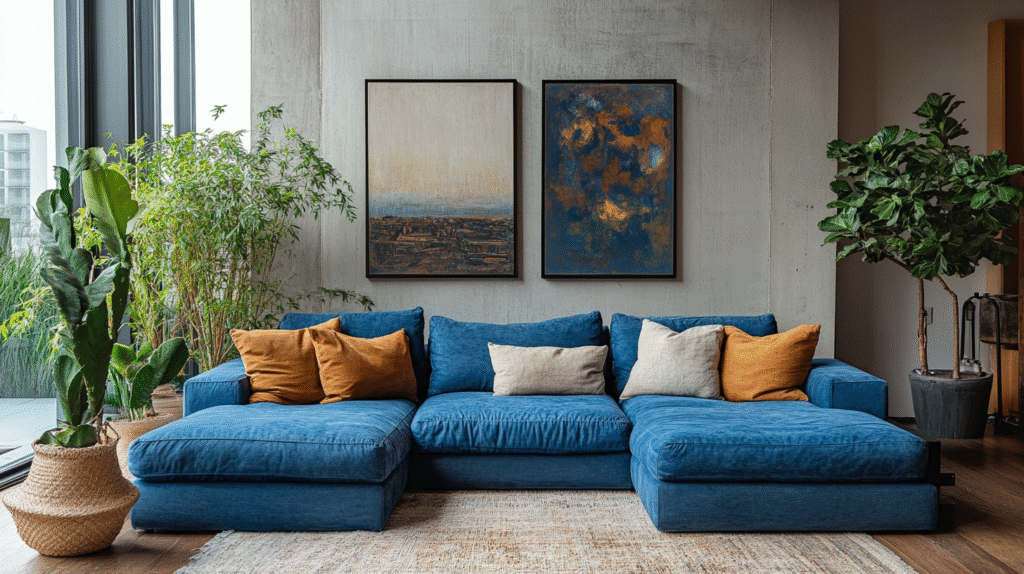
The wabi sabi entryway is the one place I let the imperfections stay. A chipped bowl holds keys better than a perfect tray ever did.
Wabi sabi is a Japanese aesthetic built around imperfection, age, and honest materials. In an entryway that translates to:
– Matte, chalky walls instead of eggshell
– Raw or reclaimed wood you can see the grain on
– Handmade ceramics with wobbly rims
– Iron, not chrome
– One branch, not a bouquet
– Empty space treated like a design element
It overlaps heavily with Japandi (Japanese + Scandinavian) and modern rustic minimalism, which is why you’ll see it everywhere in 2024–2025 mood boards. The difference: wabi sabi leans older, warmer, and more forgiving of scuffs. A dented bench isn’t a flaw here. It’s the point.
Who this is for: anyone who likes minimalism but hates showroom perfection, renters who want a calm arrival zone without renovating, and small-space dwellers who need real storage without visual noise.
The Palette and Materials I’d Actually Use
Keep the big surfaces quiet and let texture do the work.
Base colors (paint these on walls, floors, big textiles):
– Aged linen off-white — around #E8E0D5
– Weathered gray — #8F8B8B
– Natural clay beige — #B8A088
Accent colors (use in one small item at a time, not three):
– Soft moss green — #8A9A7B
– Rust — #8B4513
– Muted indigo — #4B5D67
Materials that carry the look:
– Raw or reclaimed oak, cedar, or teak
– Handmade ceramic with imperfect glaze
– Honed stone, travertine, or river rock
– Hand-forged or blackened iron
– Rough linen, hemp, jute, wool
– Washi paper for lampshades
Skip: high-gloss anything, polished chrome, MDF with a printed woodgrain, plastic baskets pretending to be seagrass.
Time, Cost, and Skill Level
Simple restyle (rearrange, add a rug, a bench, a few objects): 3–6 hours on a Saturday.
Full makeover (paint or limewash, new lighting, new bench, hooks installed): 1–2 days including drying time.
Rough budgets:
– Under $400 (refresh): jute runner $60–$180, flat-pack unfinished wood bench $80–$200, one woven basket $25–$60, a clay vase with a dried branch $25–$80.
– $400–$1,200 (mid-range): solid oak bench around $200–$600, arched or irregular mirror $150–$350, limewash materials $80–$200, a handmade ceramic lamp $120–$300.
– $1,200–$3,000+ (invest): custom reclaimed console $600–$1,500, hand-forged iron coat rail $150–$400, large artisan pottery or lighting $300–$800 per piece.
Skill level is beginner to intermediate. If you can hang hooks and use a roller, you can do the paint. Limewash is more forgiving than regular paint — that’s the whole appeal.
The Pieces That Actually Make the Room
I’ve bought and returned enough entryway stuff to have opinions. Here’s the short list.
A bench or slim console. This is the anchor. Solid oak or reclaimed teak, roughly 120 cm long, 35–40 cm deep, 40–45 cm high. Anything deeper than 40 cm and you’ll clip it every time you take off a coat. I know because mine was 45 cm for eight months and I have the shin bruises to prove it.
A mirror with organic character. Irregular oval, arched, or a rectangle with a distressed wood or blackened metal frame. 60–90 cm tall for most entry walls. Hang it with 15–25 cm of breathing room above the bench.
A hand-forged iron coat rail with 4–6 hooks spaced 20–25 cm apart. A single horizontal rail reads calmer than individual scattered hooks.
A natural fiber runner. Chunky jute or flat-weave wool. 2’6″ × 8’–10′ for hallways, 3′ × 5′ for a small foyer. Jute sheds for the first month. Vacuum it and move on.
One tall ceramic vase with a single dried branch — magnolia, willow, curly hazel. Floor vase 80–100 cm, or 20–35 cm for the console.
Two woven baskets under the bench for shoes and bags. Seagrass or hemp, 30–45 cm across.
A soft light source that isn’t the ceiling. A linen or washi table lamp on the console, or a floor lantern. If you’re swapping the pendant, hang it 170–180 cm from the floor for a lower, more intimate feel.
That’s it. Seven categories. If your entryway has more than that, it’s probably why it feels off.
How I’d Put It Together
1. Empty the space completely. Coats off hooks, shoes out, art down. Wabi sabi starts from zero.
2. Paint first if you’re painting. Limewash in a soft ivory, sand, or stone gray, applied with a wide 10–12 cm brush in loose overlapping strokes. You want the cloudy variation — that’s the whole finish. If limewash isn’t an option (rentals), a matte clay-based paint applied with a brush instead of a roller gets you 70% of the way there. Call it what it is: an approximation.
3. Place the bench on the longest continuous wall. Leave at least 5–10 cm between the bench edge and the door swing arc.
4. Roll out the runner. Check sightlines from the door and from any adjacent room.
5. Hang the mirror centered over the bench, with the bottom edge 15–25 cm above the bench top.
6. Install the hook rail either above the bench or on the perpendicular wall, roughly 165–170 cm from the floor — high enough that long coats clear the bench.
7. Add the light. Lamp on the console, or a floor lantern tucked next to the bench.
8. Style with three objects. Maximum. One tall vase with a branch. One catch-all bowl for keys. One meaningful object — a piece of driftwood, an old wooden stool used as a plant stand, a single handmade pot.
9. Remove one thing. Whatever you’re most attached to that isn’t functional. That’s usually the thing making it look busy.
I found my favorite piece — a chipped, unglazed brown bowl that now holds keys — at an estate sale for $4. It has a hairline crack across the base. It’s the most-looked-at object in the room.
The Mistakes I Made So You Don’t Have To
Treating wabi sabi like boho. They’re not the same. Boho layers pattern and color. Wabi sabi strips both back. If you have more than one pattern in the entryway, cut one.
Buying shiny “farmhouse” pieces and calling it rustic. A distressed sign from a big box store is not the same as a real weathered surface. If the wear is printed on, you’ll feel it. Go for matte, honed, or actually old.
Matching lamps on either side of the console. Symmetry kills this style. One lamp on one end, a stack of two ceramic bowls on the other. Asymmetry is what makes it look considered instead of catalog-ordered.
Removing all storage in the name of minimalism. Then living with coat piles on the bench. Baskets and hooks aren’t clutter — they’re the reason the surface stays clear.
Going too high-contrast. Stark black-and-white reads Scandinavian, not wabi sabi. Keep contrast soft. Use black in small grounding doses: hook rail, lamp base, mirror frame. Not the walls, not the bench.
Small, Dark, or Rental Entryways
The style genuinely works in a 3–4 ft wide hallway. Negative space is baked in, so narrow works.
For no natural light: lean warmer. Aged linen walls instead of gray, a 2700K bulb in the lamp (not 4000K, ever), and a mirror positioned to bounce whatever light does come in.
For rentals: skip the limewash and use a matte clay-look paint you can repaint on move-out. Command hooks won’t cut it for an iron rail — but a freestanding wooden coat stand in the corner works and moves with you.
Seasonal Updates Without Redoing the Room
The same vase carries the whole year. Only the contents change:
– Spring: cherry or magnolia branches, willow
– Summer: dried grasses, olive stems, a single eucalyptus branch
– Fall: oak branches with turning leaves, seed pods, dried hydrangea
– Winter: bare curly hazel, pine, or nothing at all — just the empty vase
Swap the runner from thick wool in winter to a lighter flat-weave in summer. Add a candle lantern in the darker months. That’s the whole rotation.
For a door wreath, use bare twigs and seed heads or a loose eucalyptus loop — no glossy ribbon, no plastic berries.
Wabi Sabi Crossed With Other Styles
Japandi: the easiest fusion. Keep pale wood + black accents + handmade ceramics. Cleaner lines than pure wabi sabi, still spare.
Coastal: driftwood, sand-toned linens, river stones, a piece of bleached rope. Avoid bright blues and anchor motifs — the palette stays earthy.
Boho: dial it way back. One kilim pillow on the bench, one macrame hanging, and stop there. Colors stay muted.
Quick Answers to the Things People Ask
Do I need limewash? No. It’s the most authentic finish, but a matte clay-based paint applied with a brush gets close. The texture and matte-ness matter more than the specific product.
Will this work with kids and pets? Yes, actually better than most styles. Wabi sabi doesn’t mind scuffs, muddy paw prints on the bench, or a scratched floor. That’s patina. What it needs is storage, which you’re building in anyway.
Is it a trend? The name is having a moment. The underlying idea — old materials, honest craft, negative space — has been around for 500 years. It’ll outlast the current wave.
Cheapest way in? Thrift a solid wood bench with existing wear, oil it instead of painting, add a $30 jute runner and a $4 ceramic bowl. You’re done for under $100 if you’re patient at estate sales.
The version I have now has a bench I paid $85 for on Facebook Marketplace, a limewashed wall that took one afternoon, and a branch I picked up on a walk. It’s the calmest three feet of my apartment.